From Peter Jennings'
Producer to AI Pioneer
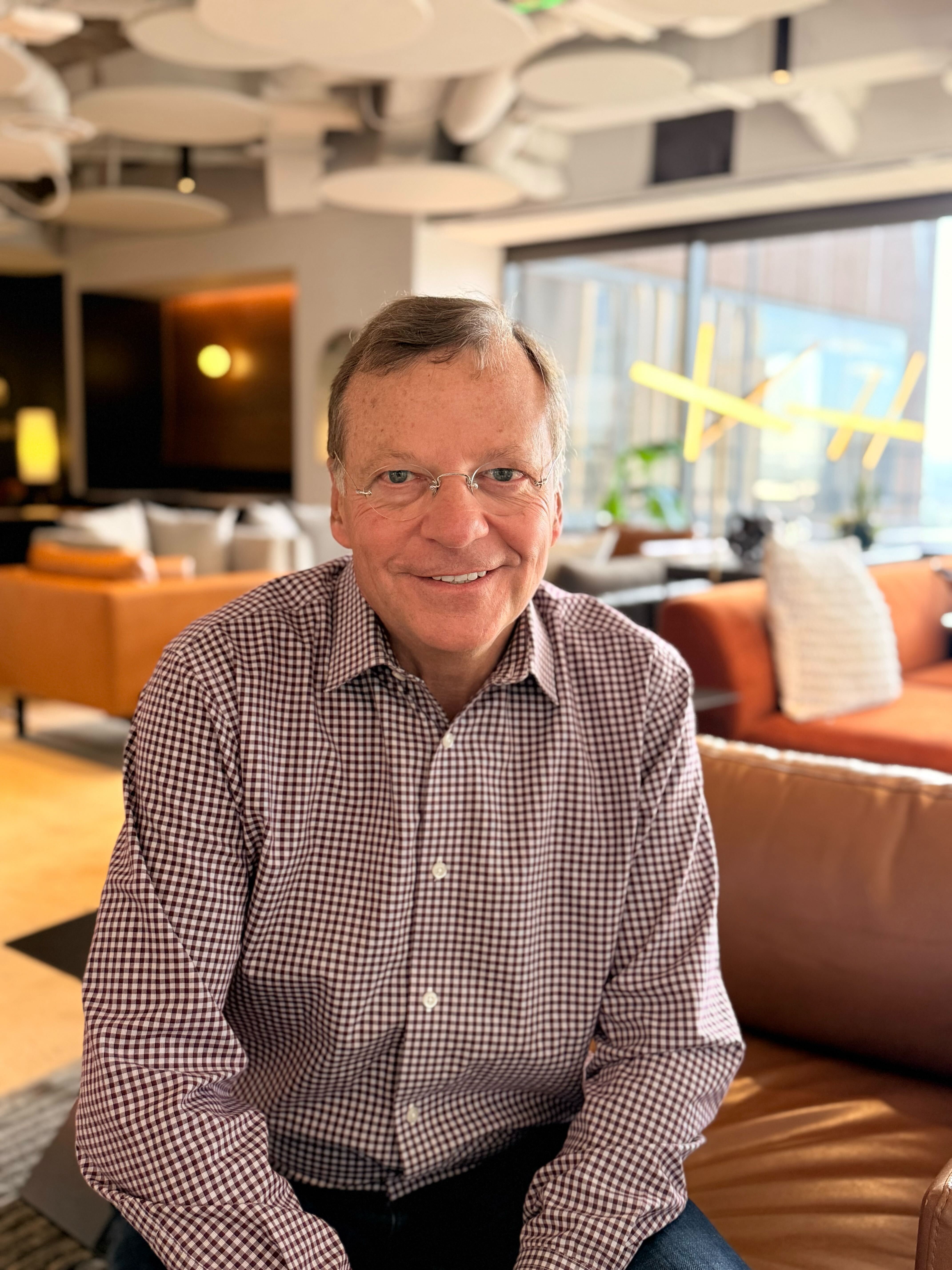
Somewhere in the early 1990s, Mark Atkinson was sitting in a edit suite at ABC News, cutting footage of the siege of Sarajevo for a Peter Jennings special on U.S. foreign policy. The piece earned him an Emmy. A second piece on Bosnia won him the Alfred I. DuPont Columbia University Gold Baton - broadcast journalism's equivalent of a Pulitzer. He had arrived. Then he left.
What pulled him toward education technology wasn't a midlife pivot or a funding opportunity. It was a persistent conviction that the most consequential skills - the ones that actually determine career trajectory and organizational culture - were being left entirely to chance. Nobody was teaching them. Nobody was giving people a place to practice them. That gap became his career.
"These power skills, as I call them, are the most important things that drive you in your career. If you look at the research now on what people want to learn, young people are more interested in these power skills than they are in the technical skills."
- Mark AtkinsonAfter transitioning from network news into education, Atkinson co-founded Teachscape, a K-12 professional development company that pioneered video-based teacher observation. It wasn't just product-market fit - it was foundational to the Gates Foundation's Measures of Effective Teaching project, one of the most ambitious education research efforts in modern history. Teachscape became the infrastructure behind how America measured good teaching. Atkinson then stepped forward again with TeachForward, a consulting firm with a proprietary web platform for educator performance assessment.
Three companies. One through line: giving professionals a structured, repeatable way to practice being better at the work that actually matters - not the technical parts, but the human parts.
Mursion, co-founded around 2015 and based in San Francisco, is where that conviction found its most technically ambitious form. The company's core product is a simulation platform that blends trained improv performers - called Simulation Specialists - with artificial intelligence to create realistic, emotionally textured practice scenarios. A manager preparing to deliver difficult feedback doesn't just read a case study or watch a video. They actually do the thing. Repeatedly. Under something resembling real pressure. In a setting where making a mess doesn't cost anyone a career.
"At the end of the day, we're trying to make you better. We're getting you to experience that same level of stress that you're going to experience when you have that conversation later in the day. So that you're calmer when you encounter the real situation at work."
- Mark Atkinson, Interview on AI SimulationsThe technical architecture behind Mursion is more interesting than it looks at first glance. Each Simulation Specialist can voice multiple characters simultaneously in real time. The AI layer handles environmental responsiveness - what Atkinson describes as a constantly moving target between where human performance ends and machine behavior begins. Mursion has been machine-learning the role of the human across tens of thousands of simulations in each domain, building what is likely one of the world's most detailed behavioral datasets for interpersonal skill development.
The platform serves healthcare professionals, K-12 educators, sales teams, customer service staff, frontline managers, and C-suite executives. Clients include AstraZeneca, T-Mobile, United Airlines, Best Western, H&R Block, Ericsson, and Novo Nordisk. More than a third of Fortune 100 companies now rely on it. The platform has delivered over 18 million minutes of simulation-based training. That number keeps growing.
Atkinson is also a board member of the Danielson Group, the Achievement Network, and the Oracle Education Foundation - a pattern that suggests someone genuinely committed to education reform as a vocation, not just a market sector.
In April 2026 he spoke at the ASU+GSV Summit on "Chaos Management: Leading Humans Through AI and Anxiety" - a title that reads like a direct description of what Mursion exists to solve. As AI accelerates workplace transformation, the premium on distinctly human skills - empathy, conflict navigation, inclusive leadership, high-stakes communication - has never been higher. His thesis, accumulated across three companies and roughly forty years of work at the intersection of story and skill, is that these capabilities are not gifts. They are learned. And learning requires practice.
"One of the most important skills is humility - no matter how good you think you are, you can always get better."
- Mark AtkinsonThe journalist who once asked why Bosnia mattered to American foreign policy is now asking a different but structurally identical question: why do the conversations happening in cubicles and boardrooms and hospital hallways matter to the people having them, and to the organizations they hold together? The answer, both times, turns out to be the same. Because they're human. And because they're hard. And because with enough practice, they get easier.