A business that turns waste into dog food has to answer some very ordinary questions. Who will manufacture it? Which shops will sell it? Will customers buy it again? LiquidGold Africa, a Durban waste-processing company commercialising black soldier fly protein, is working through those questions with a growth grant from the Nedbank ReNEW Programme. Behind the programme sits Impact Amplifier, whose particular trade is making an environmental idea ready for commercial scrutiny.
That is a useful place to begin with this South African company. The phrase “impact investing” can sound comfortably remote from the mess of running a business. Impact Amplifier works close to that mess: financial models, distribution plans, mentor assignments, supplier assessments and funding decisions. Its customers include foundations, development organisations and corporations. The people benefiting from the work range from entrepreneurs seeking capital to small farmers growing peppers for Nando’s.
Established in 2011, the firm combines acceleration, fund management, impact assessment and research. Its distinction is the way those jobs connect. It can help prepare an enterprise, support a funding programme and examine the results after money reaches the business. That gives it a broader role than the accelerator that ends with a pitch event.
The cheque was never the whole job
The original diagnosis was straightforward. Promising African businesses could address social and environmental problems, but many were poorly prepared to absorb growth capital. An investor needed more than evidence of a worthy cause. The enterprise needed a credible account of customers, costs, growth and returns.
Early partner and co-founder Pascal Fröhlicher described a business built around targeted operational help and investor connections. In a 2015 interview, he said it sometimes took equity stakes but did not then manage capital. Today, fund management is one of its main services. That change marks an expansion from preparing the business for someone else’s money to helping administer the money too.
Co-founder Max Pichulik brought banking and asset-management experience to the work. Partner Tanner Methvin’s background spans consulting, social innovation and impact investments. Their current team includes researchers and practitioners in finance, climate, enterprise development and measurement. The published manifesto encourages experimentation and risk taking; the service offering gives those ambitions a rather practical companion: homework.

After the applause, another funding problem
The SAB Foundation relationship offers a clear example of what needed fixing. Its Social Innovation Awards recognised promising enterprises. Over time, the foundation found that previous winners still needed more time, resources and support to achieve their ambitions. Recognition had not finished the job.
The response was an accelerator and fund, launched in October 2017. Impact Amplifier manages the acceleration and supports the allocation of funding as businesses become investment ready. The company’s January 2025 account described more than 58 participating businesses across eight cohorts. It also reported securing R4.4 million during 2024 for four businesses from two earlier cohorts.
This was a specific adjustment to the support model: help did not stop at the award. Entrepreneurs needed skills, documents and finance for the next stage. For a foundation designing a similar programme, the useful lesson is to budget for the work after selection. A prize ceremony has a date. Becoming ready for investment can take considerably longer.
- 01Define the changeProblem · solution · measures
- 02Find the buyerMarket · sales · distribution
- 03Cost the growthStrategy · financial model
- 04Make the caseDocuments · presentation
A simplified reading of Impact Amplifier’s published acceleration curriculum.
Nine modules, with room for a human
Impact Amplifier’s direct accelerators typically run for three to 12 months. They cover the impact case, customer segments, market access, growth strategy, financial planning and pitching. Delivery can include lectures, coaching, group discussion, webinars and assignments. A founder should expect to work on the business between sessions.
After delivering more than 12 acceleration programmes, the company identified a need for more consistent content and wider access. Its response was Impact-OS, a digital platform that other incubators, investors and enterprise support organisations can configure under their own branding. The investment readiness course has nine modules, usable through self-study or with a coach.
The product bundles curriculum with assignments, data collection, monitoring and private communities for entrepreneurs and mentors. It also offers course variations for different stages, geographies and languages. The platform reports 1,346 entrepreneurs trained across 22 countries and 14 accelerators. Those are delivery figures; they should not be read as a count of successful funding rounds.
The buying decision belongs largely to the institution running the programme. Impact-OS combines user licences with services. Starter covers 50 users for six months; Prime covers 100 users for 12 months; a fuller White Label option supports a customised campus. Plans are quoted to requirements, and the first investment readiness module can be tried free.
The practical comparison is with assembling a course, learning platform, mentor network and reporting process separately. Impact-OS puts those pieces together. Its usefulness still depends on the operator: entrepreneurs need time to complete the work, mentors need to respond, and the curriculum must suit the businesses being supported.
Patient capital gets a day job
Fund management extends the relationship beyond training. Impact Amplifier describes using developmental funding to structure capital around earlier-stage enterprises, alongside business support before and after investment. The aim is to accommodate businesses whose needs fall outside conventional lenders’ or funds’ mandates.
Different pots of money serve different purposes. Google.org supports the Africa Online Safety initiative, which launched its fund in 2020 and a broader information platform in February 2024. The fund-management page lists 46 grantees and US$1.3 million invested. This is money deployed through a programme, separate from investment in Impact Amplifier itself.
The online safety work also shows why the firm builds shared resources. Its second phase widened the effort beyond individual grants into research, education and a community of practitioners. The platform brings together material on risks, legal frameworks and routes to help. Grants fund interventions; shared information helps practitioners learn from one another.
By contrast, the Africa CleanTech Impact Fund, established in 2025, is presented on the firm’s fund page as mobilising capital toward R150 million, with no investees or money invested yet listed. A target is a statement of intent. It should remain visibly separate from completed investment.
The structure of the financial-services work is also specific. Impact Amplifier Fund Management (Pty) Ltd operates as a juristic representative of FyreFem Fund Managers, a registered financial services provider. Institutional customers buying this service are engaging a combination of capital administration, enterprise support and impact expertise.
The pepper test
Some of Impact Amplifier’s most revealing work happens in an established company’s supply chain. Its Nando’s engagement dates from 2012. Assessments examine what crop production means for farmers’ access to housing, food security, energy, water, education and healthcare. These are questions about household life, beyond the size of a purchase order.
A January 2025 update described a supply chain expanded during 2024 to include paprika and cayenne alongside peri-peri, reaching 1,300 farmers in Southern Africa. Impact Amplifier also studies restaurant employees’ basic needs and reviews suppliers’ labour practices, health and safety, legal compliance and environmental practices.
For a corporate customer, that is a different purchase from a generic sustainability presentation. It is evidence to inform procurement and staff support. The same habit appears in its Clout/SA work: assessing the effects of furniture and lighting procurement, examining ethical business practices and helping define a South African design category.
“We believe in building a culture of risk taking within our organisation”
Impact Amplifier’s published manifesto
The transferable discipline is to decide what a business relationship ought to improve, then investigate whether that improvement reaches people. More orders may help a supplier grow. They do not, by themselves, answer questions about a living wage, household security or employee benefits.
Waste gets a commercial brief
The ReNEW announcements make the firm’s current approach tangible. In July 2026, it named LiquidGold Africa the programme’s first growth-grant recipient. The company’s stated next steps included an initial manufacturing run, retail onboarding and veterinary endorsements for products using its insect protein.
In August, Impact Amplifier announced funding and business support commitments to five more businesses, four of them women led. Their activities span green building materials, compost, water reuse, food-waste products and agricultural waste. Participants receive a tailored Impact-OS programme, group support and mentorship.
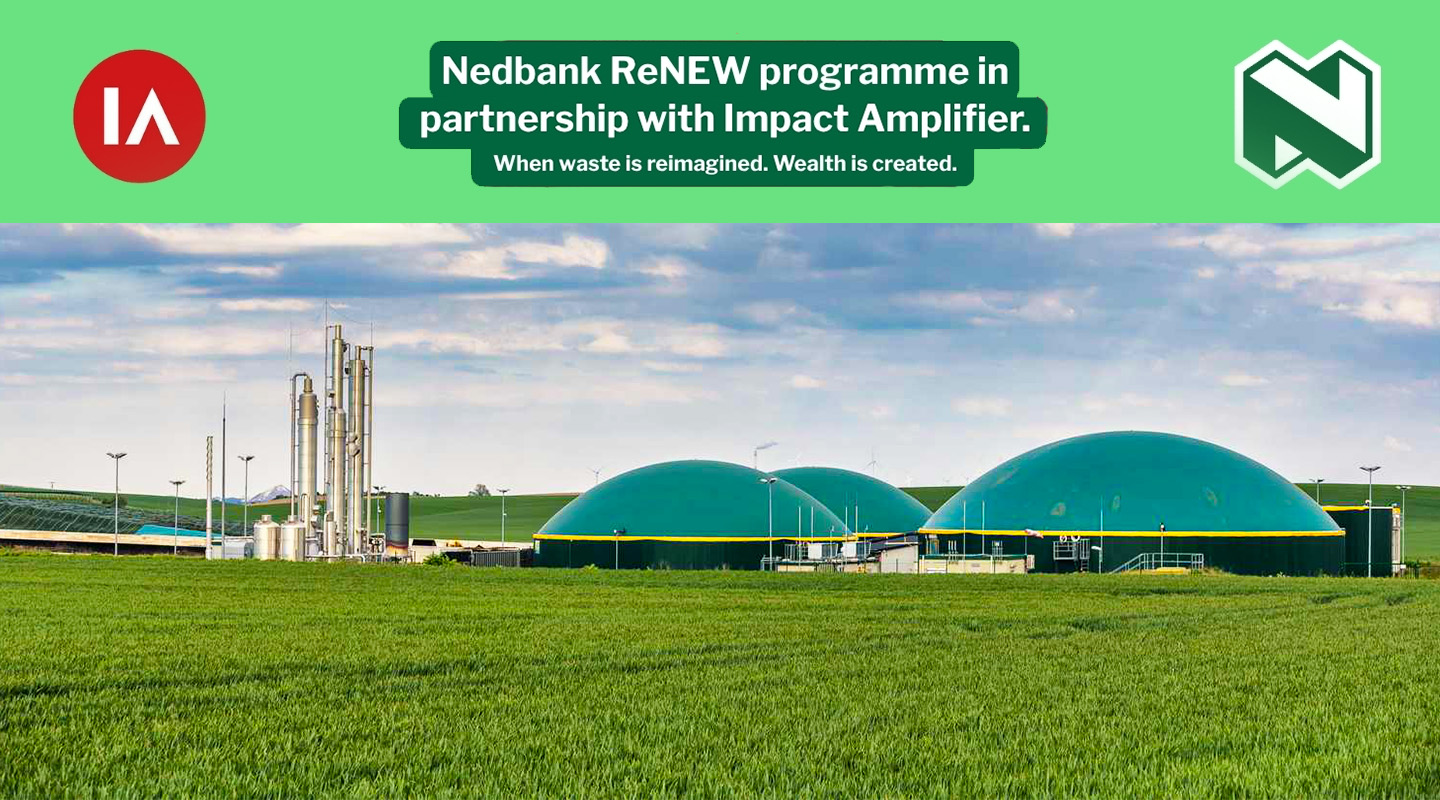
The selection matters because “circular economy” can encompass very different commercial problems. Selling building material and establishing a pet-food range require different buyers, evidence and distribution. The advisory task is to translate the environmental proposition into the next achievable business milestone. The grant then has a job to do.
Count the result, then ask what caused it
Impact Amplifier’s own 2025 reporting offers a useful final test of its approach. It separates work by how directly and substantially it contributes to outcomes. For its direct, significant category, it reports 22 social enterprises supported, R13.63 million in grant and debt funding raised, 416 new jobs and 36 sustained jobs.
Figures from the company’s Direct-Significant reporting category. Funding raised is not company revenue.
The figures belong to a defined reporting period and methodology. They do not mean that every business attending a course raised money, or that every observed outcome can be attributed entirely to an adviser. The firm itself distinguishes direct support from more indirect contributions such as research.
That distinction also helps a prospective customer decide where the model fits. An entrepreneur needs a business and the capacity to act on advice. A funder needs criteria and capital suited to the intended beneficiaries. A corporation needs access to the people and data that make an assessment meaningful. Training alone cannot remove those dependencies.
The most useful thing to copy is the sequence: understand the problem, prepare the enterprise, match support to its stage, and measure what follows. At Impact Amplifier, the ambitious language of social change eventually meets a financial model, a farmer interview or a manufacturing plan. That is where the work becomes interesting.