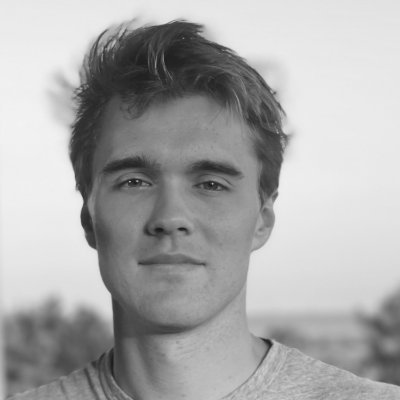
Before Ian Hathaway was managing a $175 million fund for the most consequential AI company on the planet, he was arguing with data. Not people - data. As an economist at the Federal Reserve Bank, he studied the mechanics of how economies breathe: where jobs appear, where companies form, why some cities generate ideas and others import them. That obsession with the where and why of economic activity never left. It just found a more direct outlet.
Hathaway's path to venture capital runs through the kind of institutions that don't usually produce VCs. The Federal Reserve. The World Trade Organization. Bloomberg. These are places where you learn to read signals in aggregate, think in systems, and question the received wisdom about where economic energy actually lives. When he eventually crossed over into the startup world - first at Silicon Valley Bank, then Techstars, then Haystack VC - he brought that outsider's lens with him.
The bet he kept making, with research and eventually with capital, was simple and unfashionable: the best founders aren't where the best investors are looking. Most venture-backed startups emerge outside the canonical tech hubs. Most successful founders didn't attend elite universities or work at prominent tech firms before starting their companies. He published the data. He wrote the papers. He built the think tanks to say it loud. And then he went to prove it with his own money.
Most venture-backed startup activity - from new seed deals to outlier outcomes - occurs outside the major tech hubs, and most successful founders don't attend elite universities, nor do they work at prominent tech or professional services firms before starting their companies.
- Ian HathawayWhen Sam Altman stepped back from direct management of the OpenAI Startup Fund in 2024, Hathaway stepped in. The fund - a $175 million vehicle backing AI-native startups - was already one of the most watched pools of capital in the industry. By 2025, under his watch, it had made 44 investments across its main fund and special purpose vehicles. The range is telling: from cybersecurity (a $43 million round in Adaptive Security) to biotech AI (Valthos, $30M) to AI accounting (Kick's $886M Series B). This isn't a fund following a script. It moves where the opportunity is sharpest.
But Hathaway isn't just a capital allocator who got lucky with an OpenAI adjacency. Before the fund, he co-founded FOVC (Far Out Ventures) in 2022 with Jack Greco and Jonathan Fentzke - a pre-seed and seed-stage firm with a hard-coded geographic thesis: back founders in the US, Canada, and Latin America who are building transformative companies in places traditional VCs overlook. The name isn't ironic. It's intentional. Far out - geographically, demographically, institutionally - is exactly where he thinks the signal is strongest.
His intellectual output runs in parallel to his investing. In 2020, Hathaway co-authored "The Startup Community Way" with Brad Feld - the definitive application of complexity science to startup ecosystems. The book argues that entrepreneurial communities can't be engineered top-down; they evolve, adapt, and self-organize when the conditions are right. It's an economist's book disguised as a practitioner's guide, and it became required reading in circles that think seriously about where innovation comes from and how to cultivate it without strangling it.
His blog at ianhathaway.org runs the same dual track: rigorous analysis of venture data alongside personal essays on fatherhood, sleep, and what it means to turn forty. There's a person there, not just a platform. He lives in Santa Barbara with his wife and three sons and a dog named Frankie - which is itself a kind of argument: you can be at the center of the most important technology wave in decades and not live in a two-bedroom rental in SoMa.
The Outsider Inc. podcast, launched in 2025, is the logical extension of everything he's been building for two decades. Each episode features a founder from an unexpected place - geographically, professionally, demographically - building something that the consensus told them wasn't worth building. The format is part oral history, part business case study. The thesis, as always with Hathaway, is that the consensus is wrong about where the good stuff comes from.
He's held the chair at the Center for American Entrepreneurship, served on the Policy Council at the Economic Innovation Group, and been a Nonresident Senior Fellow at the Brookings Institution. He lectures at New York University on startups and urban economic development. He has been cited in The New York Times, The Economist, the Financial Times, and Harvard Business Review. These aren't decorations. They're the institutional scaffolding of someone who has spent twenty years trying to change how America thinks about who gets funded and why.
What makes Hathaway genuinely unusual in the venture world is the combination: he came from institutions that forced him to care about aggregate effects, not just individual wins. A Federal Reserve economist doesn't declare victory because one bank is profitable - they want to know what's happening to credit formation across the economy. He brought that frame to startup ecosystems. A portfolio company winning is table stakes. The question is whether the system is working for the people it should be working for. He thinks it mostly isn't, and he's spending his career doing something about it.
The 2025 Global Venturing Powerlist recognition was probably the least surprising award he could have received - he's been in the center of gravity of venture and entrepreneurship policy for a decade. What's more interesting is where he's pointed next: deeper into AI-native companies, deeper into underserved geographies, deeper into the story of what a more distributed innovation economy actually looks like. The economist who became a VC who became a podcast host. The outsider who ended up managing the fund of the most insider AI lab in the world. He'd be the first to point out the irony - and the data behind why it makes perfect sense.