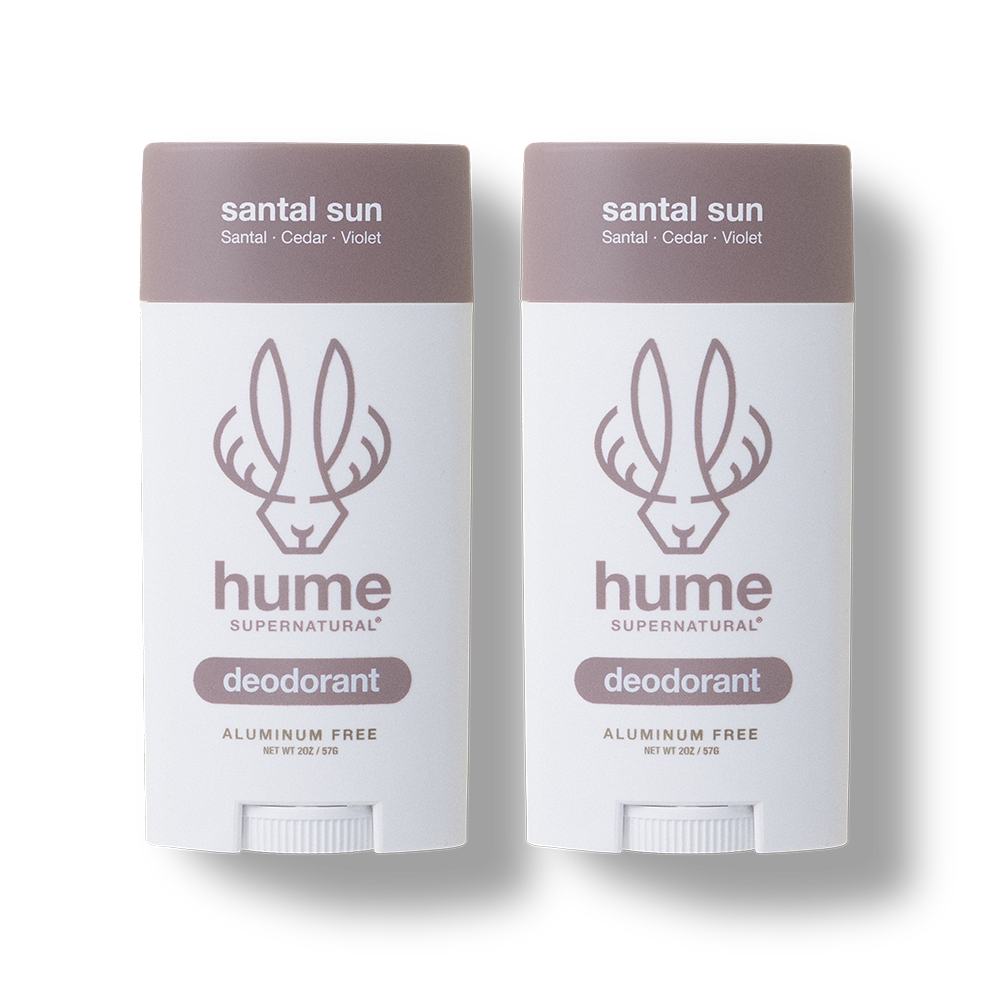
A trade-off that everyone accepted, and one company that didn't
Here is a thing about deodorant, which is a category so old and so settled that most people have never once thought about it as a category. For roughly a century the deal has been simple: the stuff that keeps you dry and odor-free is built on aluminum and a small chemistry set, and the stuff that is "clean" and "natural" mostly announces its virtue while quietly letting you down by 2 p.m. You could have effective, or you could have clean. Pick one. This was understood to be a law of nature, in the way that gravity is understood to be a law of nature, which is to say nobody checked recently.
Hume Supernatural, a San Diego company founded in 2020, is built on the premise that this law was never actually a law - it was just an unexamined assumption wearing a lab coat. The pitch is that you can make a deodorant that is aluminum-free, baking-soda-free, vegan, and free of the usual list of things people have decided they don't want near their skin, and that also works all day. The catch, which is really the whole business, is that doing this is genuinely hard. It is much easier to make a deodorant that is clean OR effective than one that is both, which is precisely why the gap existed and why filling it is worth something.
"Natural sounds simple, but formulating products that are safe, effective, and stable without shortcuts is anything but."
— Hume SupernaturalA lawyer, a surf-brand operator, and a chemist walk into a lab
The founding team reads like the setup to a joke, and the punchline is a functioning company. Jeremy Horowitz, the CEO, is a former investment officer and attorney - he did legal work for the San Diego Padres, which is a sentence that tells you he understands contracts and probably also understands that most people's problems are not, at their root, chemistry problems. Adam Francis is a former CEO and co-owner of Sun Bum, the sunscreen brand, so he has actually done the thing where you take a personal-care product and turn it into shelf space and a following. Blair Marlin rounds out the operating side.
And then there is Melissa Christenson, the co-founder and chemist, who is the reason any of this is more than a nice slide. Every Hume formula is built from scratch rather than pulled off a contract manufacturer's shelf of stock bases - a slower, more expensive, more annoying way to launch a product, and also the only way the "clean AND effective" thesis is anything but marketing. The formulas draw on desert botanicals, minerals, prebiotics, probiotics, and proprietary ingredients developed with the San Diego biotech firm Sirenas, originally researched for pharmaceuticals and repurposed for what the industry politely calls cosmeceuticals.
Jeremy Horowitz
Former investment officer and attorney; previously counsel for the San Diego Padres. Runs the business and the brand.
Melissa Christenson
Builds every formula from scratch. The reason "clean and effective" is a product, not a slogan.
Adam Francis
Former CEO and co-owner of Sun Bum. Has taken a personal-care brand from bottle to following before.
Blair Marlin
Part of the founding operating team behind Hume's launch and early growth.
It doesn't mask odor. It changes the terms of the deal.
The mental model is where Hume gets interesting. Conventional deodorant treats your armpit as a problem to be plugged (antiperspirant) or perfumed over (deodorant). Hume treats it as skin - which it is - and specifically as a microbiome, the community of bacteria living on you that is largely responsible for whether you smell. Odor isn't sweat; sweat is mostly odorless. Odor is what certain bacteria do with sweat. So Hume's approach is to use prebiotic and probiotic-powered ingredients that support the skin barrier and nudge that microbial community toward the version of itself that doesn't make you smell, while desert botanicals and minerals absorb moisture and bind odor. It is, functionally, skincare that happens to be aimed at your underarms - and, per the "All Body Deodorant," a good deal more than your underarms.
You do not need to understand any of this to use it, which is the point. What you can do with Hume is fairly boring in the best way: put it on, go about your day, not think about aluminum, and not smell. That "not thinking about it" is the entire value proposition of a well-made consumable, and it is much harder to deliver than to describe.
One category at a time
Hume did not try to be a whole shelf on day one. It led with deodorant, earned the right to exist there, and then extended - body wash, dry body oil - the way a brand does when it treats line extensions as a reward for nailing the first product rather than a substitute for it. The tagline, in case the strategy is too subtle, is "Plant-Based Deodorant That Works!"
Deodorant
Aluminum- and baking-soda-free, plant- and probiotic-based, all-day odor control. Scented and fragrance-free options.
All Body Deodorant
A multi-use formula for underarms, feet, and wherever else - "for all parts and all humans."
Body Wash
pH-balanced with skincare-level actives, formulated to respect rather than strip the skin barrier.
Dry Body Oil
A fast-absorbing dry body oil mist for skin hydration. Full and mini sizes.
From natural channel to mass retail
The distribution story is the part investors like, because Hume ran the playbook in the harder-but-durable direction. It built credibility first in the natural retail channel - the skeptical, ingredient-literate shoppers at Whole Foods and Sprouts - and then expanded outward to mass retail at CVS and to Amazon and its own direct-to-consumer site. Earning the toughest customers first and reaching mass distribution from above is slower than the reverse, and it tends not to collapse the moment a bigger competitor shows up. The revenue figures below are company and press projections, so treat them as the aspirational-but-directional numbers that they are.
Revenue trajectory (projected)
Who's in, and what's worth knowing
Funding & Backers
- ~$2.11M total raised (Seed / Friends & Family)
- Latest reported activity: ~$200K, mid-2024
- Investor: Lupita Nyong'o (actor)
- Investor: Alex Morgan (USWNT star)
- Advisors from Vuori, Meta, Cleveland Browns & Pendry Hotels
Fun Facts
- CEO Jeremy Horowitz once did legal work for the San Diego Padres
- Co-founder Adam Francis previously ran Sun Bum
- Ingredients trace back to pharma research via biotech firm Sirenas
- All Body Deodorant is deliberately gender-neutral
- Every formula is custom-built - no white-label base
A boring category, taken seriously
The reason Hume Supernatural is worth a look is not that deodorant is exciting - it isn't - but that mature, boring categories full of quietly dissatisfied customers are exactly where the money tends to hide. Nobody storms an empty castle. The clean-personal-care shelf was full of products asking their users to accept a little less, and Hume's wager is that a chemist willing to do the hard, unglamorous formulation work can quietly refuse that ask and let the results do the selling. Whether that scales into a durable brand or a nice acquisition is the open question. But "we did the annoying version competitors won't copy" is, as moats go, a real one.
For the reader, the takeaway is smaller and more practical: this is a company whose entire promise is that you can stop thinking about one small daily decision, and that the thing you stop thinking about will also be aligned with what you'd otherwise have to compromise on. That is a modest promise, delivered with an immodest amount of chemistry.