Hinge has a peculiar sales pitch: please find someone you like enough to stop using Hinge. The app promises an exit from dating apps, a category whose products can make meeting people feel like an unpaid evening shift. And the business is growing. Hinge generated $690.9 million in direct revenue in 2025, up from $550.4 million a year earlier. Apparently, there is money in being the app people hope they will no longer need.
The apparent contradiction is the company’s organizing idea. A dating service can earn a recommendation by helping somebody leave happily. It can also earn money while somebody is still searching. Hinge operates in that uncomfortable space, where a better introduction serves the customer and a paid visibility upgrade serves the business. Its story is about the product decisions that hold those two interests together - and the limits of what software can do about attraction.
A $25,000 party, then a much harder reset
Founder Justin McLeod’s early idea drew on a familiar social shortcut: meeting through friends. Hinge’s official timeline dates its creation to 2012 and its mobile launch to 2013. The company says it put its last $25,000 into the launch party. That is an unusually literal approach to bringing a dating market together: first, get people into the same room.
Outside money followed. In December 2014, Hinge announced a $12 million financing involving Shasta Ventures. But funding did not settle the question of what the product was for. As McLeod later described it, Hinge kept adding competitors’ features and drifted away from helping people make satisfying connections. The app could keep people occupied without making their romantic lives much better.
A bruising 2015 Vanity Fair examination of dating-app culture added pressure. McLeod also credits reconnecting with his college sweetheart with sharpening his original ambition. Hinge relaunched in 2016 with swiping removed and more emphasis on substantial profiles. The new version initially charged $7 a month. It was a change in both interaction and intent, with a price attached.

“Would it lead to more great dates?”
Justin McLeod, describing the standard for the rebuild
A profile with something to answer
Today, Hinge is a consumer dating app for adults who want meaningful connections, particularly the younger daters central to its marketing. It is available on iOS and Android. People build profiles, consider suggested matches, send likes and talk when interest is mutual. The audience includes different genders, sexualities and backgrounds; the relationship-oriented positioning describes the invitation, not a guarantee about everyone who accepts it.
The distinctive move is small enough to fit under a thumb. You like a particular photograph or prompt response, rather than an entire person in the abstract. You can attach a comment. That gives the recipient something to answer and the sender something more useful to work with than a blank message box. A profile becomes a collection of possible openings.
Hinge’s competition includes Bumble, Tinder, Match and eHarmony, along with the friend who insists you should meet someone from work. Tinder and Match also belong to Match Group. Hinge’s place within that portfolio depends on making deliberate dating feel accessible on a phone. It cannot claim exclusive ownership of serious intentions; it can make those intentions easier to express.
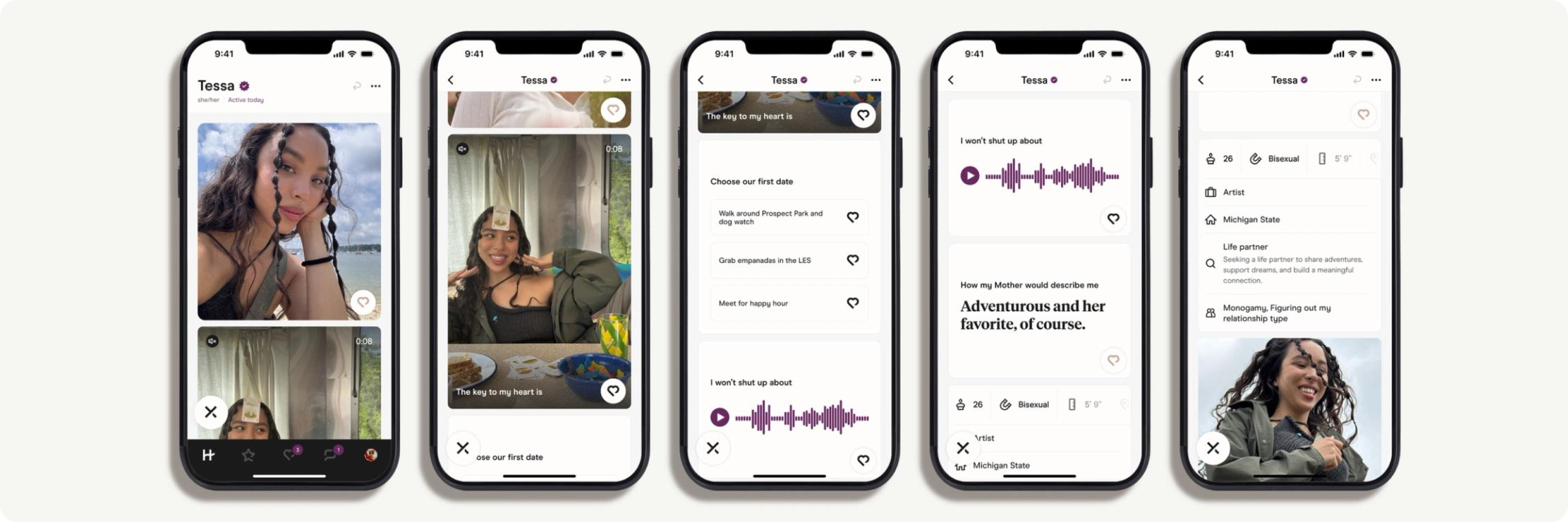
Please deal with your inbox
One of Hinge’s more revealing features prevents people from collecting more possibilities. Your Turn Limits, launched globally in September 2024, asks daters with too many people waiting on a reply to respond or end existing conversations before making new connections. The rule applies to subscribers, too. Buying more access does not excuse leaving everybody in the waiting room.
Hinge reported that its test increased responsiveness by 20%. That is a company-reported product result, not evidence that relationships became 20% happier. Still, the intervention addresses a recognizable problem: having matches and having conversations are different experiences. The design makes users confront that difference before adding more names to the list.
+20% responsiveness in Hinge’s reported test. A messaging measure, not a relationship-success rate.
Another feature, We Met, follows the action offscreen. After phone numbers are exchanged, Hinge asks whether a date happened and whether the person was someone the user would want to see again. Feedback stays private and can inform recommendations. This is a useful admission from a software company: the event that matters most does not happen inside its software.
Free to meet. Pay to move up.
Hinge now operates a freemium business. Matching and messaging are free. Hinge+ sells unlimited likes, advanced preferences and the ability to see all incoming likes together. HingeX adds enhanced recommendations, priority likes and earlier profile visibility. Roses and Boosts offer additional ways to attract attention. The commercial menu is largely about narrowing the search and getting seen.
Prices and available subscription packages are displayed in the app. For a reader deciding whether to pay, the useful distinction is between access and outcome. A filter can remove an obvious incompatibility. Earlier placement can increase the chance that someone notices a profile. Neither purchase can supply interest on the other side of the screen.
Annual direct revenue
Match Group started investing in Hinge in 2017, acquired a 51% stake in June 2018 and completed full ownership in 2019. In the second quarter of 2026, Hinge reported $203.5 million in direct revenue and 2.049 million average payers. Revenue rose 22% year over year; payers rose 17%. These are paying customers, not a count of everyone using the app.
The incentive tension survives those numbers. Successful couples may leave; frustrated customers may leave, too. Both disappear from the same screen. Hinge has to distinguish between them, improve the experience for people still searching and persuade the next group to try it. Growth makes the promise commercially interesting. It does not, by itself, prove the promise has been kept.
The lab has a dating budget
Hinge Labs combines behavioral and relationship science with user research and data analysis. Its remit spans first impressions, recommendations, conversation and burnout. The company also publishes its operating principles in a book, How We Do Things. A quarterly State of the User Base presentation brings research about daters into the workplace, giving teams a shared picture of what customers experience.
Then there is the benefit with the best dinner-party explanation: US employees receive a $100 monthly dating stipend. Hinge also advertises a $3,000 annual learning allowance after three months. The dating benefit makes sense alongside the research presentations. Employees building a service about human connection have reasons to get away from the product and experience some.
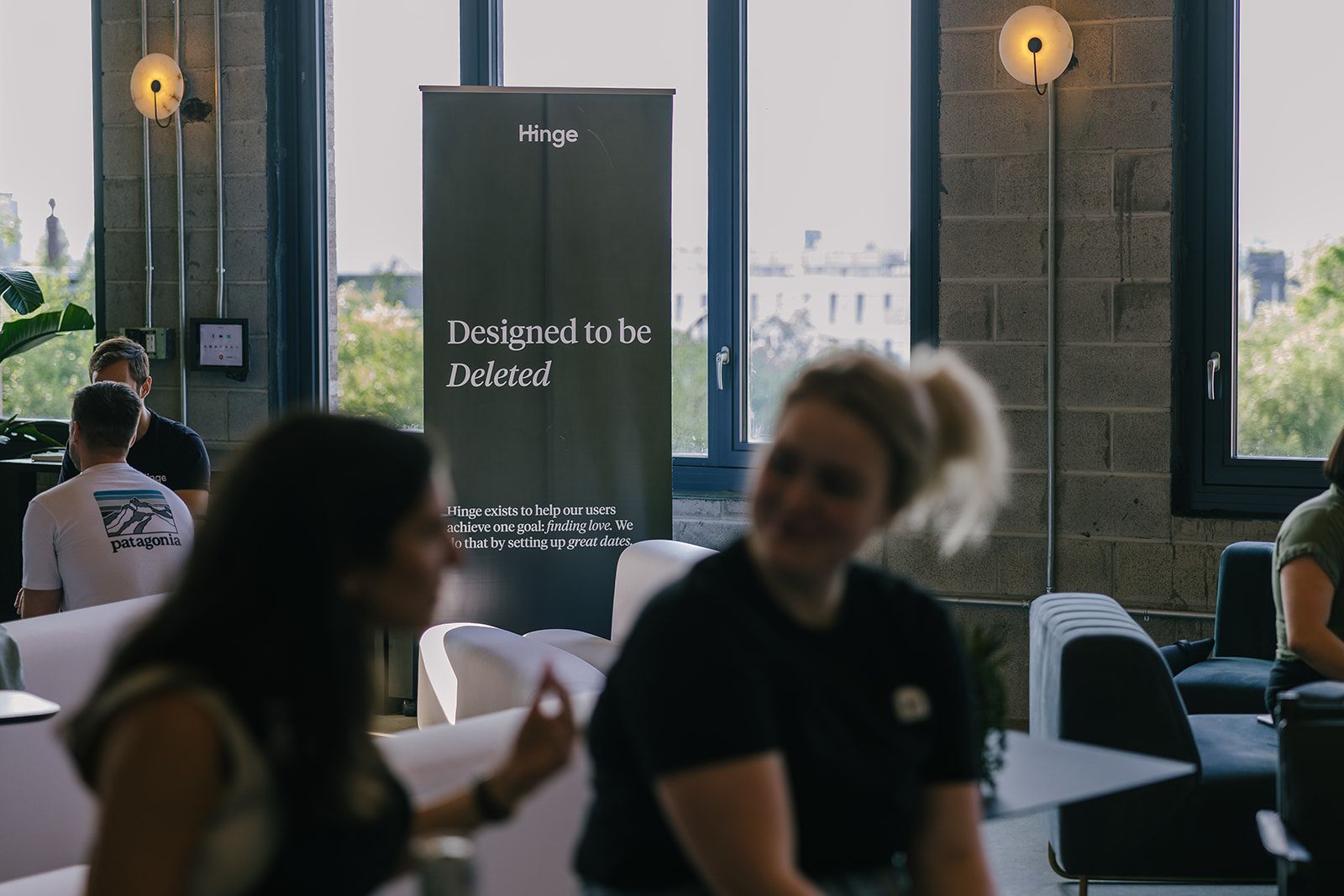
The offline emphasis extends beyond employees. Announced in December 2023, One More Hour launched with a $1 million fund supporting in-person community for Gen Z. Initial grants targeted recurring gatherings in Atlanta, Los Angeles and New York. Hinge worked with DoSomething Strategic and the Foundation for Social Connection. The recurring part matters: a regular group offers another chance to show up after an awkward first visit.
A new boss, an AI nudge, the same awkward first hello
In December 2025, Jackie Jantos moved from president and chief marketing officer to CEO as McLeod left to launch Overtone, a separate AI-driven venture backed by Match Group. Hinge entered the handoff with growth and a recognizable identity. The next leadership chapter must keep that identity legible as the technology and geographic footprint change.
Hinge says it introduced a deep-learning recommendation system in 2025 that considers both whom a user might like and who might reciprocate. Its Convo Starters feature, available in supported regions, uses OpenAI to generate topic suggestions from public profile content. Hinge says it does not draft or send the message. The user still has to turn the suggestion into something they would actually say.
Marketing is working on the same problem of credibility. Tamika Young, Hinge’s chief marketing and communications officer, oversaw the May 2026 campaign Can’t Believe We Met on Hinge. It features couples reflecting on their earlier feelings about online dating. The approach makes room for doubt within the advertisement itself. For an audience tired of cheerful dating promises, that is a sensible place to begin.
Make the exit worth recommending
The practical lesson for product builders is to locate the behavior standing between activity and a useful outcome. Hinge’s examples are specific: give people material for a first message, ask what happened after an introduction, and interrupt the accumulation of unanswered chats. Those moves are easier to copy than a brand slogan. They also require a team willing to make an interaction less convenient in one place to improve it elsewhere.
There are conditions attached. A dating app needs enough compatible people nearby, users willing to participate and trust sufficient to move a conversation into real life. Better sorting cannot manufacture a local dating pool. A reply requirement cannot manufacture affection. Hinge itself says selfie verification does not guarantee someone’s safety. The software can improve an introduction; the people involved still decide what follows.
For daters, the corresponding lesson is modest: give another person a detail they can respond to, spend attention on conversations already underway, and judge the app by what happens beyond it. Hinge’s strongest promise remains a very ordinary evening: two people have enough to talk about that their phones can stay in their pockets.