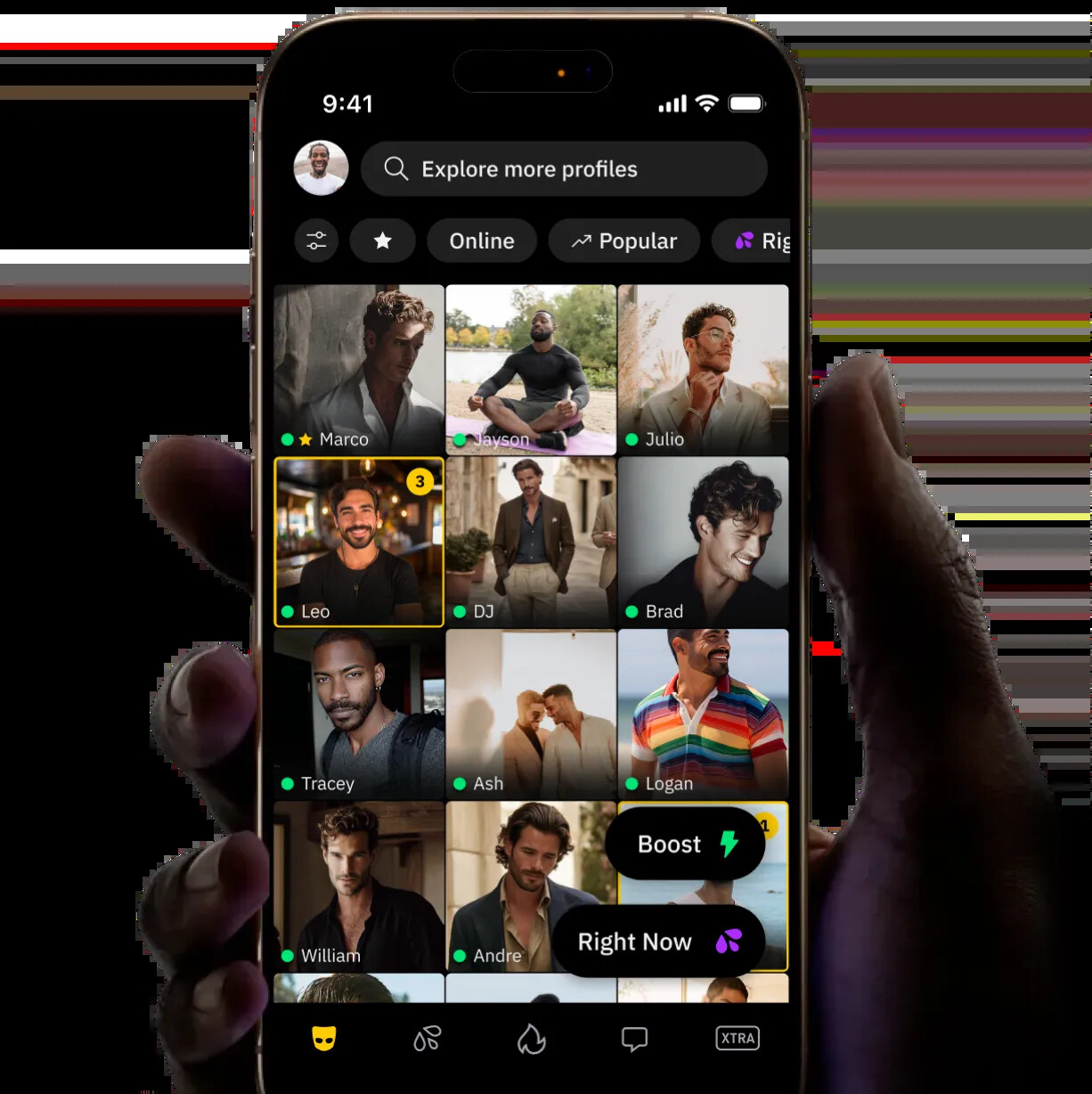
Open Grindr and the thesis is visible before the first message arrives. The screen is not a compatibility quiz, a carousel or a coy promise that an algorithm has found your soulmate. It is a grid of people, arranged largely by distance. The product’s founding insight was less romantic and more useful: for gay, bisexual, trans and queer adults, simply knowing who else was nearby could be transformative.
Joel Simkhai launched the iPhone app in 2009. It collapsed the distance between seeing and meeting, particularly in places without an obvious gay district, welcoming bar or safe public cue. A user did not need a mutual friend or a match. The network was the introduction. That immediacy made Grindr a dating product, a hookup utility, a travel hack and, sometimes, an emergency bulletin board. The company now reports 14.985 million average monthly active users across more than 190 countries and territories.
The trick is that Grindr’s customers are not all buying the same thing. Free users buy nothing and provide the density that makes the grid alive. Paying users buy speed, reach, filters, visibility and privacy controls. Advertisers buy access to a sharply defined audience. Health and advocacy groups borrow distribution that would be expensive or impossible to recreate. Each group needs the others, and each can annoy the others. That is the whole business in miniature.
The business hiding behind the mask
Grindr is a freemium consumer-software company with unusually direct economics. In 2025, subscriptions and paid add-ons produced $366.3 million of direct revenue. Advertising contributed another $73.6 million. The company reported $94.8 million in net income and $195.6 million in adjusted EBITDA. For a product known more for disappearing photos than income statements, it is a muscular little cash machine.
Most users still do not pay. Average paying-user penetration was 8.4 percent in 2025, even after the paying population grew 17 percent to 1.258 million. Management sees runway: offer more reasons to subscribe, tune prices, merchandise weekly plans and sell one-off visibility products such as Boost. The user sees a different equation: how much friction has been placed in the free experience, and is the paid escape worth it?
The cost side is equally revealing. Grindr spent $112.6 million on cost of revenue in 2025, including app-store fees and infrastructure; $48.9 million on product development; and $143.3 million on selling, general and administrative expenses. Those are the costs of running the network now. The larger historical price tags belong to ownership: Beijing Kunlun bought control for $93 million in 2016; San Vicente Acquisition paid roughly $608.5 million for nearly all of Grindr in 2020; and the 2022 SPAC deal carried an announced enterprise value of $2.1 billion.
What failed first: stewardship
The early product worked. Stewardship was shakier. In 2018, reporting revealed that user-reported HIV status was being shared with analytics vendors that helped test and optimize the app. Grindr stopped the practice after public outrage. A separate European case concerned personal data disclosed for behavioral advertising without valid consent; Norway imposed a NOK 65 million fine, later upheld through multiple appeals. For an app combining identity, location, private messages and health information, privacy is not paperwork. It is product quality.
Ownership became a security issue too. U.S. officials scrutinized Kunlun’s control after Beijing-based engineers had access to sensitive U.S. user information. Kunlun was pushed to sell. There was no evidence cited that the database had been misused, but the episode established a hard truth: a social network can be geopolitically important when its data could expose people.
The next failure was quieter: stagnation. Grindr’s own 2026 roadmap refers to “years of underinvestment in the core app.” Users had been inventing new jobs for the product - finding a vaccination appointment, asking locals where to go, scouting a city before landing - while the company mostly maintained the same utility. Competitors could copy features, but Grindr risked squandering the far harder asset: a live, geographically dense network.
The users changed the company’s mind
The new mission, announced in 2024, is the “Global Gayborhood in Your Pocket.” Corporate slogans often arrive wearing borrowed excitement. This one at least describes observed behavior. Physical gay neighborhoods concentrate safety, culture, gossip, commerce, care and potential dates. Grindr already concentrated people. The strategic question became whether it could supply more of everything around them.
Roam lets a user temporarily appear in another location before a trip. Right Now makes immediate intent explicit. For You and Discover recommend profiles beyond a static nearby list. Grindr Presents puts video programming inside the app. Woodwork began testing a path into discreet health care, while a planned Health Center broadens the idea toward sexual health, weight management, hair loss and wellness. Maps are meant to show not only people but bars, gyms, restaurants and, eventually, perhaps hotels.
The AI layer, branded gAI, aims to rank conversations, surface people who fit a user’s type, summarize previous chats and improve search. EDGE packages several of these functions into a premium tier being tested in selected markets. The pitch is not artificial companionship. It is less dead time: fewer irrelevant profiles, fewer buried messages, fewer promising conversations abandoned because nobody remembers where they stopped.
This is where Grindr differs from Tinder, Hinge, Bumble and smaller LGBTQ+ networks such as Scruff, Jack’d and Hornet. A swipe app with a matching gate optimizes selection. Grindr optimizes availability. Its moat is not that nobody can reproduce a cascade of faces. It is that opening a copycat grid in São Paulo, Sydney or a small town is disappointing if the people are still on Grindr. Network liquidity beats interface novelty.
The public-health machine hiding in a dating app
Grindr for Equality, created in 2015, is the expansion that already works at scale. It uses in-app messages and local organizations to distribute health and human-rights information. Partnerships have promoted free HIV self-tests in the United States, Australia and Namibia; a 2025 campaign with the Pan American Health Organization addressed PrEP and syphilis; advocacy partners have also used the network around marriage equality.
The Together TakeMeHome program passed one million distributed HIV self-test kits in 2025 with support from Grindr and other community partners. The mechanism is worth studying. Grindr does not need to persuade an audience to visit a new health portal. It can place timely, localized information inside a habit that already exists. Distribution is the product advantage.
That advantage has limits. It works when the message is specific, trusted and immediately actionable; when local partners can fulfill the promise; and when users believe engagement will not expose them. It works poorly where a campaign is generic, care is unavailable after the click, or the platform’s own privacy record overwhelms the message. Reach can open a door. It cannot build the clinic behind it.
What builders can copy - and what they cannot
The portable lesson is not “make a dating app for a niche.” It is to begin with a painful, frequent job whose value improves as more of a specific community joins. Grindr’s grid answered an urgent question in seconds. It did not begin with media, telehealth, hotel booking and an AI assistant. Those options appeared because the narrow utility became a habit, and the habit became a network.
- Solve one time-sensitive question before building a platform.
- Make the network useful before charging its edges.
- Watch the workarounds: users often prototype the roadmap for free.
- Treat trust and safety as core functionality, not a policy page.
- Expand where identity, location and timing create an unfair advantage.
This playbook fails when the target community is too small or thinly distributed to produce local density; when the core need is occasional rather than habitual; when safety costs overwhelm the economics; or when expansion has no relationship to the original advantage. A generic marketplace cannot simply declare itself a neighborhood. The neighborhood has to show up.
Grindr’s culture memo describes a demanding operating style called Grindr Mode, with a high-output steady state and a harder gear for exceptional moments. It is an attempt to prevent a repeat of the underinvestment years. Yet speed is dangerous in this category. AI recommendations can feel helpful until they feel invasive. Health products can feel convenient until commercial incentives cloud the advice. A luxury tier can lift revenue while turning a communal space into a velvet-rope business.
That is the tension in Grindr’s next act. The company has the audience, profit and cultural permission to build beyond dating. It also handles information whose misuse can change a person’s life. If the new products make the grid faster, safer and more useful, the gayborhood metaphor may earn its keep. If they become tollbooths and clutter, users will notice before the next earnings call. They are already standing in the town square.
Keep exploring