Himanshu Patel began his working life examining car companies. Today, he runs a company whose name appears on the little machine that asks for your card. Between those two jobs lies a career in the machinery of business: how companies finance themselves, how software earns its place, and how a purchase becomes a completed transaction. It is an unusually good route into an industry whose public performance is supposed to last only a few seconds.
There is a quiet comedy to payments. A retailer can spend an afternoon helping someone choose an item, then entrust the closing scene to a screen with a few buttons. All the persuasion has already happened. Now comes the practical question of whether the money will move. Patel’s job at Verifone sits inside that final exchange, with all the unglamorous coordination it requires.
His progression offers a way to understand that work. He has been an analyst, a strategy executive and a chief financial officer. At Fiserv, he helped lead a business serving financial institutions. In November 2023, he became Verifone’s chief executive. Each move brought him closer to responsibility for the system as a whole.
Before the tap, the balance sheet
Patel graduated from NYU Stern in 1997. His early equity research work covered the automotive industry, a rather different setting from digital checkout. The connection is less peculiar when viewed as a question of business judgment. Both an analyst and an operating executive have to ask what a company’s assets can actually produce. The difference is who must act on the answer.
He spent 16 years at JPMorgan. His responsibilities included senior equity research work from 2001 to 2011 and, later, leading strategy for Chase’s mortgage banking division as a managing director. In June 2013, he moved to First Data to oversee strategy, planning and business development. By September 2015, he was its executive vice president and CFO.
First Data credited him with helping reshape its balance sheet through a $2.8 billion IPO, a $3.5 billion private placement and more than $10 billion in debt refinancings. Those figures describe corporate financing, rather than transactions at a shop counter. Yet they belong in this story: before he was responsible for a payments company’s direction, he worked on the financial foundations that give a business room to operate.
A November 2015 regulatory certification carries his signature as First Data’s principal financial officer. It is a plain document, without the vocabulary of reinvention. Its significance is accountability. The same executive who had worked on business opportunities was putting his name to the company’s financial reporting. Numbers become rather less abstract when you sign them.
A useful detour to the developers
While at First Data, Patel described deliberately spending time with software developers. He wanted to understand how they chose platforms and placed their development bets. They worked with limited resources; their judgments could provide a useful check on executive assumptions. Here was a finance leader taking the trouble to ask what a platform looked like from the person building on it.
“You need to have a desire to traverse all sides of a great idea.”
Himanshu Patel, speaking to NYU Stern
His advice to students was to connect a technical idea with a business vision. That observation supplies a thread through the career. A feature can look attractive in isolation and awkward once somebody has to deploy it. A modest piece of engineering can become valuable when it solves a recurring problem. The executive’s task includes making those judgments across different disciplines.
There is a reason this matters at a company such as Verifone. Its products occupy physical places, while the services around them depend on software and financial connections. A decision made in one part of that arrangement has consequences elsewhere. Patel’s interest in other people’s working constraints provides a useful lens for his later assignment. A strategy has to be intelligible to the people expected to implement it.
A familiar machine, a wider assignment
Patel arrived at Verifone after a decade across First Data and Fiserv. His last Fiserv role was EVP and co-head of its Financial Institution Group, with responsibility focused on payment solutions. Verifone announced his appointment in October 2023, effective November 1. He succeeded Mike Kohlsdorf, who remained on the board.
At the time, Verifone described a workforce of more than 4,500. Patel was taking responsibility for an existing international business, with customers and installed systems already depending on it. That gives a CEO a particular kind of challenge. New directions must accommodate the obligations of products already in use. The next chapter has to work with the previous chapters still open on the counter.
Verifone’s current corporate description puts its solutions in more than 165 countries and its integrations above 2,500. These are company-wide measures, accumulated across a business that predates Patel’s tenure. They help explain the scale of coordination in his job. An integration is a connection someone must build, maintain and keep useful when another part of the arrangement changes.
Company-reported footprint; these figures describe Verifone, not individual results attributed to Patel.
His public argument is that payment infrastructure should let merchants add capabilities without repeatedly rebuilding their connections. Geography, payment preferences and older systems complicate that ambition. It is easy enough to promise a smooth checkout. The interesting work begins when the same merchant needs it to function in another setting.
Commerce leaves the cash register
In May 2024, Verifone and Logos Payment Solutions announced a partnership around the UX700 unattended payment device. The applications included fuel, car washes, electric vehicle charging, vending and automated retail. These are useful reminders that a sale need not involve a cashier, a shopping bag or even a shop.
For Patel, the partnership gave the platform argument a physical shape. A machine has to fit the place where the transaction occurs. A driver at a charger and a customer at a vending machine arrive with different tasks, even if each eventually needs to pay. The payment device becomes part of another company’s service, with its own timing and expectations.
Self-service also changes where assistance lives. The product cannot depend on a cashier standing beside it to explain every instruction. That makes the relationship between equipment, payment software and the surrounding service especially visible. The ambition may be expressed in corporate language; the test can be as ordinary as whether somebody understands the next step.
Let the partners onto the screen
In 2025, two partnerships made Verifone’s approach easier to examine. Its expanded arrangement with PayPal paired physical payment capabilities with online commerce and processing services for enterprise merchants. PayPal’s investor presentation identified Verifone as a launch partner, pointing to a footprint of more than 45 million devices worldwide.
That footprint matters as a starting position, rather than a promise that every device will adopt every service. The proposed combination gave the partners a way to address the same merchant across different places where a customer buys. For Patel, it put a familiar piece of physical infrastructure into a broader commercial relationship.
The Stripe announcement followed in May. Stripe services would run natively on Verifone payment devices, initially for customers in the United States. The companies described support for tableside ordering and self-service checkout, with capabilities including digital wallets, QR codes, receipts, tipping and loyalty. Merchants would also have device management through the Stripe Dashboard.
Consider what that means for the CEO’s assignment. Selling equipment begins a relationship that continues through deployment and management. A merchant may choose its software first, then need hardware that fits. Opening the device to a partner’s services gives Verifone another route into that decision. The relationship between the businesses becomes part of the product the merchant receives.
Twelve ways to ask for the money
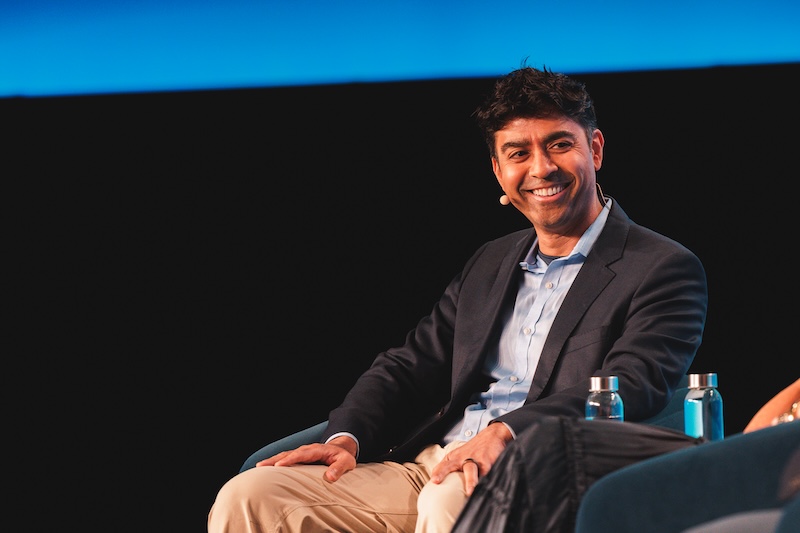
At PayPal Beyond in San Francisco in April 2026, Patel joined PayPal’s Frank Keller and Sephora’s Denise Daly for a discussion of commerce across channels. His contribution emphasized the difficulties of personalizing physical retail and giving store associates the information and payment options available online. The conversation brought the strategy back to the people serving customers.
The range of payment form factors merchants needed to support had expanded from roughly three use cases to twelve, according to the event account. It is a revealing measure of the problem he was describing. More ways to buy create more places where a merchant needs the technology to cooperate. Choice arrives carrying an implementation bill.
A conceptual map of the work around a transaction, not a technical processing sequence.
By May, another part of the assignment was visible at the fuel counter. Verifone described AI assistance for its Commander platform: searching documentation, helping support agents assemble information and identifying recurring issues across support cases. The company said Commander served more than 45 percent of US fuel and convenience sites and handled over 35 million transactions daily.
Those applications give the technology discussion a welcome specificity. Someone needs an answer in a product manual. Someone else needs a useful record of a support call. Patel’s stated goal was to help merchants use AI without adding complexity. Whether such tools deliver that benefit is a question for the daily operation, where a feature eventually has to earn its keep.
His career has carried him from evaluating businesses to taking responsibility for them. At Verifone, the work now stretches from partners’ software to the equipment customers touch. The moment of payment remains brief. Behind it sits the continuing task of making all those decisions agree. For the person waiting at the counter, the best ending is wonderfully undramatic: payment accepted, purchase complete, day resumed.