Before Himanshu Gupta became the chief executive of a company that models weather years into the future, he learned to work with what was directly in front of him: wires, chips and a soldering iron. Fresh from studying electrical engineering at IIT Kharagpur, he joined AREVA T&D and helped make smart-grid products. His job stretched from building and coding them to selling them. It was an education in the full distance between an elegant idea and a buyer who needs the thing to work.
That distance still explains much of Gupta's career. Climate change is planetary, statistical and stubbornly abstract. A crop decision is local, seasonal and due on Tuesday. ClimateAi, the San Francisco company he co-founded at Stanford, exists in the gap between the two. Its models aim to tell food and agriculture businesses where crops may thrive, which supply regions are exposed and how plans should change before weather turns a forecast into an invoice.
The software may be sophisticated. Gupta's public language about it is pleasingly suspicious of sophistication for its own sake. “AI can be overkill,” he told Climate Tech VC in 2020, arguing that a simple regression may create enough customer value without a complex neural network. It is an unexpected line from the boss of a company with AI in its name. It is, however, the line of an engineer who once had to sell what he soldered.
A first flight, then a wider map
Gupta grew up in Vrindavan, a religious town in northern India. He has described his family as lower-middle-class and conservative. His father did not study beyond high school. California was not a childhood horizon; Gupta says he did not know what it was until he was 20. His first flight came at that age, a nervous three-leg journey to the United States for an internship.
The inheritance he emphasizes is less material than procedural. His father and grandfather taught discipline, passion for one's work and the duty to find mentors. They could not personally guide their children through every educational gate, he has said, so they taught them to look for people who could. Later, names from policy and climate economics would recur in his story: Indian civil servant Anil Jain, economist Montek Singh Ahluwalia, Nicholas Stern and Al Gore.
“To me, as an entrepreneur, the first principle for me is always the problem.”Himanshu Gupta, The India Energy Hour
After engineering came government. In 2011, Gupta took a substantial pay cut to move into India's public energy work. At the Planning Commission, he worked on renewable and low-carbon policy, including the renewable-energy chapter of the country's Twelfth Five-Year Plan and the India Energy Security Scenarios 2047 project. The view was vast: national demand, technology choices, emissions and policy levers measured across decades.
Engineer
Electrical engineering gives way to the practical mechanics of smart-grid products.
Policy maker
National energy plans turn technology into scenarios, trade-offs and public choices.
Founder
At Stanford, climate science becomes a product for decisions in exposed supply chains.
Adaptation advocate
Recognition, public writing and a new podcast widen the conversation beyond the company.
The gate in Gurgaon
In 2014, the tidy career sequence broke. Gupta had accepted a role with a renewable-energy producer and arrived at its Gurgaon office for his first day. At the gate, doubt won. He called Shrey Goyal, who had worked in solar and biomass, and they discussed a startup. Gupta went home and sent the would-be employer a regret email.
Gupta and Goyal launched Sustainable Growth Initiative, advising companies and governments on energy security and lower-carbon operations. Forbes India put the pair on its 30 Under 30 list in 2016. The gate story is appealing because it has none of the polished inevitability that startup histories acquire with age. A person made a choice from outside the building, while still unsure. The career became coherent later.
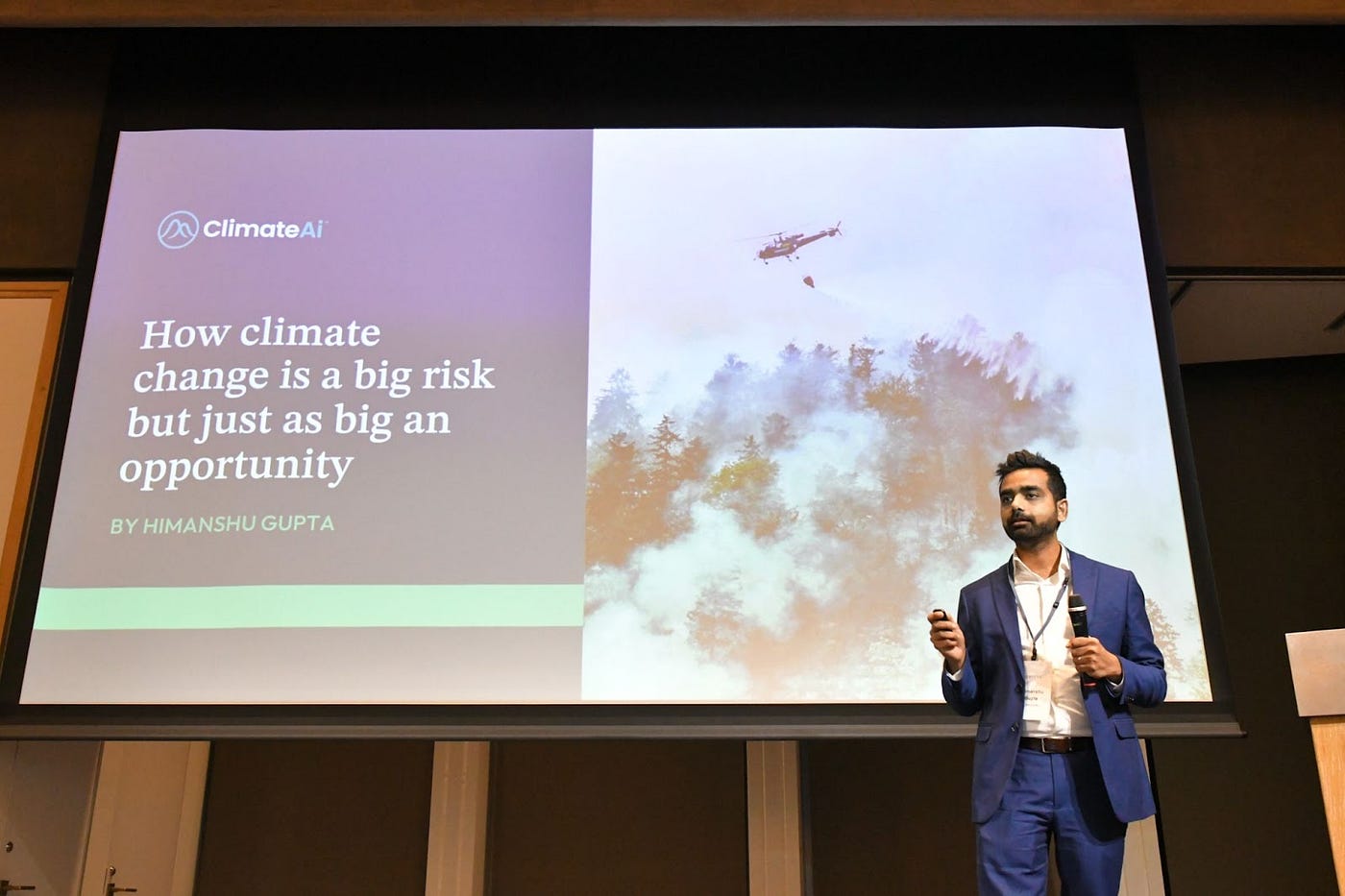
Stanford supplied the next turn. Gupta pursued an MBA and a master's degree, met Max Evans and began building ClimateAi. Public profiles place the company's founding in 2017 or 2018, a small calendar disagreement around a much clearer origin: the company emerged from Stanford with the aim of making climate risk operational.
Agriculture was the first proving ground because weather is not a footnote there. It alters yield, quality, safety and income. Seed development can take years. Supply contracts are signed before a season reveals itself. Historical weather is a poor rehearsal when the climate itself is changing. TIME selected ClimateAi's forecasting tool for its Best Inventions of 2022, describing hyperlocal projections that looked as far as 20 years ahead.
Three questions beat one grand warning
Gupta has a compact way to move from planetary risk toward a decision. First, what is the hazard: drought, flood, heat or wildfire? Second, what is a company exposed to? Third, where is it vulnerable? The sequence matters. A hazard without exposure may be dramatic but irrelevant to a particular operator. Exposure without vulnerability may be manageable. Put all three together and the general forecast gains an owner.
The decision lens
Hazard
What physical climate condition could occur here?
Exposure
Which crop, facility, supplier or asset sits in its path?
Vulnerability
Where would that contact cause a material loss or disruption?
This is where his policy education and product education meet. Policy asks which levers can shift a system. Product work asks whether a specific user will pull one. ClimateAi's users have included seed companies, processors and food businesses. Their questions are concrete: what should be planted next season, whether production can meet demand, or where a crop may move as growing conditions change.
Timing is the quiet product feature. A seasonal warning can adjust planting or procurement; a longer-range projection can shape crop breeding, facilities or sourcing geography. The same physical signal has different value depending on when it enters the calendar. Gupta's work repeatedly returns to this translation from probability into lead time. A company does not purchase certainty. It purchases the chance to choose while several choices remain.
The company has also drawn a line around who it will help. Gupta said ClimateAi had turned down prospective oil and gas customers and would not work with the fossil-fuel industry. A model, after all, does not supply its own moral direction. The customer and use case do that.
A beautiful forecast that arrives after the contract is signed is simply weather-themed literature.
Adaptation gets a verb
For years, climate technology conversation leaned toward mitigation: reduce the emissions that cause warming. Gupta's work insists on adaptation as the necessary companion. Even while emissions are cut, farms, cities and businesses must respond to conditions already changing. His preferred formulation is early action: tools and partnerships that help people adapt before the shock, when options are wider and usually cheaper.
That position has given him a public role beyond ClimateAi. The World Economic Forum named him a Young Global Leader in 2023. Business Insider included him in its AI 100 that year. In 2025 he received the Uttar Pradesh Gaurav Samman, an honor from his home state, and appeared at the Forum's Summer Davos meeting to discuss AI's predictive role in climate action. His writing argues for supply-chain adaptation plans that coordinate companies, governments and finance rather than leaving each farm or supplier to improvise alone.
There is an aspiration inside that systems language: make resilience fair. A forecast bought by a large company can still change what happens farther down the chain, but benefits do not distribute themselves. Gupta's personal site describes a mission spanning agriculture, finance and vulnerable communities. The old policy maker remains visible in the founder, watching not only whether the machine works but also who gains room to move.
The new forecast is about people
Lately Gupta has taken his habit of studying systems into more personal territory. His podcast, Genius Born or Made?, asks how extraordinary performance develops and what families, students and ambitious people can learn from unusual lives. It follows a post about his parents visiting ClimateAi's San Francisco office and the distance his family had traveled across generations. The guests come from science, sport, business and public life. The underlying inquiry is familiar: which parts of an uncertain future can be made more navigable?
Weather and talent appear to be different subjects. Gupta approaches both through patterns, mentors and timely intervention. His own account makes mentorship a kind of human forecasting tool: find someone who has seen farther along the road, learn what signals matter, then decide with more than instinct.
The lesson worth borrowing from his career is modest enough to survive contact with reality. Begin with the problem. Name the hazard. Find the exposed decision. Use as much technology as earns its place, and no more. The future does not become certain. It becomes specific, which is often the first condition for courage.