The first question is not whether Higgsfield can make a handsome six-second clip. It can. The better question is whether you make enough images, ads, storyboards, talking characters, and cinematic shots to need a whole production lot in one browser tab. Higgsfield is built for that person: the social marketer testing ten hooks before lunch, the director pre-visualizing a scene nobody has financed, the small agency asked for twelve formats by Friday, or the curious filmmaker who knows the difference between a dolly and a zoom.
If you only want to animate one holiday photo, the lot may feel comically large. Menus lead to image models, video engines, audio, lip sync, upscaling, a node canvas, an agent called Supercomputer, ad production, an academy, and a filmmaking workspace named Cinema Studio. The breadth is the point, but it creates homework. Higgsfield rewards people who arrive with a repeatable job and punishes tourists who click premium models without checking the fare.
Book the studio
You publish often, need recurring characters, compare models shot by shot, or make paid creative where iteration has a budget.
Keep window-shopping
You need one occasional clip, dislike credit arithmetic, or expect every generation to land without rerolls and cleanup.
The short verdict
Higgsfield’s clever move was to stop selling a magic camera and start building the studio around it.YesPress review
Why it exists: models are plentiful, production is still a nuisance
Higgsfield began in 2023 with Alex Mashrabov, formerly Snap’s head of generative AI, and Yerzat Dulat. Its first public swing was Diffuse, a mobile app that turned a selfie into short social video. By 2025 the company had shifted its attention to a browser suite. That pivot explains the product’s personality. It still loves a viral effect, but it now speaks in the language of casts, lenses, locations, campaigns, and production pipelines.
The raw engines are a rotating ensemble. Recent menus and product notes include Seedance, Kling, Wan, Gemini, GPT Image, Seedream, Flux, MiniMax, ElevenLabs, and Higgsfield’s own Soul image technology. A proprietary reasoning layer sits above them, planning camera logic, pacing, and continuity. The practical benefit is model shopping without moving your references, characters, and project organization to a new account every week.
Cinema Studio is the reason to care
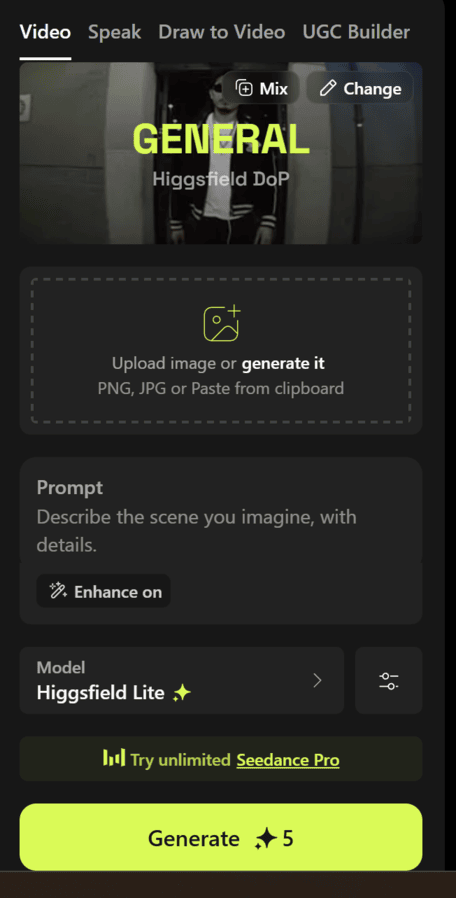
Cinema Studio 4.0 is where Higgsfield becomes more than a model buffet. You can direct by genre, camera movement, lens, focal length, tempo, cast, and location. Montage Pacing asks whether a sequence should feel chaotic, dynamic, calm, or like a single shot. AI Cast and reusable locations aim to keep the same people, clothes, weather, and streets across scenes. Team members can co-direct inside a shared project instead of swapping prompts in a chat thread.
The current pitch includes native 4K and generations up to one minute. Those are useful ceilings, not promises that every minute will survive the edit. Generative video still produces drifting faces, odd props, and tiny physics crimes. One G2 reviewer, a VFX producer and filmmaker, praised the ability to try several models but noted that a setup could work five times and go strange on the sixth. That is the honest rhythm of the category: generate, inspect, reroll, cut.
The supporting tools matter just as much. Soul ID and AI Cast give recurring faces a home. Canvas turns a creative recipe into a reusable node graph: prompt to image, image to video, then branches for alternate crops or styles. Marketing Studio can pull a product, logo, colors, and images from a URL and assemble ad variants. Audio tools cover speech, voice changes, translation, and lip sync. Editor integrations bring generation into Premiere Pro, After Effects, and DaVinci Resolve, while MCP and CLI connections let an agent trigger work.
| Job | Higgsfield route | Watch for |
|---|---|---|
| Directed narrative shot | Cinema Studio with cast, location, lens, camera, genre, and pacing controls | Premium settings can make each retry expensive |
| Recurring spokesperson | Soul ID, AI Cast, lip sync, and translation | Consistency improves; it is not a continuity guarantee |
| Many ad variants | Marketing Studio, URL-to-ad, Canvas, and parallel agent sessions | Confirm brand claims and inspect every output |
| Targeted video remix | Genjutsu Motion Transfer or Object Swap | Current pricing scales with length and resolution |
The credit meter deserves its own close-up
Higgsfield sells Starter, Plus, and Ultra subscriptions, enterprise access, add-on credits, and temporary or model-specific Unlimited offers. Prices and allocations have changed often enough that a timeless number would be dishonest. Recent September 2026 company comparisons put entry pricing around $9 to $15 per month, Plus near $49, and Ultra near $129, with annual offers producing other figures. Treat the live checkout as the contract and take a screenshot before paying.
“Unlimited” requires the most careful reading. Higgsfield’s own July explainer says eligible generations run only on the main website with the Unlimited toggle on. Canvas, MCP, CLI, Supercomputer, Marketing Studio, and Shorts Studio still use credits. The Unlimited lane is a shared queue with one image, one video, and one audio generation at a time. Credit generations use the faster priority lane. This distinction explains why one customer can call the offer generous while another reports waiting hours.
Public reviews mirror that split. Trustpilot showed a 4.0 score from more than 4,000 reviews in early September 2026. Its summary praised the approachable interface and range of creative options, while flagging expired credits, renewals, cancellation friction, and uneven support. Recent individual reviews range from creators calling the platform central to their work to subscribers angry about low-priority queues and fast credit burn. Reddit is rougher and more suspicious, though some users there say Cinema Studio’s controls and consolidated workflow keep them subscribed.
The lesson is not that either camp is wrong. A marketer shipping paid ads values a usable winner more than a cheap attempt. A hobbyist values play time and predictable limits. The same queue can feel like economical background rendering to one and a broken promise to the other.
What the $500,000 movie actually proved
In 2026, Higgsfield made Hell Grind, a 95-minute AI-generated feature, in about two weeks and screened it at the Marché du Film, the Cannes market rather than the festival competition. The Wall Street Journal reported a $500,000 budget, with 80 percent spent on compute. Around 100 hours of footage were generated and edited down. That ratio is a better product demo than any cherry-picked clip.
Business Insider’s Dan Whateley found a brief emotional spark before synchronized laughter and other synthetic tells broke the spell. The script was mostly human-written because, Mashrabov said, the AI-written filler was noticeably weaker. So the film did not announce the death of film crews. It showed that a small team can now attempt a visual scale once fenced off by money, while paying for that freedom in selection, compute, and taste.
A smart first week with Higgsfield
- Choose one deliverable: a six-shot product spot, a recurring character test, or three ad hooks. Do not tour every model.
- Use Academy lessons and included practice generations to learn Cinema Studio without spending your main balance.
- Create low-cost drafts first. Move only selected shots into higher resolution or premium engines.
- Record the credit quote before every generation. After ten attempts, calculate cost per usable shot.
- Test cancellation, renewal date, credit expiration, and Unlimited eligibility before your refund window closes.
Compare Higgsfield with the native home of the model you use most. Kling-only creators should price Kling. Veo devotees should inspect Google Flow. Runway offers a mature editing environment, Krea is a clean multi-model playground, and LTX Studio leans into storyboarding and longer projects. Higgsfield wins when the connective tissue matters: one cast across models, camera direction, ad variants, shared assets, and an automation path. If you ignore that tissue, you may be paying a studio fee to rent one chair.
The final verdict is pleasantly unromantic. Higgsfield is a serious production toolkit with a restless release schedule, a lively creative culture, and a billing system that demands adult supervision. For a working creator with a weekly output target, it can replace a small stack of logins and turn elaborate ideas into testable footage. For a casual user, the breadth can become noise and the retries can eat the month. Bring a shot list, a budget, and enough skepticism to keep the green button from directing you.