Herman W. Lay looked at a job selling potato chips and decided there was no future in it. This was an unfortunate judgment for the future of his judgment, though an excellent opening for his biography. The young salesman needed work. Atlanta’s Barrett Potato Chip Company had work. He declined it anyway. A week later, with his prospects unimproved, he came back.
The second visit belongs near the beginning of any account of Lay. His name would end up on bags of chips, on university buildings, and in the founding history of PepsiCo. But the business began with a willingness to reconsider. There was no elegant revelation, no new invention waiting in a workshop. There was a product to deliver and a customer to persuade. Lay accepted the work he had thought beneath his ambitions, then spent decades enlarging it.
A customer across the street
Born in Charlotte in 1909, Lay grew up in Greenville, South Carolina. His father sold farm machinery, so the idea of earning a living through sales was already close to home. As a boy, Herman sold soft drinks and snacks from his front lawn, across from a baseball park. Before he had a corporate address, he had a useful location.
It is a small scene with a large amount of business inside it. Spectators wanted something to eat and drink; a boy could supply it without asking them to go far. The baseball game gathered the customers for him. The stand turned passing traffic into trade. Looking back at the beginnings of a familiar brand, it is tempting to make everything seem inevitable. A lawn opposite a ballpark is a more convincing explanation than destiny.
Sport also offered Lay a way into college. He attended Furman University on an athletic scholarship and played baseball and basketball. After about two years, he left to pursue sales. Furman would return to his life much later, in a different capacity: the former student would become a donor, an honorary degree recipient, and a name attached to a scholarship.
Leaving college did not provide a straight road to success. He worked for Sunshine Biscuits and lost that job during the Depression. He placed classified advertisements and wrote to prospective employers. The response that led him to Barrett brought an opportunity he initially dismissed. Even the person whose surname now makes a potato chip seem obvious once needed persuading about potato chips.
The route becomes the business
In 1932, Lay started a snack distribution business in Nashville, selling products made by Barrett in Atlanta. The early picture is wonderfully unceremonious: a salesman, a car, and chips. He crossed the South making deliveries from his vehicle. The work put him close to the people who decided whether the product deserved a place in their stores.
Distribution is an ungainly word for something quite intimate. A packet has to arrive somewhere a person can buy it. The customer can like the name and still leave empty-handed if the shelf is bare. Lay’s beginnings kept those two sides of the business together: the promise on the package and the practical act of getting it into the shop.
His recollection of the work emphasized ownership. The territory felt like his business. “This sense of independence kept me working,” he said. That is a modest sentence beside the size of the company that followed. It also offers a better explanation of his persistence than an invented childhood prophecy would. He had something whose improvement depended on his own effort.
“This sense of independence kept me working.”
Herman W. Lay, recalling his sales territory
The operation grew beyond one person’s rounds. Lay hired salesmen, extended the territory, and built an organization around repeat deliveries. A route could become several routes; several routes could support a warehouse. Each change made the business less dependent on how much one driver could carry or how many stops he could make in a day.
By 1939, Lay had acquired Barrett’s Atlanta and Memphis plants and established H. W. Lay & Company. Buying the manufacturer changed his relationship with the product. He was now responsible for what happened before the delivery car was loaded. A business that had started with selling someone else’s snacks had acquired the means to make its own.
- 1932NashvilleA snack route
- 1939AtlantaH. W. Lay & Co.
- 1961DallasFrito-Lay
- 1965PepsiCoFoods + beverages
Two surnames, years of acquaintance
Lay’s development ran alongside another snack business. In Texas, Charles Elmer Doolin had begun the Frito Company in 1932, the same year Lay started his Nashville operation. One business was associated with corn chips, the other with potato chips. The names would eventually be joined, but their commercial relationship came first.
In the mid-1940s, H. W. Lay & Company became a franchise manufacturer and distributor of Fritos in the Southeast. That arrangement matters because it gives the 1961 merger a history. These businesses had already worked together. Their combination grew out of a relationship involving products, territories, and the practical experience of putting another company’s name in front of customers.
There is a satisfying plainness to the eventual name, Frito-Lay. Both sides remained visible. A person could read the corporate sign and recognize the snacks. Lay became the combined company’s chief executive and later its chairman as well. His family moved to Dallas, making the merger a change of home as well as a change of organization.
The growing assortment also changed what a sales visit could accomplish. A company handling several kinds of snacks had more to offer than a single packet. Potato chips, corn chips, and pretzels could reach the customer through the same larger enterprise. The ingredients differed; the need to make products available remained familiar.
It is easy to let the merger swallow the earlier years in the telling. Yet the name Frito-Lay rested on businesses built separately, then connected through distribution before they were formally combined. Lay’s career rewards attention to those intermediate steps. A famous corporate event can conceal the long apprenticeship that made it possible.
The younger people at Pepsi
By 1965, Lay was chairman and chief executive of Frito-Lay. Donald M. Kendall was president and chief executive of Pepsi-Cola. Combining their companies would put snacks and beverages under the new name PepsiCo. Lay became its first chairman, while Kendall became CEO. The distinction is worth preserving: their partnership had two different jobs at the top.
At the time, Lay was 55 and Kendall was 43. Lay spoke warmly about Pepsi’s younger executives. “I need the association of younger people,” he said. There is something refreshing about a founder expressing that need aloud. A person who had built a business from deliveries could recognize that its next phase required other people’s energy and experience.
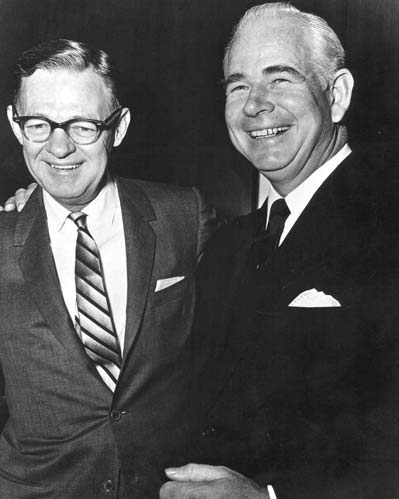
The attraction also involved geography. Pepsi had a substantial international presence. Frito-Lay’s snack business was much less widely distributed abroad. For Lay, the combination offered access to an organization with experience beyond the territory his own company had built. The old question of reaching customers had acquired a different map.
Snacks and soft drinks were a readily understandable pairing. The organizational challenge was larger than the shopping occasion, however. A product people enjoyed in one market still needed an operation capable of selling it in another. PepsiCo joined businesses with different histories and capabilities. The merger supplied a structure in which those capabilities could be used together.
“I need the association of younger people.”
Herman W. Lay, 1965
Lay’s job changed again in 1971, when Kendall succeeded him as chairman. Lay became chairman of PepsiCo’s executive committee and continued working for the company before retiring in 1980. The progression complicates the picture of a founder forever occupying the same chair. His name stayed on the chips while his responsibilities moved through several forms.
The name outside the grocery aisle
Lay’s association with Furman survived his short time as a student. The university named him its first Alumnus of the Year in 1965 and awarded him an honorary Doctor of Laws in 1967. The Physical Activities Center bears his name, connecting a former scholarship athlete to the place where later students would play and train.
The scholarship in his name gives that connection another use. Recognition on a building is visible; help with the cost of attending university works more quietly. Together they make an interesting counterpart to the brand. In one setting, Lay’s name accompanies a purchase. In the other, it accompanies an opportunity to study.
He also supported private enterprise education. His donation helped make possible the Association of Private Enterprise Education, which later established a memorial award in his name. His interest in business continued beyond operating a business: he supported institutions concerned with how enterprise was understood and taught.
Dallas offers another view of the family’s giving. The Lay Family Garden at the Arboretum occupies 2.2 acres, with planting and water features. At the Meyerson Symphony Center, the Herman W. and Amelia H. Lay Family Concert Organ carries both spouses’ names. The instrument has 4,535 pipes. A surname familiar from something eaten between errands also belongs to something heard while sitting still.
Lay died in Dallas on December 6, 1982. His business story continued without him. In July 2026, PepsiCo marked the distance from his early car deliveries to a brand supplied by billions of pounds of potatoes each year. The scale is striking, but the opening remains small enough to picture without a chart.
A young salesman rejected a job. Then he returned, made deliveries, acquired plants, and worked with partners whose businesses changed his own. The second visit to Barrett deserves its place beside the mergers. It was the moment Lay allowed experience to correct his first opinion. For someone who spent his life asking customers to change their minds, that was a useful place to start.