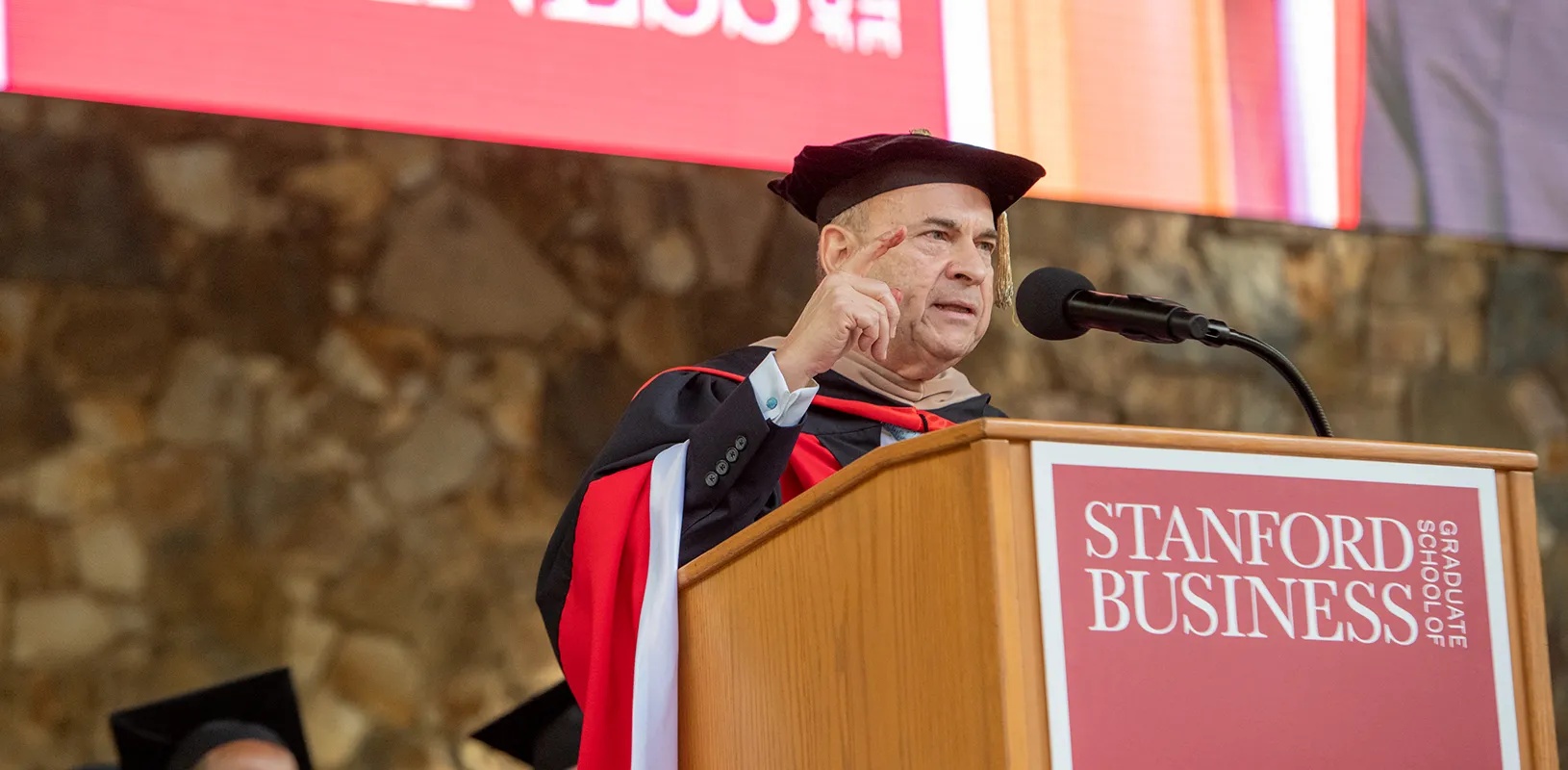
At Stanford’s business-school graduation in June 2023, Henry Fernandez had a household chore to recommend. The chairman and chief executive of MSCI, returning four decades after his own MBA, urged the graduates to do the dishes. Ambition had brought them this far. It would also leave a certain amount of washing up.
There was a business argument underneath the joke. A strategy acquires value through execution, including the repetitive work that rarely earns anyone a commencement invitation. Fernandez had come back to a school that helped him reconsider his future. His advice was cheerfully practical: prepare to keep working after the exciting part of having an idea has worn off.
That is a useful way into a career spent making financial information usable. MSCI’s name appears on indexes, risk models and research used by investors around the world. Fernandez’s own path involved a revolution, economics classrooms, diplomacy, Wall Street and entrepreneurial disappointments. The continuity is easier to see in retrospect. He has repeatedly had to imagine a future, then arrange the work needed to reach it.
A future that had to be rewritten
Fernandez was born in Mexico City and grew up in Nicaragua. His early education and working life already crossed borders: he studied economics at Georgetown University while serving as a diplomat at the Nicaraguan Embassy in Washington. He received his bachelor’s degree in 1979. It is an unusually literal way to combine international affairs with homework.
That same year, revolution in Nicaragua overturned his expectation of eventually making his life there. He has described becoming a political refugee and having to begin again in the United States. The point matters beyond the drama of an interrupted plan. A person can prepare diligently for a future that events remove from the menu.
He pursued doctoral studies in economics at Princeton before entering Stanford’s MBA program, graduating in 1983. These were different kinds of preparation: studying how economies behave, then studying how organizations operate within them. His eventual work would sit comfortably between the two, supplying investment professionals with ways to organize markets and examine the risks they were taking.
The institutional connection lasted. Stanford recognized him with its Excellence in Leadership Award in 2013, and he joined its Board of Trustees in 2016. His return as commencement speaker in 2023 brought the relationship full circle. The graduate who once needed a new direction was now addressing people trying to choose their own.
The education between the job titles
Fernandez joined Morgan Stanley in 1983. Over his time there, his assignments included corporate finance, mergers and acquisitions, mortgage finance, equity derivatives and emerging markets. That is a substantial tour of the machinery behind an investment decision. Each area supplies a different answer to the questions of what an asset is worth and what could go wrong.
His Morgan Stanley career came in two stretches, from 1983 to 1991 and from 1994 to 2007. Between them were entrepreneurial ventures. He founded Ferco Partners, a private equity investment firm in Mexico, and served as president of HispaniMedia. The experience gave his later leadership a history beyond promotions within one institution.
In talking about his career, he has acknowledged business ventures that failed. That admission gives the tidy executive biography some necessary friction. A list of appointments can make every step appear to have been the intended next step. Leaving, trying something and returning is a more recognizable account of how people actually learn what they can build.
The range also helps explain his emphasis on broad capabilities. His public advice to younger professionals includes learning enough about advanced technology to participate in the changes it brings. After working across several financial disciplines himself, he argues against defining a career so narrowly that the next useful opportunity becomes difficult to recognize.
First came the business. Then came independence.
Fernandez began heading the MSCI business in 1996 and became chief executive in 1998. The distinction is small on a timeline and useful in a life story. Leadership started before the title that would become attached to his name for decades. MSCI was then connected to Morgan Stanley and Capital Group; its future as an independent public company still lay ahead.
The construction happened in stages. MSCI acquired Barra in 2004, adding equity-risk capabilities alongside its index business. Its initial public offering followed in 2007, the year Fernandez became chairman. The formal separation from Morgan Stanley was completed in 2009. An IPO supplies a memorable date. Building the company on either side of it takes rather longer.
- 1996Heads MSCI business
- 1998Becomes CEO
- 2004Barra acquisition
- 2007IPO; becomes chairman
- 2009Separation completed
- 2010RiskMetrics acquisition
The 2010 acquisition of RiskMetrics extended the company’s capabilities again. Subsequent purchases included IPD in real estate and other providers of investment information. The pattern matters more than a catalogue of transactions: the business was developing several ways to help investors examine portfolios, measure performance and understand exposure.
These are related tasks, though they are hardly interchangeable. An index provides a defined view of a market. A risk model helps examine the forces affecting a portfolio. Performance analysis asks how the result came about. For the investor, the usefulness lies in being able to move between those questions without losing the thread.
For clients, each additional tool also raises an expectation of consistency. A pension fund may need to compare a result with a benchmark, investigate its sources of risk and explain its choices to a board. Those tasks can arrive in the same meeting. The commercial opportunity lies in understanding the working day behind the purchase, as well as the product being purchased.
Fernandez’s achievement has therefore involved organizational work as much as financial invention. Buying a capability is one decision; making it useful alongside the capabilities already inside the company is another. His long tenure has made him responsible for both the accumulation and the combination.
Why so many ways to count the market?
Asked by Barron’s interviewer Andy Serwer why MSCI calculated roughly 250,000 indexes from around 10,000 internationally investable equity securities, Fernandez reached for the wardrobe. A limited set of primary colors can produce a great many shades. Stocks, in his analogy, can be combined into an enormous variety of market views.
The explanation is more accessible than the arithmetic initially sounds. One investor wants exposure to a country, another to an industry, another to a particular combination of characteristics. A common underlying set of companies can support many different selections. The demand comes from the questions investors bring to it.
There is something revealing about that choice of analogy. Rather than make the numbers more imposing, Fernandez made the operation easier to picture. Finance has plenty of impressive nouns. A shirt in a different shade of blue can sometimes do more explanatory work.
A common set of securities → different selections and weights → different views of the market.
Conceptual illustration of Fernandez’s colors analogy; not a performance chart.The next difficult places to measure
Private markets now occupy an important place in Fernandez’s agenda. On July 9, 2026, MSCI and UBS announced a partnership to expand an AI-powered platform for private-market investing. The proposed combination brought MSCI’s independent data and models together with UBS’s alternatives experience and knowledge of its clients.
The practical problem is fragmented information. The partnership is intended to connect fund discovery, portfolio management, analytics and benchmarking, with UBS also becoming an early adopter. Fernandez framed the ambition as bringing private-market investors more of the rigor and accessibility they expect in public markets. The announcement describes an undertaking, with its value still dependent on delivery.
Climate risk presents a related measurement challenge. MSCI completed its acquisition of First Street on August 3, 2026. The company described the acquired business as providing physics-based climate-risk information across more than 2.4 billion structures worldwide. That brings the discussion down from a global trend to the location of a particular asset.
A building has an address as well as a valuation. First Street’s models examine hazards and their potential financial consequences, including damage and business interruption. Integrating that information into investment workflows is a concrete expression of Fernandez’s broader interest in risks that a conventional financial view may overlook.
His inclusion in the 2025 TIME100 Climate list recognized this part of his work. In his accompanying comments, he connected climate policy with economic outcomes and emphasized the role of investment in reallocating capital. It is an argument made in the language of his profession: financial decisions need to account for a changing physical world.
The dishes are still waiting
For all the discussion of AI, private assets and global portfolios, Fernandez’s most compact advice remains domestic. His Stanford reminder has the advantage of being difficult to mistake for a promise of effortless success.
“Grunt work is the foundation of all successful businesses.”
Henry Fernandez · Stanford GSB, 2023
His career supplies several versions of that proposition. An education required years. Independence required stages. Acquisitions required integration. A new platform requires adoption. Optimism, in this account, makes room for patient effort rather than dispensing with it. The future may offer opportunities; someone still has to make the information useful.
There is a pleasing modesty in ending a business-school address with the washing up. Graduates are invited to picture the organizations they might lead and the lives they might change, then reminded of a task they can perform that evening. Fernandez’s larger ambitions survive the joke. They simply acquire a schedule.