Douglas Valenti was helping look for a chief executive when the search took a personal turn. A venture investor at Rosewood, he found himself wanting the operating job. “It dawned on me I didn’t want to own a piece,” he later explained, describing his impatience with holding a fragment of somebody else’s ecommerce venture. The candidate he had in mind was himself.
It is an awkward discovery for someone sitting on the investor’s side of the table. Advising a company leaves room to go home and think about another company. Running it means the unanswered question is waiting when you return. Valenti chose the longer assignment. He founded QuinStreet in 1999, became its CEO that July, and remains in the job more than a quarter-century later.
Today, the Foster City business works in the space between a person looking for something and a business willing to pay to meet that person. Insurance, loans, credit cards, a contractor for the house: these are decisions with consequences beyond the browser window. Valenti has built his working life around making those introductions measurable. The career that brought him there took a rather indirect route.
A résumé with several engines
Before the internet company came industrial engineering at Georgia Tech. Valenti graduated with highest honors and was named the university’s Outstanding Senior in 1982. He also completed the Navy’s postgraduate nuclear engineering program. His military service included five years as a nuclear submarine officer, and he earned the gold dolphins of a qualified submarine warfare specialist.
Those credentials make a striking opening line at a business dinner. They also deserve to stand on their own. A submarine is a specific professional environment, not a convenient explanation for every decision an executive later makes. Valenti’s subsequent career ranged well beyond engineering: three years in management at Procter & Gamble, an MBA at Stanford, three years at McKinsey, and five years at Rosewood Capital.
At Stanford’s Graduate School of Business, he was an Arjay Miller Scholar. At McKinsey, he worked as a strategy consultant and engagement manager. At Rosewood, he became a partner. The sequence put him on several sides of the business conversation before he started QuinStreet: managing, advising, investing, and then accepting responsibility for the whole enterprise.
There is a pleasingly earthbound detail in the investment chapter. In 1997, Valenti was quoted discussing Peet’s prospects in a coffee market dominated by Starbucks. He thought the company had a credible chance to become a strong national number two. Before spending decades arranging digital introductions, he was considering where Americans might buy their next cup.
- Engineering & NavyGeorgia Tech, nuclear training, submarine service
- Management & strategyProcter & Gamble, Stanford MBA, McKinsey
- Investment & ownershipRosewood Capital, then QuinStreet in 1999
The business of the next click
QuinStreet’s business becomes easier to understand when you begin with a modest domestic problem. Someone needs a roof repaired. A contractor wants customers in the area it serves. The homeowner needs a useful choice; the contractor needs an inquiry worth answering. The company operates marketplaces designed to bring those interests together.
The commercial units are concrete. QuinStreet lists clicks, inquiries, calls, completed applications and sales among its products. A click takes a visitor to a client’s website. An inquiry asks for information or contact. Each moves the encounter a little further along. That is a less glamorous vocabulary than advertising usually permits itself, but it does have the advantage of describing things a customer can actually do.
The matching relies on segmentation, optimization and accumulated campaign experience. For Valenti, this creates an operating problem as much as a marketing one. Media must reach people, technology must sort opportunities, and clients must find enough value in the results to keep buying. The marketplace needs both sides to show up again.
In 2010, QuinStreet listed on Nasdaq as QNST. A public listing added another audience for the work: shareholders expecting regular explanations of revenue, costs and prospects. Valenti had already been chairman since March 2004. The founder who volunteered for the operating seat now had a continuing obligation to explain how the machine was running.
A meeting with room for questions
A photograph from a Modernize office visit provides a less formal view of that job. Valenti stands near two large screens, speaking to colleagues gathered around tables and a sofa. Remote participants fill a screen behind him. Someone has a laptop open. It looks like a working meeting, complete with the practical difficulty of finding somewhere to put all the chairs.
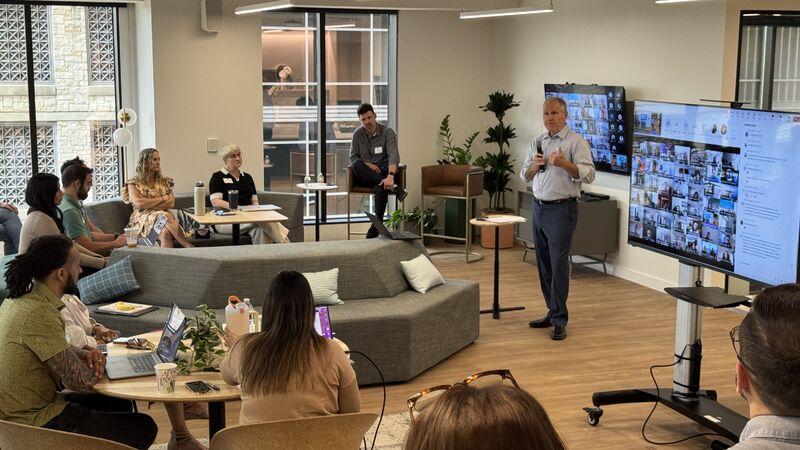
Jeffrey Barnes, who shared the photograph, described Valenti as a longtime champion of performance, high standards and open communication. He recalled Valenti explaining that values provide a base from which people can do the difficult work of creating business. The emphasis falls on what follows the statement of values: people still have to go out and do the work.
Another account gives that access a more routine form. In 2021, Modernize’s description of onboarding said new hires would have a lunch meeting with Valenti to learn about his background and connect personally. Executive lunch-and-learn sessions also gave employees a chance to hear about markets and ask questions. A corporate organization chart is a rather dry introduction to the person at the top. Lunch offers better possibilities.
There is also a sharper managerial instruction. A 2018 case study described Valenti asking QuinStreet to ensure it worked on the right things. The resulting discussion concerned how teams coordinated projects and connected engineering efforts with strategic objectives. It is a small phrase with considerable administrative weight. Every business has work available. The scarce item is agreement about which work deserves the next hour.
Buying a bigger workshop
Valenti’s long tenure has included changing what QuinStreet chooses to own. In July 2020, the company announced the acquisition of Modernize, establishing it as the flagship brand for home services. The stated consideration was $67.5 million in cash and notes, subject to closing adjustments. Modernize brought experience connecting homeowners with contractors in trades including windows, roofing, siding and air conditioning.
That purchase was accompanied by a reduction elsewhere. Across fiscal 2020 and the first quarter of fiscal 2021, QuinStreet divested businesses including its education and B2B technology client verticals and its mortgage business. Its reporting structure settled around financial services and home services. The founder’s job involved deciding which opportunities belonged together and which should leave.
These decisions give the longevity some texture. Twenty-seven years at the same company does not mean twenty-seven years supervising an identical collection of assets. An executive can stay in the chair while substantially changing the work in front of it. For Valenti, acquisitions and divestitures became ways of altering where the company concentrated its people, technology and capital.
In January 2026, QuinStreet announced the closing of its HomeBuddy acquisition. The stated terms included $115 million in cash at closing and $75 million in payments over four years, subject to adjustments. HomeBuddy was to join Modernize, adding products, media and client relationships. The company expected the purchase to contribute at least $30 million in adjusted EBITDA in its first twelve months. That figure was an expectation, with the integration still to be delivered.
Every business has work available. The scarce item is agreement about which work deserves the next hour.
THE PROBLEM OF PRIORITIES
The numbers still get a vote
The results complicate any temptation to make this a frictionless founder story. In fiscal 2024, QuinStreet recorded $613.5 million in revenue and a GAAP net loss of $31.3 million. Adjusted EBITDA was $20.4 million. Valenti was describing a recovery in auto insurance demand, with the company working to expand media supply to meet it. Even a business built around measurable results must wait for customers’ budgets to move.
Two fiscal years later, the picture had changed. For fiscal 2026, QuinStreet reported approximately $1.3 billion in revenue, up 18%, and GAAP net income of $81.2 million. Adjusted EBITDA reached $112.5 million. The adjusted measure removes certain expenses and other items; it is distinct from net income. Both appear in the company’s account of the year, and they answer different questions.
Annual revenue, rounded · up 18% year over year
The June quarter’s revenue also shows the shape of the business Valenti now leads. Financial services contributed $232.3 million, about 62% of the total. Home services supplied $141.6 million, about 38%. The contractor introduction had become a substantial counterpart to the financial-products marketplace.
Quarter ended June 30, 2026. Percentages rounded.
Still taking the operating job
On the August 2026 earnings call, Valenti discussed AI in decidedly practical settings: coding, advertising creative, consumer interfaces and contact centers. He described productivity improvements and the use of AI to help qualify consumers before a representative became involved. The interesting test is how those applications change the work and the economics, something his company will have to keep demonstrating.
Management’s initial fiscal 2027 outlook called for revenue between $1.45 billion and $1.55 billion. Valenti also outlined further margin ambitions and continued acquisition activity. These were plans for the coming year, not accomplished results. For a founder still running the company, the distinction keeps the job usefully unfinished.
The career began with engineering, passed through consumer brands and investment meetings, and reached a moment when choosing another CEO no longer satisfied him. Decades later, the work has grown to include contractor marketplaces, insurance budgets and new software tools. The next meeting still requires an explanation of what matters and what happens next. Valenti continues to be the person expected to give it.