The first thing that failed was the website. Then the second website failed, too. James Clarke had paid deposits to developers who went out of business before delivering. For a young company trying to reach customers online during the dot-com wreckage, this was an expensive way to acquire nothing. The third attempt began with a different bargain: the developer would get paid when the website generated a sale.
- The business: buying guides, marketing campaigns and sales teams working together.
- The customer: brands that need buyers, and consumers trying to choose.
- The useful lesson: agree on the outcome before buying the activity.
Clarke founded Clearlink in 2001. His deal with Odyssey Web helped get the business online; he later acquired the developer. Today, the company connects consumer publications with performance marketing and sales operations. The founding problem is still recognizable. A brand can buy attention by the truckload and remain thoroughly disappointed when nobody buys anything.
01 / The guide has somewhere to go
Consider the ordinary misery of choosing an internet provider. Availability changes by address. Prices need interpreting. The fast plan may be unnecessary; the cheap plan may be inadequate. Clearlink owns HighSpeedInternet.com, one of the publications that helps people untangle those choices. It also owns Reviews.org, CableTV.com and WhistleOut. Elsewhere in the portfolio, Move.org tackles moving, SafeWise covers security, and The Penny Hoarder addresses personal finance.
These subjects share a useful characteristic: the reader has a decision to make. Clearlink’s expertise sits where research becomes action. Its publications offer content and comparison tools; its marketers work across organic search, paid media and automated campaigns; its agents can help complete a purchase. For a consumer, the immediate benefit is a shorter route through a confusing category. For a partner, it is access to someone already considering a purchase.
Sales feedback informs the next campaign ↵
That combination places Clearlink between a publisher, an agency and an outsourced sales operation. A brand could hire separate specialists for each job or build the whole thing internally. Clearlink’s pitch is that bringing the handoffs together makes them easier to measure and improve. The mechanism matters more than the label: a conversation with a customer can reveal something that a page-view count never will.
02 / Change what gets paid
In his account of the early website deal, Clarke put the offer plainly: “I’m not going to pay upfront, but I’ll pay you for every sale you generate through the website you build.” That sentence explains the company’s attraction to performance arrangements. It gives the supplier a financial reason to care about what happens after delivery.
Agree on the outcome before buying the activity.THE LESSON TO BORROW
Clearlink describes its performance model as getting paid for customers created. That makes conversion a commercial concern, rather than a decorative number in a presentation. But the company sells several kinds of engagement. Its agency-of-record offer starts with a free audit, moves into paid implementation, and prefers a six-month initial term. The sales center is optional. Buyers should distinguish those terms from the outcome-based pitch.
The practical shopping list is substantial: SEO, paid media, content, conversion optimization, analytics, engineering and digital PR. Clearlink Social adds listening, content and community management. The sales operation serves residential, business and Medicare categories, using training, speech analysis and reporting to coach agents. The customer buys specialist work coordinated around acquisition, rather than a software subscription with a standard checkout price.
03 / A large number needs a small footnote
Clearlink’s homepage reports 300 million annual site visitors, 29 million leads and 315,000 closed sales. Those are company-reported activity measures. They describe different things and should not be divided into a supposed companywide conversion rate. A reader researching a service, a lead passed to a partner and a sale handled by an agent are different units of work.
Company-reported homepage figures. Separate measures, not a matched funnel.
The more revealing question is whether a partner can acquire customers economically. In a Frontier Business case study, Clearlink reports cutting paid-search spending by 86% while increasing sales by 41%. It is a vendor’s account, rather than an independent experiment. Still, it identifies the right test: more purchases for less acquisition spending. Impressions alone would not tell that story.
Clearlink has also been an acquisition target. Pamlico Capital took a majority stake in 2011. In 2016, SYKES signed an agreement to acquire Clearlink for approximately $207 million in cash consideration, subject to adjustments. That was a purchase price for the business, not its revenue or an advertising budget. Clarke returned through a 2022 investment and management partnership with Sitel, now known as Foundever.
04 / People still answer the phone
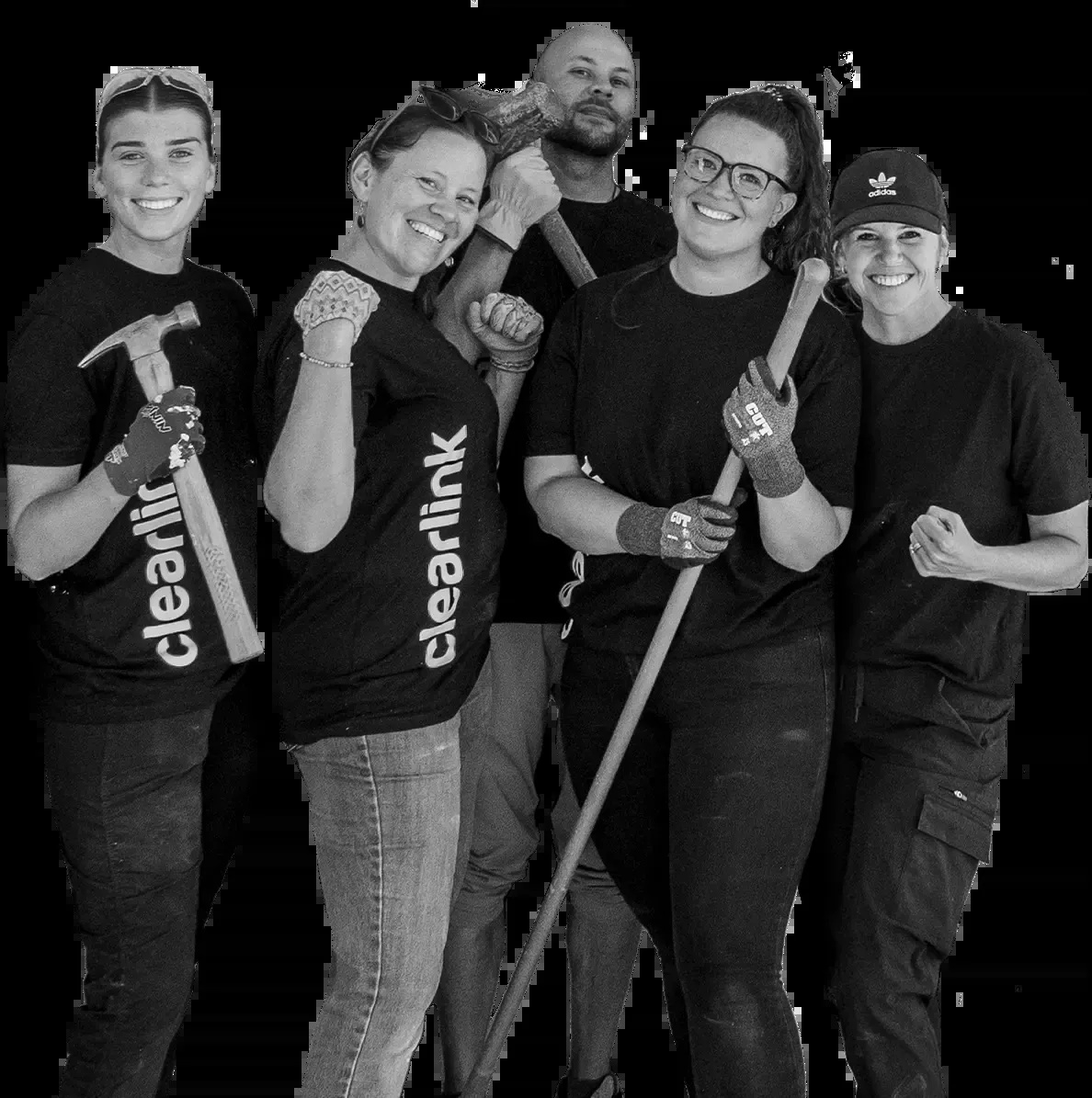
The human component makes the company more complicated than a collection of websites. Clearlink’s culture page features internal career changes, employee development and community service. One employee describes moving from sales into compliance, recruiting and forecasting before leading recruiting and learning. That is useful institutional knowledge for a business whose work requires understanding both customers and the people speaking to them.
There is a harder chapter, too. Clarke’s 2023 return-to-office town hall drew criticism after he praised sacrifices including an employee selling the family dog. The episode exposed a gap between leadership’s message and how it landed. It belongs alongside the company’s stated values, not outside the account. It also belongs to a previous leadership period.
05 / What happens when the answer replaces the click?
In October 2025, Foundever appointed Mark Larkin CEO and Marc DeBevoise board chair. Its announcement explicitly linked their digital media experience to AI-driven changes in search and discovery. For a business built partly on helping people find answers, that is a direct challenge: an answer delivered inside a search engine can leave the publisher without the visit.
The logic of Clearlink’s model depends on access to prospective buyers, trustworthy guidance, trackable outcomes and enough value in a sale to fund acquisition. Thin margins, weak attribution or dependence on a single discovery channel make the arrangement harder. The part another business can copy is simpler than assembling a media portfolio: follow a customer past the click, find the broken handoff, and make somebody responsible for fixing it.