A scientist walks into a marketing meeting carrying a deck. The deck contains the mechanism, the validation data, the product architecture and a diagram with twelve arrows. Everyone around the table understands that the science is important. Nobody has yet said what the communication is supposed to change. This small confusion - mistaking information for direction - is the territory HDMZ has chosen to occupy.
HDMZ is a Chicago-based, privately held communications agency focused on life sciences. It works with biotechnology, biopharma, diagnostics, medical-device, clinical-development and digital-health organizations. Its offer stretches from naming and identity to public relations, scientific content, paid media, analytics, websites and enterprise integrations. That range can sound like the familiar agency buffet. The interesting part is why the dishes ended up on one menu.
The merger hidden inside four letters
The company traces its roots to 1936, long before anyone needed to optimize a clinical-data hub for a phone. A second strand began in 1994, when Zoomedia started building interactive communications for life-science companies. In 2014, Harris D. McKinney acquired Zoomedia after a mutual client introduced the firms. HDM understood brand and marketing communications. Zoomedia understood digital systems. The new name, HDMZ, retained a piece of each.
This history explains the agency better than a service list. A scientific claim may begin in a paper, reappear in a sales conversation, surface in a search result and end inside a clinician's decision. The website cannot be treated as a display case if it also needs to connect a content system, customer database, analytics layer and compliance tooling. Likewise, the technology cannot rescue a muddled proposition. HDMZ's niche is the seam between the argument and the machinery that carries it.
A brief is often a premature answer
In 2025, the agency looked back at what its most productive and enjoyable client relationships had in common. It found three conditions: the client had ambition beyond an incremental gain; the work was tied to a clear business objective; and agency and client agreed early on what success meant. This was the internal “aha” that pushed HDMZ to formalize what it calls Future State Strategy.
The framework is deliberately backward. First, name the future state: perhaps entering a market, creating a category, defending leadership or attracting investment. Second, audit the present across brand, content, PR and digital operations. Third, map the gap and choose the actions that close it. A press release is no longer commissioned because a launch needs a press release. It is commissioned only if it helps produce the agreed future.
in three moves
Turn “we need a campaign” into a business outcome that people can recognize and measure.
Inspect today's story, visibility, platforms and internal constraints without pretending they are separate.
Select the smallest coordinated set of actions that can move the organization from here to there.
There is a sales advantage in this, naturally. An agency invited to define the problem is more useful - and harder to replace - than one asked to produce a banner. But the method also contains a restraint many integrated firms avoid: sometimes HDMZ's role may be to draw the map and let someone else drive. The test is not whether every department gets work. It is whether each assignment can be traced to the destination.
What the portfolio actually shows
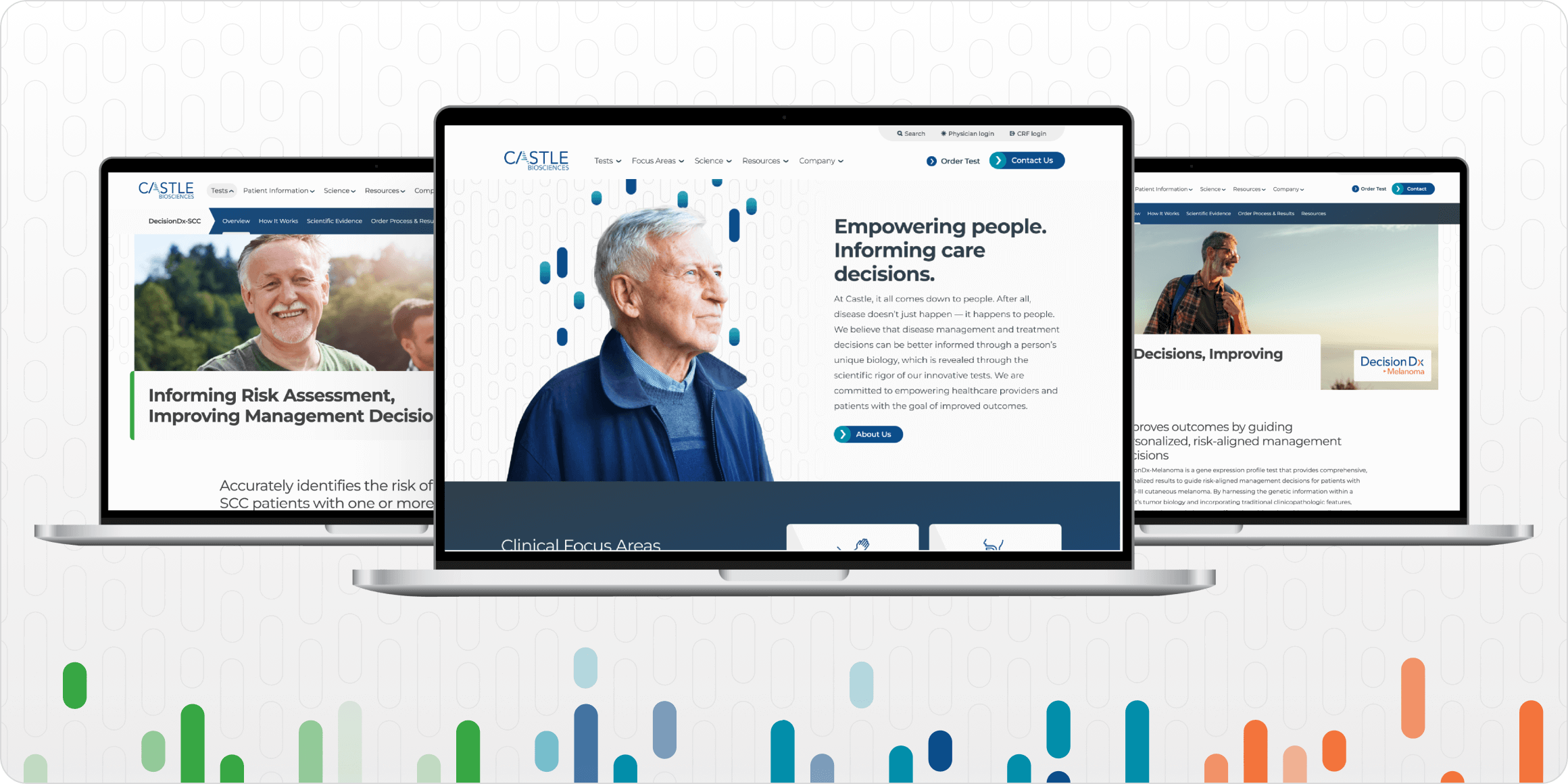
For Medtronic, HDMZ built mobile-friendly content hubs that turned clinical data into dynamic material and paired it with video cases from medical experts. For Thermo Fisher Scientific, the agency supported the launch of the Oncomine Dx Express test with campaign creative, branding, messaging and advertising collateral. For Castle Biosciences, it refreshed the identity of dermatologic tests, rebuilt the website and extended the system into paid, earned, social, organic and conference channels.
Medtronic's clinical data moved into responsive content hubs with expert video, designed to make existing assets work harder.
Thermo Fisher's diagnostic launch joined positioning, creative, messaging and advertising around one product argument.
Castle's identity traveled through websites, clinician and patient media, brochures and a conference environment.
The Gilead Sciences Research Scholars project reveals the technical end of the range. HDMZ developed a portal that manages applications from submission through review and award selection across multiple therapeutic programs. For Endologix, the work started with a corporate identity campaign after the medical-device company returned to private ownership, then expanded to the launch of its DETOUR System. These are not identical outputs. They are examples of communication following the operating problem.
Reported company growth / index
The people who can spot a plausible mistake
Specialization matters most when an error sounds reasonable. HDMZ's leadership includes communicators with experience in molecular biology, crystallography, pathogenic genetics, biophysics and immunology, alongside specialists in media, creative, operations and cloud infrastructure. That mix helps the agency catch the phrase that is elegant but scientifically wrong, the data point that needs context, or the digital promise that the underlying system cannot support.
The culture is distributed but periodically physical. HDMZ maintains its Wacker Drive office while employing people across the United States and internationally. Its annual Chicago summit pulls the group together for client roundtables, skills sessions and, by the agency's own photographic evidence, karaoke. Published values include passion for science, putting the team first, proactive problem-solving, client-focused outcomes and curiosity. In 2021 the company said it received Great Place to Work certification.

Customers range from academic spinouts trying to interest investors to global names such as Agilent, Beckman Coulter, Gilead, Medtronic, New England Biolabs and Thermo Fisher Scientific. The business is a conventional professional-services model - projects and ongoing agency relationships - with unusually broad delivery. Pricing is private. The competitive set includes specialist healthcare agencies such as Real Chemistry, EVERSANA INTOUCH, Klick Health, CG Life and Supreme Group, as well as the familiar alternative of hiring separate brand, PR, media and development firms.
The part worth borrowing
HDMZ's method is most useful when the challenge crosses audiences or functions: a diagnostic needs clinicians to understand the evidence, patients to recognize the relevance, investors to see a market and a digital system to serve each without contradiction. It is less useful when the goal is already narrow, the deliverable truly is standalone, or the organization will not align on a destination. Backward planning cannot compensate for five executives privately choosing five different futures.
- Write the future state as an observable business condition, not a marketing activity.
- List the audiences whose decisions must change for that condition to become real.
- Audit the current story, channels, systems and evidence for the gaps that block those decisions.
- Commission only the work that closes a named gap, and agree on measurement before production begins.
The charm of “Don't send us a brief” is that it sounds rebellious. The discipline behind it is less theatrical. It asks a client to postpone the comforting certainty of a deliverable and sit, briefly, with the harder question of change. For a company built to communicate complicated science, that may be HDMZ's cleanest piece of communication: the request to decide where you are going before asking for directions.
Keep exploring