In the spring of 2020, America briefly became a nation of amateur surface scientists. People wiped cereal boxes. They debated bleach. A trip to the supermarket could produce six pieces of cleaning advice, four of them contradictory. For the American Cleaning Institute, the trade group for a $59 billion industry, this was a communications problem with unusually literal consequences. BRG Communications began where a sensible scientist would: it looked for the gaps in what people actually knew.
The Alexandria, Virginia, agency commissioned national research, then built different forms of guidance for businesses, schools, childcare centers, colleges and households. It put experts in the news. It recruited creators who could speak to specific communities. It did not ask one press release to carry the whole public-health burden. The campaign produced more than 2.8 billion impressions across 2,475 placements, and the institute's website recorded 25 percent year-over-year growth.
Those figures are useful, but the more revealing detail is structural. BRG was not selling publicity as an ornamental layer placed on top of expertise. It was selling translation: the work of finding a consequential fact, locating the person who needs it, and removing enough friction that the person might do something next.
The narrow lane that kept getting wider
Jane Barwis founded BRG in 2001 after more than 15 years at communications firms including Ketchum and Hager Sharp. Her early description of the company rested on talent, flexibility and “uncommon performance.” The phrase is broad. The client list that followed is not. Medtronic. The Heart Rhythm Society. The American Diabetes Association. Aetna Foundation. Inova. The American College of Preventive Medicine. The National Sleep Foundation.
BRG calls its platform “Communications for Better Living.” Corporate mottos are usually wallpaper, but this one became a filter. The agency concentrated on health, science, safety, wellness and social impact - fields where a technically correct message can still be practically useless. A cardiology abstract does not arrive pre-shaped for a local television segment. Preventive medicine does not become interesting because a committee says it should. A warning about laundry packets must compete with everything else on a parent's phone.
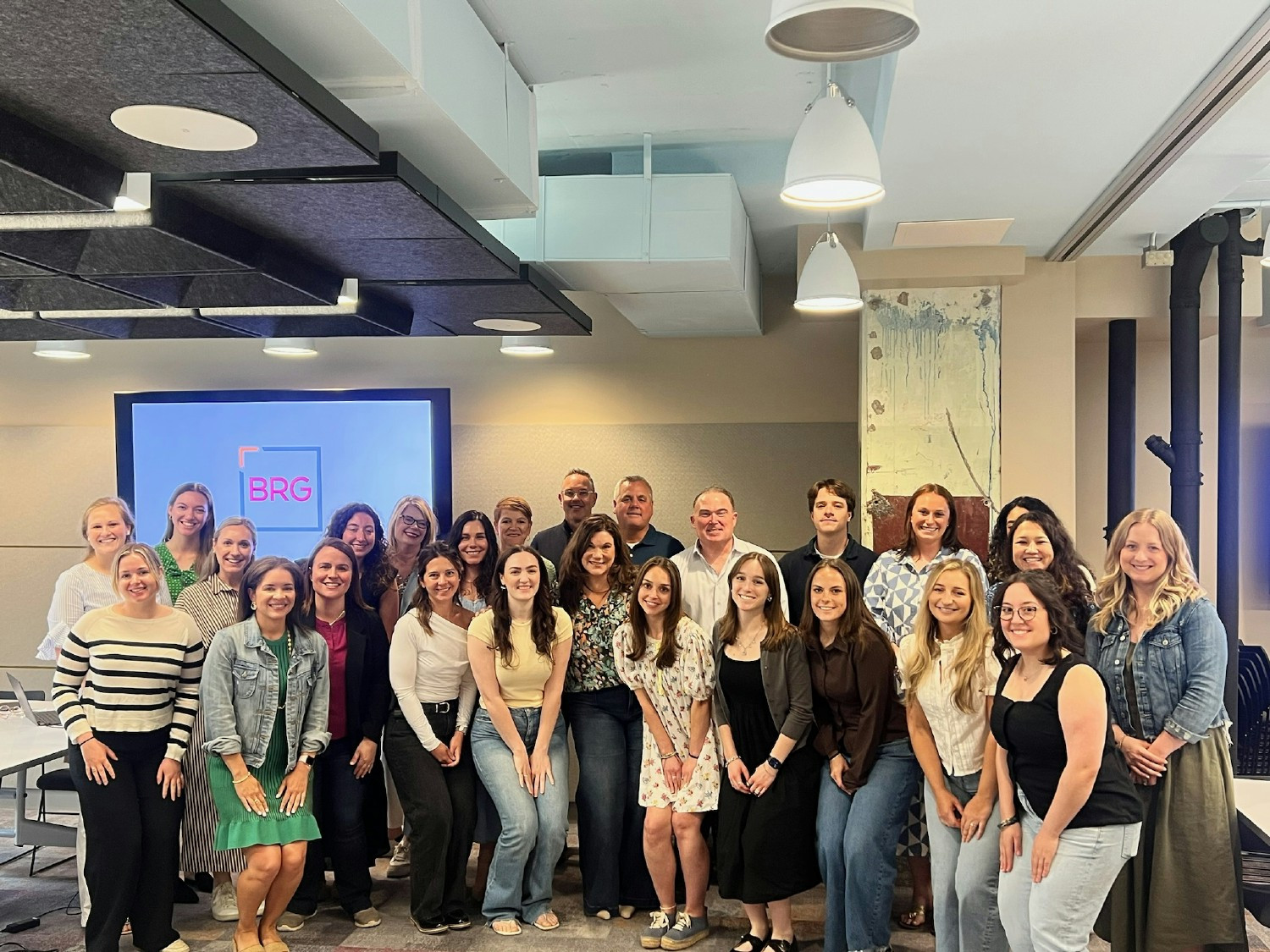
This focus tells us where BRG fits. It is smaller than the global health-agency networks and broader than a specialist media-relations shop. It offers planning, research, brand strategy, thought leadership, earned media, influencer engagement, social and digital marketing, content and design. The customer is usually an organization with real expertise and a translation problem: a medical society with new data, a nonprofit with a behavior to change, a device maker with an approval to explain, or a foundation trying to turn a large pledge into local participation.
First the evidence. Then the messenger.
The recurring BRG method has four moves. Research replaces assumption. A message is made specific enough to survive contact with a busy audience. Credible messengers - physicians, association members, patients, creators or executives - carry it. Then channels are assembled around the behavior the campaign wants, rather than around the agency's favorite tactic.
For the American College of Preventive Medicine, that meant building a network of more than 100 ambassadors. For the cleaning institute, it meant more than 80 influencers and 100 social activations, from parenting content about laundry-packet storage to campus hygiene videos. For Medtronic, it meant pairing FDA and data milestones with patient stories, securing hundreds of placements and carrying findings from a scientific meeting to an audience of nearly 13,000 healthcare professionals.
The most expansive example came from outside conventional healthcare. BRG helped the Walmart Foundation explain a $2 billion anti-hunger commitment through national media, stores and Facebook. The work generated more than 1,500 placements and activated consumers in more than 200 communities. By the initiative's end, Walmart and its foundation reported donations of 1.58 billion pounds of food - almost half a billion pounds beyond the original commitment - plus $260 million for hunger relief.
The copyable part is not the scale. It is the sequence. Start with the knowledge or motivation gap. Give the campaign an action a person can picture. Choose messengers for trust, not merely reach. Use channels in combination. Measure the movement after attention: a safer practice, a site visit, a donation, a physician conversation, a community vote.
What failed first when the rooms went dark
COVID-19 removed one of medical communications' oldest pieces of infrastructure: the conference hall. Scientific sessions for the Heart Rhythm Society, the Society for Cardiovascular Angiography and Interventions and Digestive Disease Week moved online. The physical press room failed first. BRG shifted interviews and meeting publicity to virtual platforms while helping clients decide which non-COVID stories could still be told without sounding oblivious.
That episode sharpened a larger change. Earned media remained valuable, but it could no longer be the only engine. Audiences were finding expert information through search, newsletters, social feeds, podcasts and self-education long before speaking with an organization. The agency needed more owned-content depth.
A small acquisition with a legible purpose
In January 2025, after five consecutive years of double-digit revenue growth, BRG acquired Right Source Marketing, a healthcare content-marketing firm founded in 2009. The transaction was categorized by the seller's adviser as under $5 million. The useful detail was not the exact check. It was what crossed the table: experienced healthcare content leaders, a network of specialist freelance writers, and capability in content strategy, search, paid media and lead generation.
The sellers wanted a larger system with more resources; BRG wanted deeper content capability without abandoning its specialty. Right Source's CEO Mike Sweeney and senior content leader Yvonne Lyons joined BRG's leadership. This was capability acquisition as cross-sell, not a quest for fashionable scale.
By 2025, industry reporting put BRG's revenue just under $6.5 million, up roughly 23 percent for a sixth straight double-digit growth year. It added the Inc. 5000 in 2024, 2025 and 2026, and PRWeek named it Outstanding Boutique Agency twice before naming it Outstanding Small Agency for 2026. Awards are imperfect evidence - especially when the subject is a communications firm - but the revenue pattern supports the narrower thesis: expertise can compound.
Clarity needs something to stand on
BRG's method is strongest when the underlying evidence is credible, a trusted messenger exists, and the requested behavior is concrete. Remove those conditions and translation becomes decoration. No amount of influencer mapping can rescue a weak study. A beautifully framed awareness campaign may produce impressions without changing conduct. In regulated health work, speed also loses to accuracy whenever the two collide.
The agency's culture appears designed around that constraint. Senior leadership stays visible. The company pays employee healthcare and dental coverage, offers flexible schedules and development support, and launched Better University in 2023 with more than two dozen courses and full staff participation. Great Place to Work reported 24 U.S. employees in July 2025; 86 percent called it a great workplace. A small expert firm cannot afford to treat expertise as disposable.
There is a pleasing circularity here. BRG tells clients to earn trust before requesting action. Internally, it invests in the people expected to earn that trust. The business is not really the distribution of messages. It is the careful transfer of confidence - from evidence to expert, expert to story, and story to the person standing in a pharmacy aisle, conference login screen or voting queue, deciding what to do next.