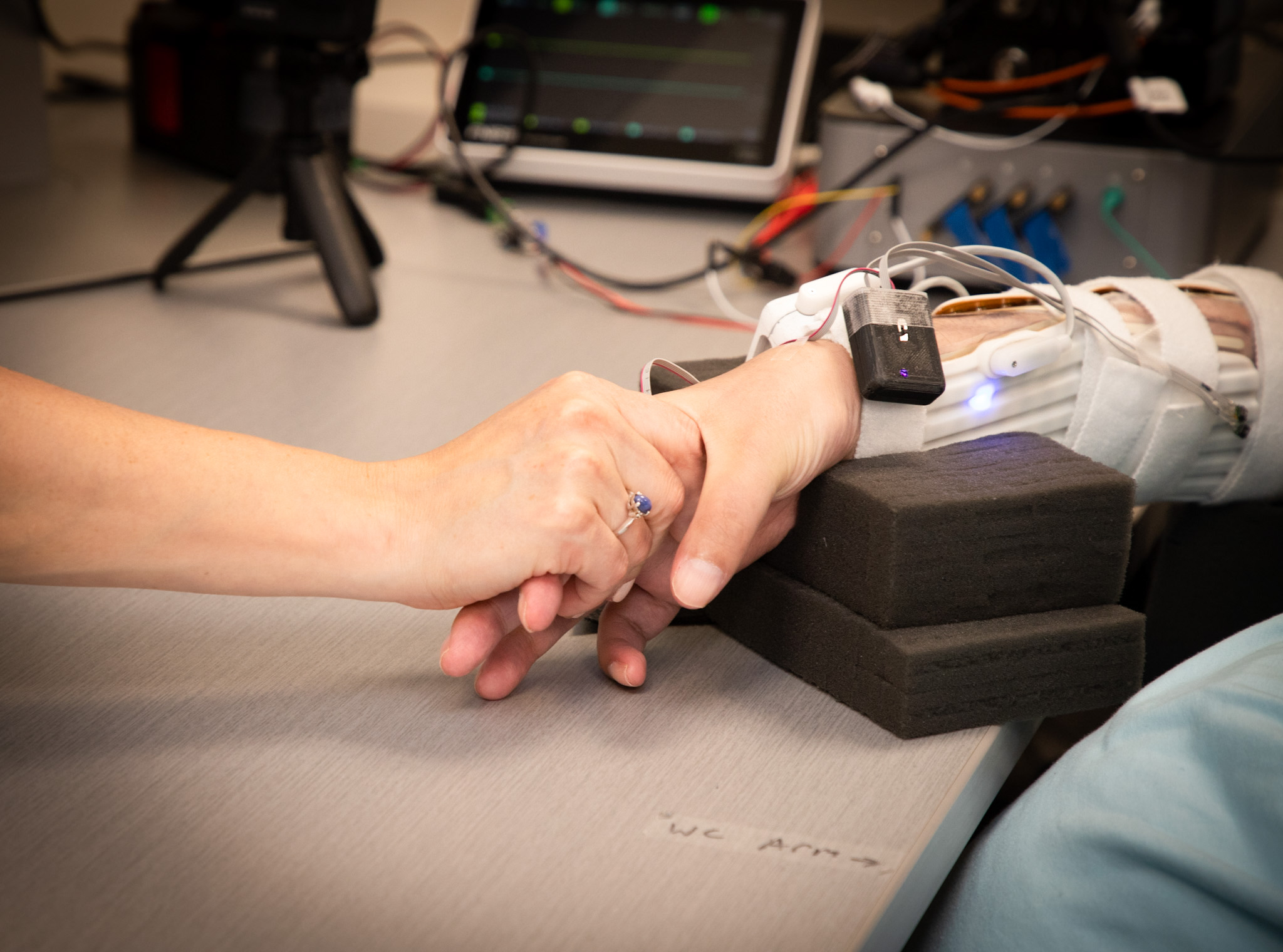
The decisive image is not a logo, a podium or a ribbon being cut. It is one hand holding another. The hand on the right belongs to Keith Thomas, a man living with paralysis. Sensors sit along his forearm. Cables wander out of the frame. His sister reaches in from the left. Through a system of brain implants, artificial intelligence and spinal stimulation, he can feel her touch.
For Northwell Health and the Feinstein Institutes, this was a first-of-its-kind clinical trial. For MediaSource, it was also a communications problem. The science was dense enough to lose a general audience in one sentence. The human meaning was immediate. So the Columbus public relations agency built the campaign around the instant the two became the same story.
The agency recorded interviews and b-roll before surgery, filmed in the operating room, tracked Thomas's progress for months, and prepared several edits: a long version, a television news package, social cuts and clean footage for other producers. It negotiated one national television exclusive and one print or online exclusive, then widened the release. A branded multimedia newsroom let journalists download broadcast-quality material without a login.
Those numbers explain what MediaSource actually sells. It is not simply video production, and it is not simply a list of reporters' email addresses. It is the work between the clinical paper and the morning show: finding the visual hinge, translating without trivializing, producing every asset a newsroom needs, pitching at the right moment and then asking whether the resulting attention moved anything beyond an impressions counter.
The crib beside the edit bay
Lisa Arledge Powell started MediaSource in 1998 after working as a television reporter, producer and anchor. In the first office she installed a crib for her baby son, Grant, under the optimistic theory that an infant and a new company might observe complementary schedules. They did not. Powell learned to write scripts during naps.
The anecdote is charming because it contains the company in miniature: television discipline, domestic improvisation and an impatience with the written-only model of public relations. At the time, most PR machinery ended with a press release. Powell believed organizations would need to make their own pictures and think like the people who assembled the evening news.
“More than two decades later, though the methods of sharing stories have changed, we are operating under the same purpose: sharing credible, important information through storytelling.”Lisa Arledge Powell, founder and CEO
But an early instinct is not the same thing as a sharp market position. For roughly 15 years, MediaSource offered a wider collection of communications services without one defining trademark. In a 2014 interview, Powell described the pre-focus company plainly: before it committed to brand journalism, it did not have a real signature. The move was subtraction. MediaSource centered the company on newsroom-style storytelling, then joined production and media relations around it.
That change matters because agencies often respond to competition by adding nouns. Strategy. Creative. Digital. Innovation. MediaSource became easier to understand by choosing a verb: report. The staff finds stories inside an organization, assigns the equivalent of beats, develops sources, gathers evidence and packages material for both earned and owned channels.
A newsroom kit with a business objective
The clearest expression of the model is the Multimedia Release, the firm's flagship product. It begins backward, with the desired result and audience. Then come story discovery, visual planning, interviews and a media map. Production yields scripts, stills, captions, audio, multiple video cuts, soundbites and b-roll. Distribution happens through a client-branded newsroom. Outreach and reporting finish the loop.
This is more practical than it sounds. A hospital communications director could separately hire a strategy consultancy, a film crew, an editor, a PR firm and a monitoring vendor. Every handoff creates translation work. MediaSource puts those functions together, with healthcare fluency as the connective tissue. Its customers have included Ohio State's Wexner Medical Center and James Cancer Hospital, Nationwide Children's Hospital, Orlando Health, Northwell Health, National Jewish Health, Amgen and Roswell Park. In 2025, PRovoke reported that 81 percent of the client base was in healthcare or healthcare technology.
The market around it is crowded. Large agencies such as Edelman, FleishmanHillard and FINN Partners can bring global scale. Healthcare specialists such as GCI Health, Real Chemistry and Cura Strategies bring deep sector practices. A hospital can also build an internal studio. MediaSource occupies the seam between boutique PR firm, production company and analytics shop. Its advantage is most visible when a story is clinically complicated, visually strong and tied to a result the institution can count.
What did the attention cause?
Public relations has an old measurement problem. A placement can be counted. Its theoretical audience can be counted. Neither tells a chief financial officer whether someone booked an appointment. MediaSource worked with Orlando Health and Mastercard Data & Services on a test-and-learn framework that compared exposed markets and campaign timing with business behavior, including patient activity and revenue. The approach won industry recognition because it treated earned media less like a trophy and more like an intervention.
Earlier campaigns offered hints of the same idea. A 2014 story about an experimental Alzheimer's pacemaker reportedly led to more than 200 patient inquiries and a traffic increase of nearly 2,000 percent on release day. A campaign for the Plasma Protein Therapeutics Association later increased content downloads by 600 percent. The double neural bypass work generated a list of more than 200 possible clinical-trial participants. Different goals, same useful question: what happened next?
MediaSource does not publish a rate card. The two public signals above show specialist campaign economics, not a standard price. Most of its work is sold through projects and annual relationships, and almost half of its clients have reportedly stayed more than a decade. Scope depends on access, travel, clinical complexity, the number of deliverables and how much measurement data a client can share.
The week the machine jammed
The model's clearest stress test arrived in 2020. When hospitals entered crisis mode, MediaSource's normal PR work stopped for several weeks. Video shoots were largely impossible. Then the blockage reversed. In one week that April, more than 100 client stories were being developed or pitched. The existing structure could not carry the load.
Powell combined public relations, creative and strategy under a temporary “COVID Command Center.” People moved across departmental lines while hospitals tried to explain testing, safety and treatment in a news cycle already saturated with the pandemic. The agency soon averaged more than 270 placements a week, according to Powell. The emergency passed; parts of the combined workflow remained. What changed her mind was not a management seminar. It was a queue nobody could clear.
There is a copyable principle here for any expert-services firm: organize around the customer's urgent outcome, not the boxes on the org chart. Another is to make the recipient's job easy. MediaSource's no-login newsroom, clean b-roll and alternate edits are small operational courtesies. Together they reduce the number of reasons a journalist has to abandon a complicated story.
From search results to answer engines
MediaSource closed 2025 with $4.13 million in PR fee income, up 10.5 percent year over year, according to PRovoke. The industry publication also placed it among the 100 Best Agencies in the United States in 2026. Awards accumulated across PRSA, PR Daily, PRNEWS and Ragan. More interestingly, the agency has begun adapting the old earned-media logic to AI search.
Its NextLab initiative experiments with AI-assisted workflows and generative engine optimization, or GEO. The premise is familiar: credible third-party reporting influences what an audience finds. Only now the first reader may be a model assembling an answer. It is early, and the evidence for any agency's GEO claims is still developing. Yet the move is consistent with MediaSource's history. The delivery system changes. The useful story still needs evidence, an intelligible shape and somewhere trustworthy to appear.
That is why the hand-holding image lingers. It is not sentimental decoration placed on top of the science. It is the science becoming graspable. MediaSource built a business around noticing that moment, preparing it for circulation and refusing to stop the measurement when the clip airs.