At BMO, a customer accepts an offer. Unica Interact can then suppress it, so the same proposition does not keep resurfacing. If another message is repeatedly ignored, the system can move to a different offer. It is a modest kind of intelligence: remembering what just happened. Anyone who has been chased around the internet by something they already bought will recognize its appeal.
That little act of restraint explains HCL Unica better than a parade of marketing acronyms. The platform helps large organizations decide who should receive which communication, through which channel, under which rules. The creative might be an email. The underlying problem is institutional memory.
- What it does: connects campaigns, live offers, journeys and contact rules.
- Who needs it: enterprises juggling complex data and many customer touchpoints.
- What to copy: make every channel remember the customer’s last response.
The spreadsheet problem that outlived the spreadsheet
Unica began in 1992 with Yuchun Lee, Ruby Kennedy and David Cheung, friends from MIT. Its early work involved data mining. Consulting paid for product development; the company began licensing its Model software in fiscal 1997 and campaign-management software in fiscal 1999. Marketing became the application around which the business organized itself.
In a 2005 interview, Lee described marketers working through hundreds of scattered Excel spreadsheets and custom code. His diagnosis was organizational: a department responsible for understanding customers lacked a dependable system for running its own work. Unica’s answer joined customer analysis, interactions and operational management.
The ownership changed more dramatically than that premise. Unica went public in 2005. IBM announced its purchase in 2010 for approximately $480 million, net of cash. In 2019, Unica moved to HCL in a broader IBM software transaction announced at about $1.8 billion. That second number covered a portfolio, including products such as Domino and BigFix. It was never Unica’s individual price tag.
A flowchart with a sense of restraint
Today, Unica sits within HCLSoftware. Campaign handles audience selection and campaign flows. Interact makes offer decisions during live customer encounters. Journey arranges sequences of touchpoints; Deliver handles messaging. Plan organizes marketing resources and approvals. Link connects other systems. These are distinct jobs, and the distinction matters when a campaign has to cross departmental boundaries.
Optimize tackles an especially revealing problem: several campaigns may each want the same customer. It can apply constraints involving contact frequency, budgets, available offers and channel capacity. A call center has finite capacity. A customer has finite patience. Maximizing every campaign separately is a good way to exhaust both.
BMO’s published customer case reports a threefold lift in offer responses and more than a billion interactions. Those are deployment results reported through HCL, rather than a forecast for every buyer. Ali Kazerani, a BMO marketing strategy manager, offers a more tangible measure:
“It only took us six months to get a return on our investment with Unica Interact.”
Ali Kazerani / BMO customer case
At Proximus, the Belgian telecom operator, the difficulty was disconnected marketing tools. Its inbound and outbound channels needed shared targeting logic. HCL’s account describes unifying them around real-time decisions and consent rules, with more than 600 million inbound interactions annually and two to three times higher call-center response rates. The useful lesson is coordination across channels before adding more communications.
The insurer MACIF supplies another measure of the same ambition. In HCL’s published account, fragmented tools and manual processes gave way to coordinated member engagement. Reported results include a 30-40% reduction in unsubscribe rates and a 50% reduction in campaign time-to-market. Fewer people asking to leave is a useful counterweight to the industry’s obsession with sending more.
These examples suggest a sensible evaluation test. Ask a prospective platform to demonstrate what happens after acceptance, refusal or silence. Then ask whether the website, outbound campaign and service desk can act on that response. The handoff is where the promise becomes observable.
The unglamorous work underneath
The screen makes this look tidy. Implementation is another matter. In its BMO account, partner Transiris describes extending Interact to ATMs and online banking over two quarters. The work included custom code, data and API optimization, load-balancer redesign, security improvements, training and performance tuning. Architects, engineers, marketers and testers all had a part.
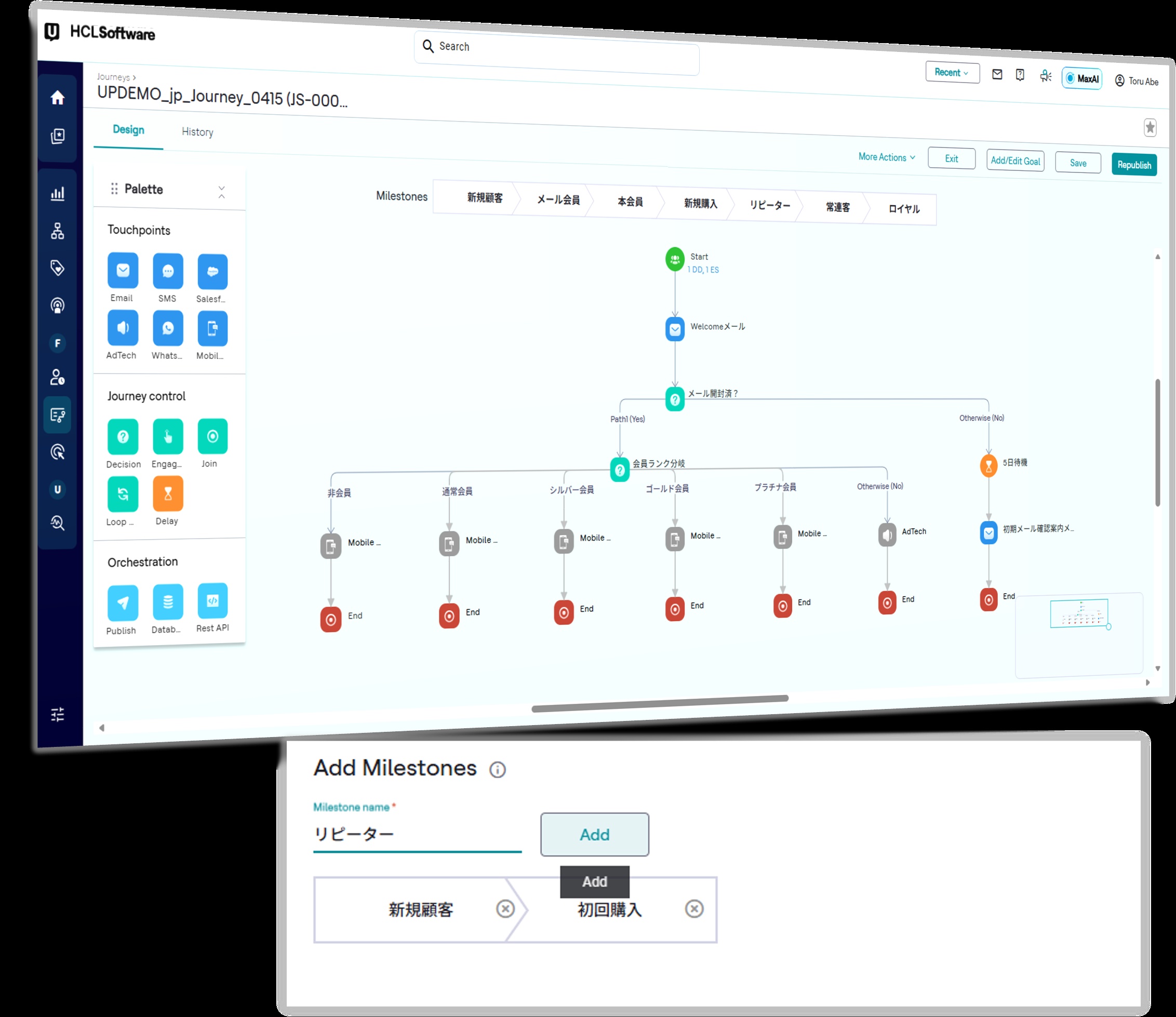
That is the practical cost lesson: license entitlements describe only part of the commitment. HCL’s 12.1.11 licensing guide lists count-based and metered models, including audience records, interactions, messages and journey audiences. A buyer must also budget the infrastructure, integration and people needed to make customer history usable. A neat flowchart cannot supply missing data ownership.
Unica competes in territory occupied by Adobe Campaign and Salesforce Marketing Cloud, with enterprise decisioning also bringing Pega into consideration. Its distinctive emphasis combines detailed campaign control with deployment choice. HCL advertises on-premises, private-cloud, hybrid and SaaS options. Its Google Cloud partnership added another deployment route in 2021. For a regulated organization, architecture belongs in the buying conversation alongside campaign features.
Nine agents inherit a long memory
The newer Unica+ proposition puts AI around that execution machinery. In June 2026, HCL announced version 26.1 with nine specialist AI agents, campaign and journey drafting, a shared data foundation and on-premises language-model options. The announced workflow keeps teams involved in reviewing what goes live. These are release capabilities, not proof that every organization will achieve the same outcome.
The interesting question is what an agent inherits. A useful audience needs a usable customer identity. An appropriate offer needs eligibility and consent rules. A quick draft still needs someone accountable for the result. Unica’s older machinery supplies the context that makes its newer interface worth evaluating.
For readers borrowing the idea, start small: choose one customer moment, connect the response history, agree on the stopping rule, and measure the result across channels. That is an inference from these cases, not a guaranteed implementation recipe. Without reliable identities, agreed rules and integration capacity, adding automation can simply repeat a mistake faster. A simple newsletter operation may have little need for this much machinery. A bank with many channels has a different problem: ensuring the next conversation remembers the last.
See the machinery
Explore Unica+, the product blog and Unica on LinkedIn. Visit parent HCLSoftware on X and GitHub.
▶ Unica+ product overview WATCH ↗▶ The cloud-native Unica launch WATCH ↗Read the 26.1 release announcement EXPLORE ↗