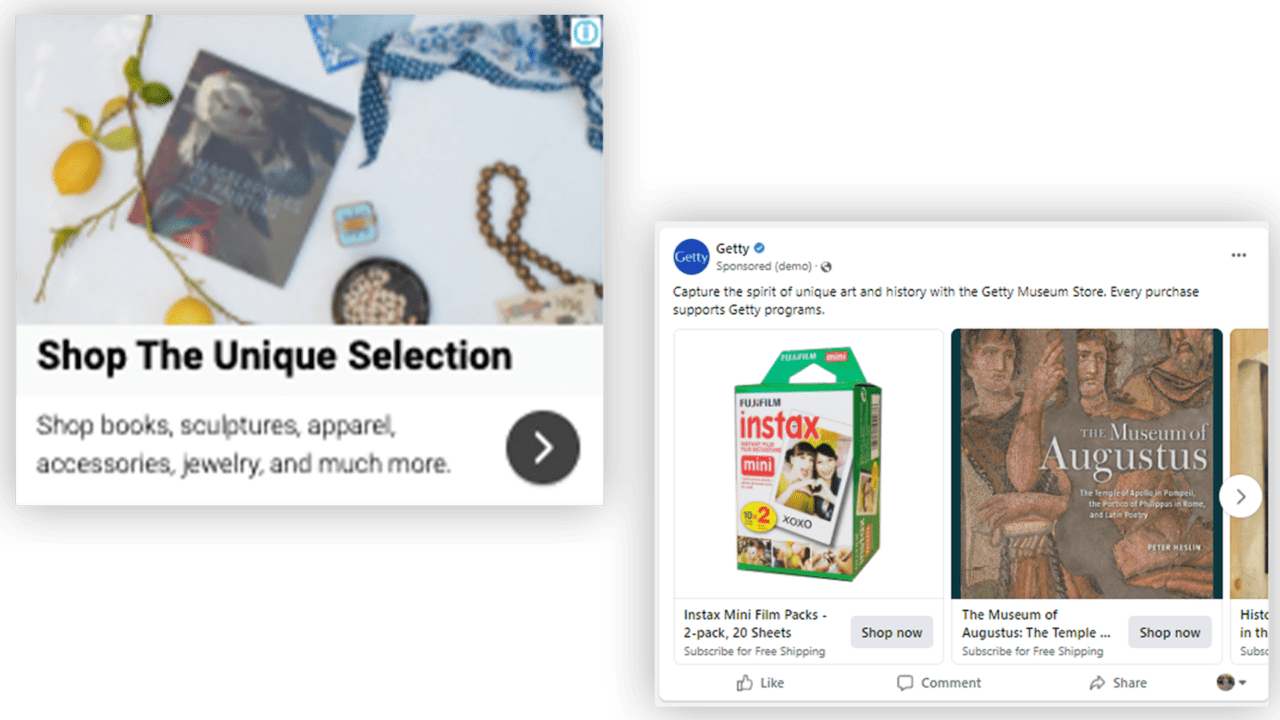
The Getty Store had a distribution problem disguised as a tourism problem. Its books, replicas and homewares were still there. The people who usually discovered them after visiting a museum were not. In 2020, the pandemic closed public spaces. A shop built around visitors suddenly needed customers who might never come through the door.
- Buy the marketing skills your business is missing.
- Keep creative, acquisition and measurement talking.
- Judge new customers separately from existing demand.
Hawke Media began working with the store in the fourth quarter of that year. Its approach combined digital advertising, influencers and a practical exchange: sign up for store communications and receive free shipping. By the 2021 holiday season, approximately 80% of online customers were first-time buyers, according to Hawke’s account. The museum shop had found an audience beyond the museum.
That is a useful way into this company. Marketing agencies often introduce themselves with a long list of things they can do. Hawke’s more interesting proposition concerns the things a customer cannot yet do. It sells access to the missing people, then tries to make their work behave like a department.
A department by the slice
Erik Huberman and Tony Delmercado founded Hawke in 2014. Huberman had worked in ecommerce and consulting. In a 2015 interview with Built In Los Angeles, he described clients who lacked the bandwidth and expertise to execute digital marketing. His answer was a seven-person group with different specialties, including email, search and Facebook advertising.
The offer was easy to grasp: select services and work month to month. A business could get help without recruiting every specialist itself. That structure also made the first purchase less intimidating. A founder with one immediate problem could begin there, rather than commit to building a whole department before learning which capabilities mattered.
“Our original model was the one we stuck with.”Erik Huberman · YPO interview, 2020
There is a staffing wrinkle. In his YPO interview, Huberman said clients received flexible access while Hawke employed the specialists full time. The agency absorbed the work of keeping that talent occupied across accounts. Buyers got a slice of a standing team. Employees got continuity that an individual freelance assignment might not provide.
The cultural language fits that arrangement. Hawke’s published values emphasize intelligence, empathy and adaptability. Those are useful qualities when the same specialist must understand different businesses. They also expose the operational challenge: a shared team needs enough context to make good decisions. A service menu cannot supply that context on its own.
Huberman described the early business as bootstrapped in a March 2025 retrospective. Hiring followed immediate need because every salary had to be justified. That helps explain the model’s economics: the agency could add expertise as client work supported it. Growth still required the discipline to keep commitments and payroll aligned.
The food brand already had the story
Masienda, the Mexican food and kitchenware brand, illustrates a different entry point. It already had an internal marketing team and strong video production. What it needed was expertise in Google and YouTube advertising. Hawke’s case study describes separate acquisition and mixed-customer campaigns, with no money put behind branded search terms.
As the program expanded into social advertising, about 70% of that social investment went toward prospecting. Product tutorials, cultural context and user-generated material supplied the creative. Hawke reports that Masienda tripled its investment, then increased it again after further success. The account supplies a reason for the spending decision: existing creative could reach additional buyers through specialist distribution.
Illustrative workflow, not a guaranteed sequence of results.
The lesson a reader can copy is quite specific. Identify the capability missing between what your team makes and what your business needs to sell. Keep first-time customer acquisition visible in the reporting. Otherwise, a campaign can appear productive because it reaches people who already know exactly what they want.
A dashboard needs someone at the controls
Hawke AI adds software to the service business. Its advertised functions include dashboards, reporting, insights and performance alerts. A separate offering for businesses with multiple locations helps teams compare performance across accounts and identify locations that need attention. The practical appeal is a shorter route from scattered numbers to a question worth investigating.
The product’s history matters. Hawke acquired the Canadian marketing technology company Morphio and launched Hawke AI in 2022. This was an expansion into software backed by an acquisition. Buyers should distinguish the software subscription from the agency engagement: a tool that identifies an irregularity and a team paid to respond to it solve related problems.
The menu keeps getting longer
Acquisitions have also expanded the human side. SimplyBe. added personal branding. PRP Group brought public relations and education-sector expertise. ARMR strengthened Amazon and retail media capabilities. These purchases give a client more possible combinations, while making the coordination behind the Outsourced CMO promise more demanding.
Hawke’s count when it announced the Rocket55 deal.
On October 13, 2026, Hawke announced the acquisition of Minneapolis agency Rocket55, calling it its largest deal and its 26th acquisition. The addition brings search, paid media, web development and revenue operations experience. Hawke’s market position is increasingly that of an expanding agency group with both specialists and proprietary software available to clients.
Buy a capability. Budget for the learning.
For a prospective client, the decision starts with scope. Hawke’s published onboarding guidance describes an initial discussion, an analytics audit and regular reviews. A sensible buying process separates agency fees, advertising expenditure and the internal time needed to approve work. Commercial flexibility helps, but a monthly contract does not make a long purchase cycle resolve in thirty days.
A small business needing a single task may prefer a freelancer. A company needing daily institutional knowledge may hire internally. Hawke’s model becomes attractive when several capabilities must work together and the company can provide access, creative input and a clear commercial goal. Poor margins or an offer customers do not want will still limit what advertising can accomplish.
The Getty Store lost foot traffic. Masienda had creative strength and a distribution gap. Their needs were different enough to explain the appeal of an assembled team. The question to take into a meeting is straightforward: what is the constraint, who will own fixing it, and what evidence would justify spending more?