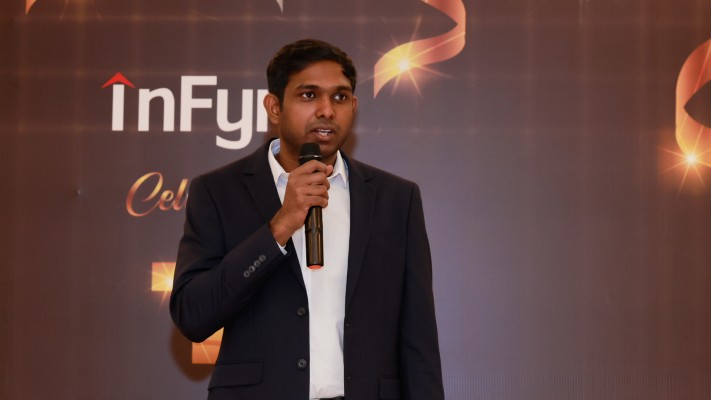
At InFynd’s third-anniversary celebration, Harish Praveen had a microphone and a company’s first three years to account for. He spoke about the ups and downs, and the employees whose work had helped the business grow. Friends and families were there, too. A company concerned with business records had briefly become a room full of people.
The programme made room for dancing, singing and silambatam. Praveen’s address sat among the performances and awards. It is a useful opening scene for a founder whose working vocabulary includes contact data, enrichment and cloud engineering. Such terms describe necessary work with almost heroic resistance to charm. Put a microphone in someone’s hand, and the people become easier to see.
Praveen’s business story can be followed through a succession of practical questions. Where do you find useful information about a prospective customer? What happens once you have acquired it? How do you check it? How do you turn it into something a team can act upon? Each question leaves work on somebody’s desk.
The list comes first
Praveen says he started InFynd in 2020 after spending more than a decade in the B2B data industry. The difficulty he identified was finding quality data. His explanation begins with familiarity: a problem encountered often enough to become the reason for a company.
For a sales team, the contact list comes before the persuasive conversation. A name must belong to the right person. A record must be relevant to the business being approached. The team needs something it can use. Even an excellent pitch has limited prospects when its destination is wrong. The most polished envelope in the world remains an envelope.
InFynd’s focus on business contact information placed Praveen close to that preparatory work. Sales, marketing and recruiting teams are among the users described for its data. The product’s usefulness depends on what happens after a record leaves the database and enters someone’s working day.
In 2023, InFynd announced that Praveen was preparing to exhibit its custom-built data at ExCeL London during the B2B Marketing Expo and Marketing Technology Expo. The invitation asked whether others would be attending. For all the technical language around prospecting, the announcement concerned an entirely familiar activity: getting into a room where potential customers could ask questions. A data business still needed to introduce itself.
His earlier roles also involved the intersection of technology and commercial work. He served as Head of Technology at Versiz and as IT & Commercial Director at Census Life. His education includes a bachelor’s degree from Anna University in Chennai and a master’s in Information Technology from the University of the West of England.
Those roles provide a practical context for the ventures that followed. Building a system and getting a business benefit from it are connected tasks, with plenty of room for complications in between. His subsequent work keeps returning to that interval.
- 2020InFynd begins
- JAN 2024Klodev introduced
- 2025LDC Ones to Watch
- APR 202627x.ai goes live
The customer still has work to do
In January 2024, Praveen explained the next move with a short sentence: “We decided to extend our expertise.” After InFynd, he had recognised the difficulties businesses experienced with managing data. The information had been found. There was still a considerable amount to do with it.
Klodev was the extension. He described services including data management, cloud engineering, visualisation, analytics and process automation. The proposition was to make the team’s expertise available more broadly, with cost-effective solutions for businesses.
This is a revealing sequence. A customer can obtain a useful resource and immediately encounter another obstacle. The handoff creates its own demands. Someone has to organise the information, connect it to other systems and make it intelligible to colleagues. Delivery can be the beginning of a new to-do list.
For a founder, that is a place to pay attention. The question following a purchase may tell you as much as the question preceding it. Praveen’s explanation of Klodev locates the opportunity in work his team already understood, beside the work it was already doing.
He is also listed as a founder of no2bounce, an email verification business. It addresses another specific stage in the process: checking email data before outreach. Finding a possible contact and having an address suitable for use are separate tasks. They can occupy neighbouring columns in a spreadsheet and still require different tools.
Across these ventures, the recurring subject is the preparation behind a commercial encounter. That preparation is easy to overlook when describing a sale. It becomes rather more conspicuous when someone has to do it, record by record.
The people behind the records
At InFynd’s fourth-anniversary gathering, Praveen and Vino Shan spoke about the journey so far: the challenges, the solutions and their future business goals. Praveen was identified as CEO; Shan as founder. The occasion put reflection beside a programme of performances, games and employee recognition.
The award names included Everyday Champion, Laser Focus and Super Squad. They are unusually cheerful phrases to find near a business data operation. Every organisation eventually has to decide what deserves applause. Here, the celebration made room for both individual contribution and teamwork.
A ceremony is a particular view of a company, shaped by its occasion. Yet the detail is valuable. Software businesses tend to describe their output in abstractions, while the work itself requires people to build, research, organise and maintain things. The anniversary programme allowed some of that work to acquire names and faces.
There is another small acknowledgement in an employee’s account of two years at InFynd. Essaki Subramanian thanked Praveen and Shan for encouraging the team and providing direction, alongside thanks to his manager and colleagues. It is one person’s account, specific to his own experience. It also gives the founder’s role a different scale from a product launch: someone at work, helping other people find their way through the work.
The contrast in scale is interesting. A database can contain more records than a person could comfortably contemplate. A thank-you still has to be directed at someone. Praveen’s anniversary appearances belong to that smaller, more recognisable part of running a business.
What should happen next?
In June 2025, Praveen published an essay titled Data Without AI Is Just Noise. It argued that collecting information and assembling dashboards could leave a business struggling to make timely decisions. His emphasis was on using information to predict, prioritise and recommend action.
The piece gives a clearer view of his stated interests than a list of job titles alone. He was concerned with the distance between possessing data and using it. The examples included scoring leads and identifying opportunities for further sales. These were arguments for how a business should work, rather than a biography dressed as a manifesto.
There is a straightforward test inside that argument. After the dashboard has loaded, what can its user do differently? An answer requires more than the satisfaction of seeing a chart. The information needs to change a choice, a priority or the timing of a response.
That question also helps connect the ventures. Each deals with a point where information is supposed to become useful to someone else. The details differ, but the practical demand remains: give the next person something they can work with.
“We decided to extend our expertise.”
Harish Praveen, introducing Klodev, January 2024
A place among the Ones to Watch
Later in 2025, Praveen appeared in LDC’s Ones to Watch selection, part of its business-leader programme with The Times. His entry described InFynd’s combination of proprietary AI technology and human verification in custom B2B data.
The pairing matters to the account he was giving of the business. Automation and human checking appeared together. The commercial promise rested on information being usable, with technology and verification both contributing to that work.
The recognition supplies a dated marker in his career. The more revealing detail remains the problem he chose to describe when given the space: helping businesses turn data into outcomes. Even in an awards brochure, the work before the sale followed him onto the page.
The product meets the world
On 9 April 2026, Praveen announced the launch of 27x.ai. “We went live today,” he wrote. The offering had two core products: an AI sales development representative and custom AI agents designed around businesses’ workflows.
His explanation concerned companies whose ambitions were growing faster than their capacity. He presented the tools as a way to save people time. That is his stated intention for the products, and a continuation of the practical concerns running through his earlier work.
A launch changes the nature of a founder’s explanation. Beforehand, the product can be described entirely through what it is intended to do. Once it is live, users arrive with their own processes, expectations and awkward exceptions. The working world has a talent for supplying the last of these.
For Praveen, the sequence now stretches from finding business data to offering tools intended to act on it. InFynd, Klodev, no2bounce and 27x.ai each occupy a different part of that territory. His story has accumulated through the tasks surrounding the customer’s next move.
The anniversary microphone provides a useful image to carry away. A founder pauses to explain how the business arrived at this point, then the programme continues. There are people to thank and another piece of work waiting. For Praveen, that next piece has repeatedly begun with a simple question: what does a business need to do with its information now?