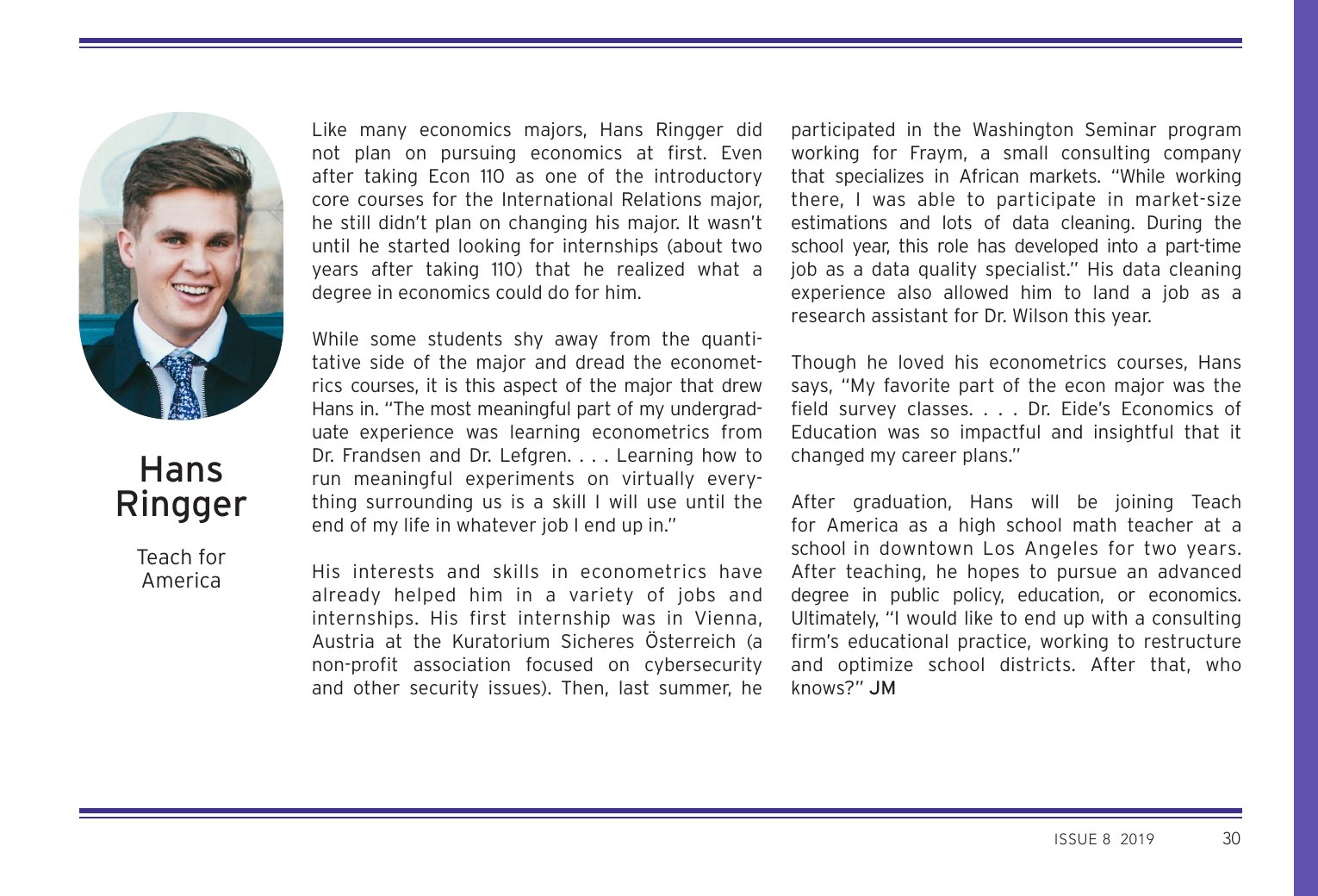
Hans Ringger did not arrive at economics in a thunderclap. He took Econ 110 at Brigham Young University because it was part of the introductory core for international relations, the subject he then expected to pursue. The class ended. His plan survived. Only about two years later, while looking for internships, did the usefulness of economics begin to declare itself. It could measure a claim. It could test an assumption. It could turn the fog around a problem into something that might be examined.
That delayed conversion is a fine opening scene for Ringger's career because nothing that followed fits the brittle version of a plan. He went from university econometrics to data quality, then into a high-school mathematics classroom, graduate study in urban education, an MBA, management consulting and, in August 2025, a chief-of-staff role at legal-software company Filevine. The industries change. The questions rhyme.
What does the evidence say? Where is the misunderstanding? How can a large system be made intelligible to the person who has to act inside it? Ringger has encountered those questions in datasets, classrooms and organizations. His résumé reads less like a ladder than a series of translations.
First, learn the language
Before the polished business-school chapters, there was a literal act of translation. From May 2013 to June 2015, Ringger served as a full-time volunteer missionary in Slovakia. His public account of the period is unusually specific: daily language study, work across socioeconomic and religious backgrounds, and responsibility for training and leading 30 international volunteers. He became professionally proficient in Slovak and developed limited working proficiency in Czech.
Fluency is never only vocabulary. It is the long embarrassment of being almost right, followed by the discipline of listening more carefully. Ringger described learning to communicate with people from many backgrounds and training others in problem-solving, teamwork and goal-setting. Those details matter because they precede the later titles. Long before he was paid to advise organizations, he was learning how a message changes when it crosses a room, a culture or a language.
Vienna provided another early classroom, this time in the shape of an internship. Ringger worked at Kuratorium Sicheres Österreich, an association concerned with cybersecurity and other security issues. The surviving description is brief, so there is no grand origin myth to varnish. What it does show is a young career already crossing borders between institutions and ideas: international relations, security, quantitative study and public questions. The setting also complicates the familiar picture of an economics student moving straight from lecture hall to spreadsheet. Ringger was testing where analytical work might matter before he had settled on the label for it.
That pattern would repeat. He did not discard international relations when he changed majors so much as carry its attention to institutions into a different toolkit. He did not leave language behind when he moved into data. The vocabulary changed from Slovak verbs to variables, but the obligation remained: be precise enough that another person can understand what you mean.
The unglamorous work earns its close-up
Back at BYU, the quantitative side of economics drew him in. He praised econometrics courses taught by professors Brigham Frandsen and Lars Lefgren and singled out field survey classes as his favorite part of the major. The enthusiasm was practical. Ringger was interested in experiments, not decorative equations.
“Learning how to run meaningful experiments on virtually everything surrounding us is a skill I will use until the end of my life in whatever job I end up in.”Hans Ringger, 2019
The first professional applications were pleasingly uncinematic. During BYU's Washington Seminar program, he worked for Fraym, a small consulting company focused on African markets. He helped with market-size estimates and did “lots of data cleaning.” The placement became a part-time data quality job during the school year. That experience, in turn, helped him land work as a research assistant.
Data cleaning rarely appears in anybody's heroic montage. It is closer to sweeping the workshop floor, except the dust can invalidate the answer. Labels must agree. Missing values must be noticed. A dataset has to become trustworthy before it can become impressive. For an aspiring economist, the work offered a useful correction: analysis begins well before analysis looks clever.
A survey class changes the destination
The class that redirected him was not the one with the densest mathematics. Ringger said Eric Eide's Economics of Education changed his career plans. Here was a subject that treated schools as human places and complicated systems at once. It gave quantitative methods a destination.
After graduating in 2019, he joined Teach For America and taught high-school mathematics at a school in downtown Los Angeles. The move looks, at first glance, like an exit from data. It was more like a stress test. In a classroom, an elegant explanation receives an immediate verdict. Students either can use it or they cannot. The feedback loop has a face.
Ringger paired the work with a master's degree in urban education at Loyola Marymount University, completed between 2019 and 2021. His college-era plan had been to teach for two years, pursue an advanced degree in public policy, education or economics, and eventually enter an education practice at a consulting firm. The sequence was unusually close to what followed, even if the final industry would change.
The pairing is important. The graduate program meant that the classroom was not merely a temporary service assignment before business school. For two years, education was both practice and subject: the daily work of teaching mathematics alongside formal study of the urban systems around that work. Ringger had once praised economics because it made experiments possible. Teaching supplied a stern reminder that people are not laboratory furniture. A policy can look coherent at altitude and confusing from a student's desk. A lesson can be correct and still fail to travel.
This is where his early interests stop looking like separate hobbies. Econometrics asks whether a result can be trusted. Education asks whether an idea can be learned. Cross-cultural work asks whether a message can cross the distance between two people. An operator eventually has to ask all three. Is the evidence sound? Is the explanation clear? Will the system still work when other people use it?
The plan holds, then bends
In 2021, Ringger began an MBA at the University of Virginia's Darden School of Business. By 2022 he was at Boston Consulting Group, where he remained until 2025. The public descriptions of his consulting work point to operations improvement and emotional intelligence, an intriguing pair because one concerns the machinery of an organization and the other concerns the people expected to operate it.
Teaching and consulting are often filed on opposite sides of a career catalog. One is associated with service and explanation, the other with strategy and analysis. In practice, both demand diagnosis. Where did the logic break? What is preventing the next step? Which explanation can travel beyond the person giving it? A good model and a good lesson plan share at least one moral obligation: they have to survive contact with reality.
Ringger's move to Filevine in August 2025 added a new setting. The Salt Lake City company builds software for legal work, bringing case information, documents, communication, billing and analytics into a shared platform. Ringger serves as chief of staff to the chief marketing officer. The title places him close to the junction between what a complicated product does and how its usefulness is explained.
Filevine is larger than the small consulting company where Ringger once cleaned data. Its public company profile says more than 125,000 legal professionals use the platform each day. The product must speak to firms handling contracts, deadlines, documents, payments and client communication, often under considerable pressure. Marketing such a system is not a matter of finding one sparkling adjective. It requires deciding which complexity to preserve and which to remove from the explanation.
A chief of staff role is also work conducted through other work. The title gives Ringger a particular vantage point: beside the executive responsible for marketing, across the priorities that office must coordinate. It is a position for someone comfortable moving between detail and system. The undergraduate who learned that dirty data could spoil an answer now works in an environment where a stray assumption can travel through a campaign, a team or a plan.
It would be tempting to draw the line too neatly. A career is not a classroom parable, and legal technology is not simply education with different nouns. Still, the recurring habits are visible. Ringger has repeatedly chosen work in which a complex system must become legible: an African market in a dataset, an equation for a teenager, an operating problem for a client, a software platform for legal professionals.
“After that, who knows?”
The telling line in Ringger's undergraduate profile came after a remarkably accurate forecast. He wanted to teach, pursue graduate study and work in consulting on school systems. “After that, who knows?” he added. It was not a shrug. It was a sensible margin left around the plan.
Plans are useful because they arrange effort. They become dangerous when they refuse new evidence. Ringger's own major changed only after internships showed him what economics could do. His interest in education sharpened when a field course gave the numbers a human setting. His path reached consulting, as predicted, then bent toward software and marketing operations.
The durable aspiration may be smaller and more demanding than a job title: understand the system, then help somebody else navigate it. That task can live almost anywhere. It can begin with a cleaned column, a better question or the moment a student finally sees why the answer works.
Ringger's story is still early enough that the punctuation matters. The college plan did not end with a period. It ended with a question mark. So far, that has proved to be the more useful instrument.