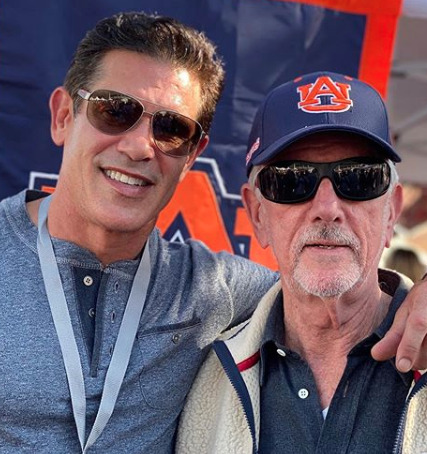
There is a particular kind of silence inside a parked car when a son wants permission to quit and a father refuses to provide it. Hank McLarty was at Auburn, a 250-pound linebacker on scholarship, and miserable enough to call home. His father was working in Las Vegas. Within ten hours, he had arrived in Alabama. He listened to the complaints about coaches and the urge to leave. Then he made the scholarship Hank’s decision. Leaving was allowed. He simply wanted his son to consider what practicing surrender might make easier later.
McLarty got out angry. He also stayed. The exchange has followed him through the years because it offered no theatrical rescue, only ownership. Long before he became a financial advisor, a founder, or the person responsible for a growing company’s culture, he learned that accountability can feel less like encouragement than a locked door with the key already in your pocket.
His career is often told through its polished nouns: Auburn, Merrill Lynch, Morgan Stanley, Gratus Capital, Focus. The more revealing story lives in the verbs. Stay. Build. Listen. Coach. Let go. McLarty’s work has been a long attempt to turn those actions into an organization.
The first play was a refusal to quit
Football gave McLarty a language for effort before finance gave him a ledger. At Auburn he played under Pat Dye, the coach whose standards became part of McLarty’s own leadership vocabulary. The useful inheritance was not rah-rah theater. It was the idea that preparation has moral weight, that each person owns a position, and that the group notices when one player improvises at everyone else’s expense.
After graduating with a finance degree, McLarty started at Merrill Lynch and later worked at Morgan Stanley. Over roughly 15 years inside large institutions, a pattern emerged among his clients. Many were entrepreneurs. They understood long hours, imperfect plans, and the loneliness of an important decision. They also arrived with complicated financial lives: investments in one corner, taxes in another, estate documents somewhere down the hall, and the business itself sitting in the middle like a piano nobody had volunteered to move.
The opportunity was organizational. Business owners did not merely need another clever portfolio. They needed the people touching their financial lives to speak with one another. In 2005, McLarty left the large-firm structure and started Gratus Capital in Atlanta. He began with one assistant, no clients, and a thesis that sounded suspiciously like a depth chart.
A wealth firm with positions
McLarty wanted investment strategy, financial planning, tax expertise, and trust and estate knowledge inside one coordinated team. The advisor would remain close to the client without pretending to be the smartest person in every specialty. That distinction is easy to admire and hard to operate. It requires experts secure enough to pass the ball, generalists disciplined enough to call for help, and a client experience that does not expose the machinery.
A story from the firm’s work makes the model less abstract. One family had more than a hundred pages of estate documents. McLarty’s team gathered the couple, their children, and their grandchildren, then reduced the legal thicket to the points each generation needed to understand. When the family later had to rely on the plan, its members already knew the shape of what would happen. The product was partly financial. The more human deliverable was clarity under pressure.
McLarty described the firm’s job in verbs too: own issues, listen and answer, anticipate, educate, and go beyond the point person. These are plain words, which is their advantage. A company can debate “excellence” until lunch. It is harder to hide from whether someone returned a call, warned a client early, or explained an unfamiliar decision without condescension.
The promise that had terrible timing
Founding stories tend to edit out inconvenient calendars. McLarty’s did not cooperate. He had once promised his older son that if the boy wanted to play football, Dad would coach the first season. The request arrived in 2005, just as the new firm was trying to become more than stationery. There was no revenue. There were no clients. There was one assistant. Youth football required two practices and a game every week.
McLarty paused for about thirty seconds and honored the promise. On practice days, he left the office in a suit, changed at a coffee shop, hauled blocking dummies down to the field, and wondered what sort of founder abandons an empty pipeline at 3:30 in the afternoon. Then the children arrived. For three hours his mind stopped chewing on the company. Coaching was both an obligation and, unexpectedly, relief from one.
The episode contains a small rebuke to startup folklore. Total availability is not the same as total usefulness. McLarty’s time on the field did not solve the business, but it preserved an older promise and forced his attention into the present tense. Gratus survived those absences. More importantly, his son did not have to learn that a founder’s commitments become negotiable whenever work grows frightened.
Ambition meets its chaperone
McLarty is candid about ego. Early recognition in finance gave him reasons to believe his own press. A sharp professional reversal and a difficult personal season stripped away that certainty. In later interviews, he described the period not as a detour to conceal but as the ground on which he rebuilt his approach to colleagues, friends, and family. Gratus took its name from the Latin for grateful. The name functioned as a brand, but also as a daily correction.
That helps explain why humility appears so often in his management language. He does not describe it as shrinking. His version is operational: hire capable people, give them room to improve, and resist the founder’s urge to touch every lever. The former linebacker still likes a demanding goal. In a 2022 conversation, he outlined an ambition to multiply the firm’s scale while improving both client experience and the experience of team members. Growth, service, and culture had to move together.
From independent firm to a larger platform
He also pushed that culture outside the office. McLarty became involved with Make-A-Wish Georgia in 1996, eventually serving in chair and vice-chair roles and helping raise money after his board tenure ended. Gratus teams volunteered quarterly across Atlanta, from stocking diapers to working in Piedmont Park. McLarty’s test for community work was characteristically concrete: he wanted people to see the effect of their time and money, not merely admire an organization from a distance.
When independence grows up
The corporate plot took several turns. Gratus joined Focus Financial Partners as a partner firm in 2014 while retaining the model McLarty had built. The firm absorbed other advisory businesses, including a 2018 combination with JPH Advisory Group. In 2019, a profile reported nearly $2 billion under management for more than 600 clients. By May 2024, the regulatory assets cited in a new combination announcement were approximately $3.8 billion.
- McLarty launches Gratus Capital in Atlanta.
- Gratus joins Focus Financial Partners as a partner firm.
- JPH Advisory Group combines with Gratus.
- Focus announces Gratus will join The Colony Group.
- The combined business operates as Focus Partners Wealth; McLarty is listed as Vice Chair at Focus.
In July 2024, Focus announced that Gratus would join The Colony Group, bringing Atlanta expertise into a wider platform with tax and family-office capabilities. The following January, the combined wealth business adopted the Focus Partners Wealth name. The Gratus sign receded. The idea beneath it did not: specialists working in concert around a client whose life refuses to fit inside one department.
McLarty now appears publicly as Vice Chair at Focus. It is a revealing destination for a founder who once left a corporation to choose his own teammates. Independence gave him the freedom to assemble the firm. Interdependence offered the next set of positions. Founders can become sentimental about autonomy, as though a company proves its integrity by remaining exactly the size and shape of its first sketch. McLarty’s career argues for a more demanding measure: does the structure still help the team keep its promise?
The lesson hiding in the huddle
McLarty’s favorite athletic memory is not a tackle. It is running out of the tunnel for the 1989 Auburn-Alabama game, the first Iron Bowl played at Auburn. That choice feels right. The tunnel is a threshold. Behind you: preparation, uncertainty, private doubt. Ahead: the noisy proof of whether the group can perform together.
The same image fits his business life. He crossed from wirehouse advisor to independent founder, from a two-person beginning to a multibillion-dollar firm, and from a company carrying his chosen name into a larger institution carrying another. At every threshold, the task changed. The playbook kept returning to ownership, coordinated expertise, and gratitude sturdy enough to restrain ambition without extinguishing it.
The father in that parked car did not tell his son how the story would end. He simply refused to make the next choice for him. Decades later, McLarty built a career around helping other people face complicated choices with a team beside them. Finance provided the subject. Coaching provided the form. And humility, learned the expensive way, became the person assigned to keep both honest.