Before open enrollment, a U.S. healthcare provider put its contact center through a rehearsal. Hammer’s published account describes several testing engagements over a month. The discoveries were wonderfully unglamorous: calls routed to the wrong destination, a business-process outsourcer short of media capacity, failover logic that stopped calls connecting, and a misconfigured trunk that restricted a cloud provider’s call volume. A telephone system had become a committee. Some members were not speaking to one another.
- Hammer tests the customer’s route through a contact center, including the connections between vendors.
- Its tools cover journey discovery, functional checks, peak-load testing and production monitoring.
- Owned by Infovista since 2021, Hammer is now evolving into the VistaCX portfolio.
The point of the exercise was to expose trouble before patients encountered it. Results, recordings and interim reports helped the provider locate problems and prioritize repairs. The case study does not establish which fault appeared first. It establishes something more useful: several different technical mistakes could produce the same miserable customer outcome. The caller cannot diagnose a trunk. The caller can hang up.
The rehearsal department
Hammer sells enterprise software and testing expertise for that awkward interval between “we installed it” and “it works for the person using it.” Customers include large contact centers and the businesses supporting them. Banks, insurers, healthcare organizations and retailers have obvious reasons to care. A menu that loops, an inaudible conversation or a failed transfer makes the technology department’s problem everybody’s problem.
The business has a long communications-testing lineage. The original Hammer venture dates to the early 1990s. Its test technology moved out of Teradyne into Empirix in 2000. Empirix later sold its web-testing suite to Oracle, entered Thoma Bravo’s portfolio in 2013 and was acquired by Infovista in April 2021. The Hammer name eventually moved from the product to the business itself. It is an unusually literal brand for software whose job is to apply pressure.
There is another change underway. Hammer’s website now leads to Infovista’s VistaCX portfolio. Infovista describes continuity of team and expertise, with existing customers retaining their contracts and receiving expanded capabilities through 2026. For someone comparing old proposals with current product pages, the translation matters: Voice Explorer becomes Discover; On-Demand QA becomes QA; On-Demand Performance becomes Load; VoiceWatch becomes Watch; Edge keeps its surname.
A whole journey, not a green dashboard
Consider a simple customer task: call, identify yourself, select an option, reach an agent. Each verb conceals a dependency. Telephone networks carry the call. An interactive voice response system supplies the menu. An application looks up information. Routing finds the appropriate destination. The agent’s desktop must be ready, and the audio must remain intelligible. Checking one component cannot tell you whether the assembled journey succeeds.
Discover maps IVR and conversational AI flows and can turn the resulting documentation into reusable tests. QA checks behavior: does the new feature work, and did its arrival disturb something that already worked? It supports importing existing regression scripts in CSV or XML formats. That makes yesterday’s testing effort useful again instead of leaving it in a spreadsheet’s retirement home.
Load asks a different question. How does the system behave when many customers arrive together, or keep arriving for a sustained period? The product distinguishes load, stress and soak testing. These examine expected peak demand, breaking points and endurance. Its virtual interactions can exercise inbound and outbound flows, including AI-agent infrastructure. A quiet Tuesday demonstration is poor evidence for a frantic Monday morning.
After deployment, Watch runs recurring checks and sends alerts against chosen thresholds. Its published specification allows scripts as frequently as every two minutes. Edge measures the experience at the agent end, across devices, locations and internet providers. Infovista says Edge does this without recording screens or intercepting customer conversations. Assure adds correlation between real journeys and underlying service, application and network signals.
A lender retires the mobile-phone test
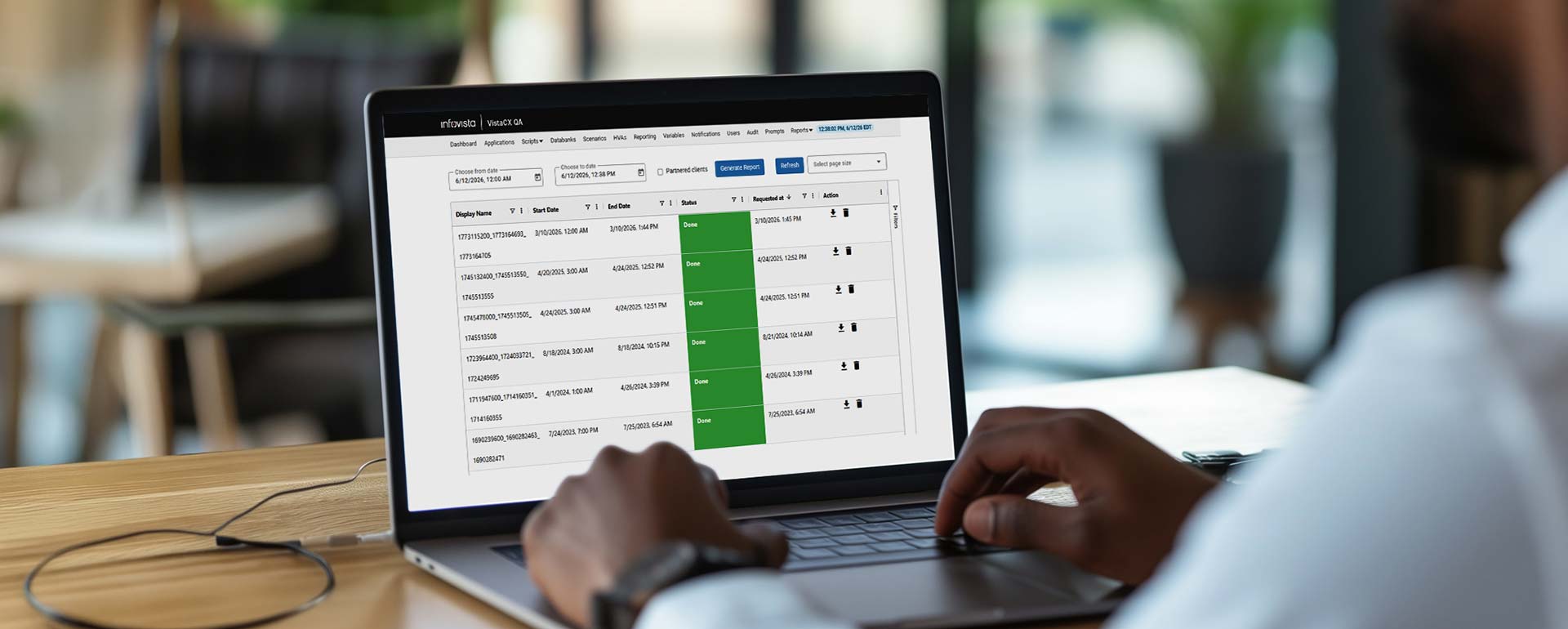
A second Hammer case study follows an unnamed wholesale mortgage lender whose contact center grew roughly tenfold, from fewer than 100 agents to more than 1,000. A move to Cisco Unified Contact Center Enterprise brought new capabilities and a need for consistent testing. Colleagues recommended Hammer; the team selected On-Demand QA and VoiceWatch after comparing alternatives.
Previously, staff tested different routes by making calls on their mobile phones. The new approach automated inbound and outbound checks, sometimes every 15 minutes, with APIs connecting tests to other automation. The customer reported a failure alert within its first two weeks. Its engineer estimated that an undetected incident could have caused hundreds of thousands, perhaps millions, of dollars in downtime costs. That is a customer’s avoided-loss estimate in a vendor-published account, rather than an audited saving.
“Hammer is an insurance policy for us.”Communications engineer, unnamed wholesale mortgage lender
The useful lesson is the replacement of occasional human effort with a repeatable customer journey. A person must remember to make the call. A scheduled test makes it again. Growth also changes the arithmetic: a handful of sample routes becomes less persuasive as systems, agents and connection options multiply. The lender needed more tests running together.
The AI agent joins the queue
The current VistaCX proposition extends that same habit into conversational AI. A conventional phone tree has branches that can be enumerated. An AI agent introduces answers and behavior that can vary. QA’s advertised scope includes accuracy, compliance, brand safety and drift; Load examines infrastructure behavior under concurrent demand. Those are different forms of failure, deserving different tests.
An agent may give an acceptable answer while a transfer to a human fails. It may perform well alone while latency climbs under traffic. The practical question is whether the whole interaction remains useful under the conditions customers actually bring. Testing an answer and testing the machinery delivering it belong in the same operational conversation.
Hammer’s positioning rests on communications depth and visibility across vendor boundaries. It works alongside contact center platforms rather than supplying the agent’s entire working environment. Infovista lists Amazon Connect, Genesys, NICE, Cisco, Avaya and Microsoft Teams among compatible providers. Cyara is a direct alternative with its own whole-journey testing and monitoring portfolio. Both describe broad coverage; the sensible comparison is a trial of the buyer’s actual routes and integrations, with identical acceptance criteria.
Buying a rehearsal, then acting on it
Commercially, this is an enterprise software and services business. Hammer has offered managed testing through On-Call, where specialists develop the plan, execute tests and report results. In September 2025, the company announced its Cloud Platform suite on AWS Marketplace. The Edge listing describes SaaS delivery, custom pricing and onboarding support. Its package terms distinguish licenses from annual support and maintenance, with possible additional AWS infrastructure costs.
A buyer should therefore cost the complete engagement: software, deployment, expert help, test traffic and the people who will repair what the tests uncover. A purchase only becomes useful when someone owns the result. A precise failure report left unread is an expensive way of preserving the same old problem.
The method is copyable even without buying Hammer. Map the journeys that matter, preserve them as repeatable tests, rerun them after changes and examine peak demand and failover. Include the remote agent’s end of the connection. Choose thresholds and decide who receives the alarm. These are recommendations drawn from the product approach, rather than a claim that one test suite guarantees reliability.
Coverage still depends on the scenario. A reassuring result for one account type, one location or one traffic mix says little about paths left untested. A synthetic journey needs representative inputs, and a capacity rehearsal needs a credible workload. Hammer’s appeal is that it makes this work systematic. Its usefulness finally depends on whether the organization is willing to hear an inconvenient answer before a customer delivers it.
Follow the next call
Explore Hammer’s current portfolio, VistaCX QA and the AWS Marketplace listing. Follow Hammer on LinkedIn, the Empirix X account and Facebook. Find updates on Infovista’s blog, its marketplace announcement and Infovista’s video channel.