At Arch Insurance, the software kept arriving every two weeks. The application helped business users rate, quote, and maintain insurance policies; a mistake could wander well beyond a screen. Testers were scrambling. Then a trial of mabl got ahead of the project schedule and found a production bug the vendor had missed. The purchase followed the proof. There is something wonderfully unfashionable about that sequence.
- Automates web, mobile, API, accessibility, and performance checks.
- Lets QA specialists build tests with less coding and infrastructure work.
- Sells customized SaaS plans; cloud execution consumes usage credits.
A purchase order follows the proof
mabl sells relief from a familiar bargain: release quickly, then spend the saved time discovering what broke. Its low-code platform lets teams create, run, and maintain automated tests, with AI helping repair tests and diagnose failures. The ambition is to make a working user journey repeatable without making someone maintain an entire testing machine.
Arch’s published customer story reports test creation three times faster than its previous tool, and two weeks’ worth of testing work completed in two hours. Those are customer-specific results, published by mabl. They explain the attraction better than an abstract promise about productivity: a QA team could cover more of a consequential application before the next release arrived.
“That’s when we were convinced to buy it.”Gary Gann, Arch Insurance, on getting ahead during the trial
The monitoring men change jobs
Dan Belcher and Izzy Azeri had already built Stackdriver, the cloud monitoring business Google acquired in 2014. Their own account dates mabl’s beginning to early 2017. Monitoring tells you how a running system behaves. Testing asks whether a particular action produces the outcome somebody intended. Both require evidence; the second can prevent a customer becoming the first person to supply it.
The founders assembled engineers with machine-learning, analytics, cloud, and testing experience. In their launch account, engineers crossed product boundaries rather than belonging to separate backend, interface, and operations teams. An early employee described a company that dispensed with internal titles. Today its published values are Drive, Insight, Support, and Authenticity, supported by learning benefits, collaboration perks, and a recognition programme called mabl Kudos.

Capital followed: a $10 million Series A in February 2018, a $20 million GV-led Series B that September, and a $40 million Series C led by Vista’s Endeavor Fund in November 2021. At the last announcement, mabl reported $77 million raised cumulatively and more than doubled global annual recurring revenue over the preceding year. The funding supported wider operations and expansion into neighbouring quality problems.
A journey has more than one screen
Consider an account registration. A user enters information, receives an email, follows a verification link, and expects the application to recognise the account. Testing the first screen alone leaves the plot unfinished. mabl Mailbox supports that whole sequence. The broader platform also checks APIs and documents, adds accessibility and performance testing, and puts results into development and collaboration workflows.
Mobile became another chapter. Azeri wrote in January 2024 that mobile automation had been customers’ biggest request; the company launched mobile app testing that April. At SmugMug, photo uploads crossed mobile and web experiences. Its engineering manager reported automating mobile UI tests at least ten times faster with mabl. The offer brings iOS and Android journeys into the same testing organisation, rather than leaving the phone as an inconvenient appendix.
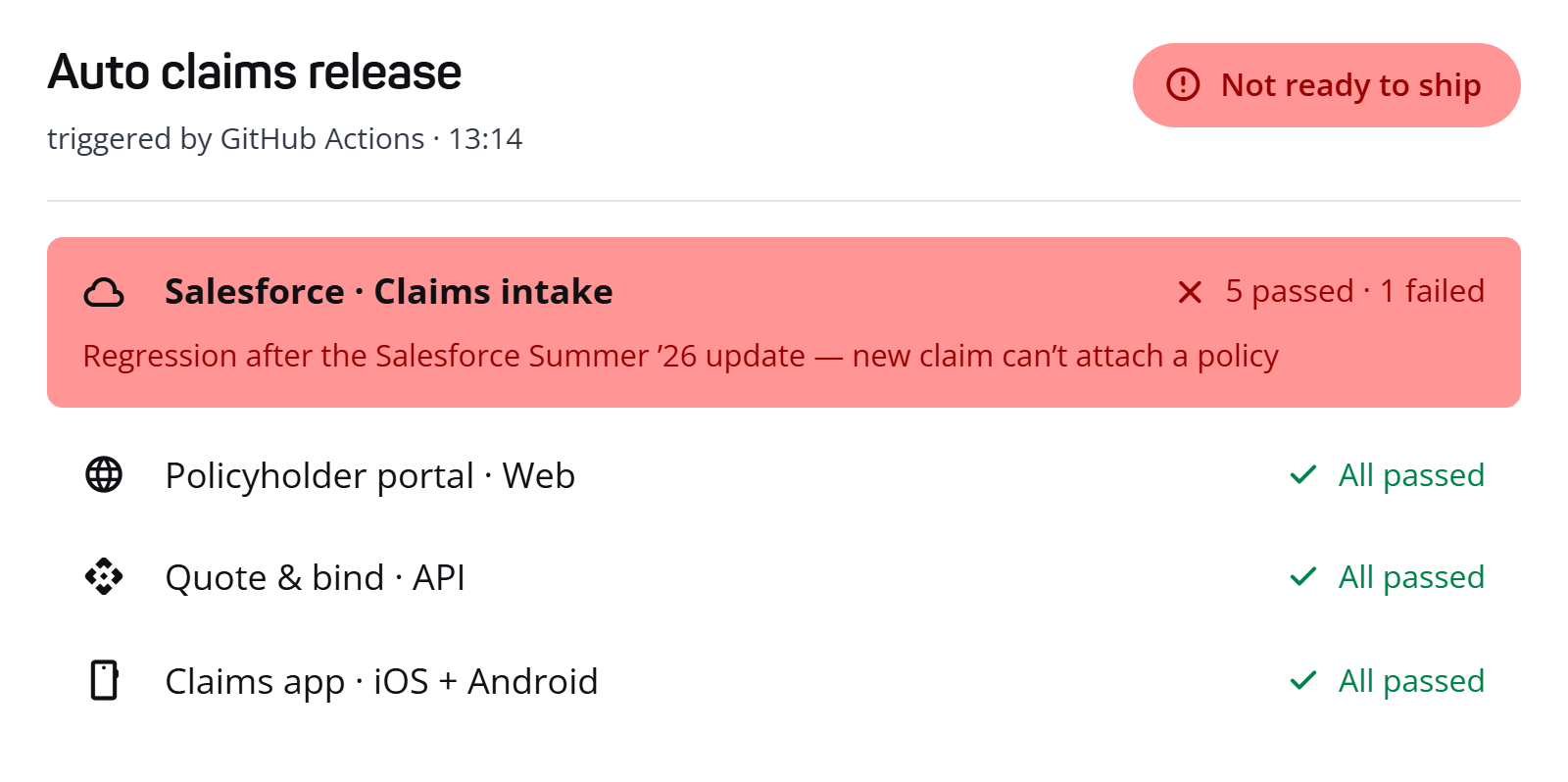
Published users include Barracuda, JetBlue, LendingClub Bank, and Arch Insurance. One unnamed Fortune 500 retailer faced over seventy shipping-rule variations. Its mabl case study reports 32 hours saved per production cycle, a move from monthly to biweekly releases, and a 16% year-over-year reduction in escaping defects. Useful gains, though hardly a warranty for the next buyer.
Seventeen checks, with consequences
In October 2026, mabl engineer Pratish Singh described an internal problem: developers no longer believed a failing gate. An agent initially mapped important journeys to 288 tests. The team settled on 17 before merge, retaining a wider regression suite afterwards. Selecting the gate involved real usage and the consequences of failure. Singh then spent two months stabilising its individual tests.
Illustration: 0.99n, assuming independent failures. These are calculated probabilities, not measured mabl pass rates.
The lesson travels. Decide which outcomes matter, make those checks credible, and keep broader coverage elsewhere. A gate that people habitually rerun has become a ritual. Adding another candle will not help.
The checker needs checking
mabl’s July 2026 account of its internal agent pipeline provides a useful complication. A reviewer could identify failure symptoms accurately but misread their causes roughly a quarter of the time. The company therefore treated explanations as hypotheses, sending a code-aware investigator to verify them before another agent wrote a fix. Humans retained the final merge.
Even that machinery needed repairs. Parallel fix workers exhausted the host’s memory during an overnight run, prompting isolated verification in CI. A reviewer pursued nine rounds of refinement on one change, prompting a stopping rule. These are unusually instructive admissions from a business selling automation: speed requires resource limits, and an eloquent diagnosis still needs proof.
For customers, the cloud MCP server connects testing to coding-agent environments through around eighty tools. Failure analysis can draw on test history and retry patterns; the same connection supports creation, recovery, and reporting. That puts evidence nearer the person changing the code, while leaving the quality decision worth arguing over.
Who pays for the machinery?
Selenium and Playwright offer code-based browser automation; Testim is a commercial alternative with AI-powered authoring and resilient locators. Playwright itself includes recording, tracing, and parallel execution. mabl’s distinction is the managed, low-code package spanning multiple testing surfaces. The buying question is how much infrastructure and maintenance a team wants to own, and who needs to author the checks.
mabl provides customized quotes and a fourteen-day trial. Its pricing page includes unlimited local and CI runs and cloud concurrency, but cloud executions consume credits. Mobile testing and technical account management appear as add-ons. A buyer should test representative journeys and compare the whole operating bill: subscription, cloud usage, setup, maintenance, and staff time.
The offer makes sense where repeated workflows and frequent changes consume QA capacity. Teams with a well-maintained code-based suite may have less reason to switch. A recorded click still needs a meaningful assertion. The sensible trial asks whether a saved policy, delivered email, or completed upload survives the journey. A green light should mean somebody checked the destination.