At Dropbox, a roomful of engineers would click through the same workflows, week after week, hunting for whatever the new code had disturbed. The ritual worked. It was also expensive, repetitive and oddly wasteful: when the bug bash ended, the recordings of all that careful human behavior were thrown away. Gabriel Spencer-Harper, then a software engineer, saw the discarded material and asked the question that became Meticulous: what if those sessions were the tests?
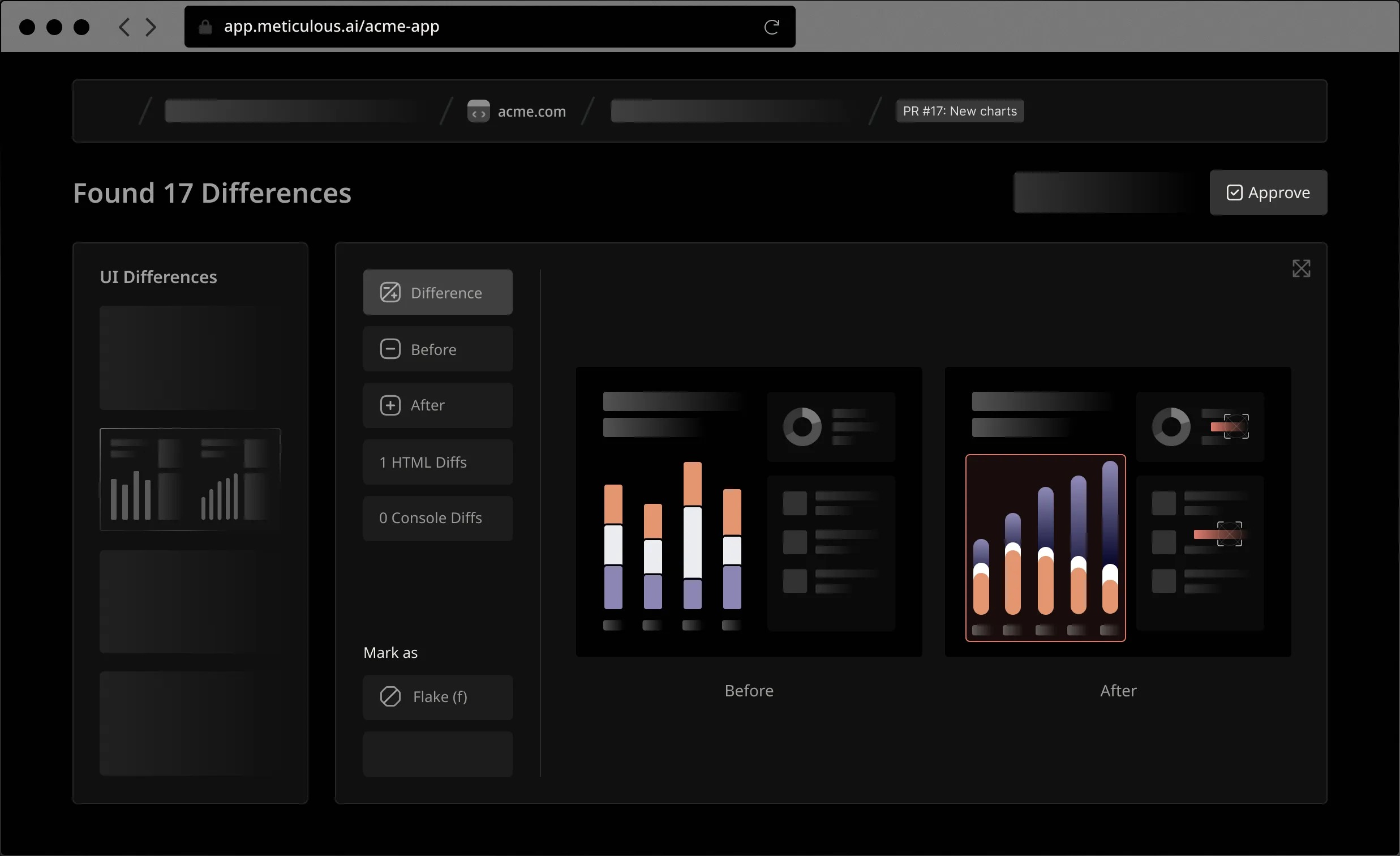
Five years after its 2021 founding, Meticulous has turned that observation into a serious enterprise developer tool. A small JavaScript recorder watches how developers, coding agents and, in some deployments, users move through a web application. The system links those journeys to the code they exercise. When a pull request appears, it selects the relevant flows, replays them against the old and new versions, and presents the differences - visual, behavioral and logical - for a human to approve.
The company says this now happens across more than 90,000 pull requests and 1.5 billion snapshots each month. Customers named publicly include Notion, Dropbox, ElevenLabs, Wiz, Mercor, CoreWeave, LaunchDarkly and Engine. In July, Meticulous raised a $15 million Series A led by Chemistry, with Menlo Ventures participating, after reporting fivefold annual recurring-revenue growth. The financial numbers are the headline. The product's real appeal is more domestic: nobody wants to spend Friday afternoon repairing a test that failed because Tuesday's loading spinner was 200 milliseconds late.
The mechanismIt harvests behavior, then replays the useful bits
Traditional end-to-end testing starts with an author. Someone decides that a workflow matters, writes a script in Cypress or Playwright, prepares test data, mocks unstable services and maintains the result as the interface evolves. Meticulous starts one step earlier. It captures interactions that are already happening on localhost, preview, QA or staging environments. Production recording is possible, but the company recommends beginning internally.
At test time, saved backend responses can be replayed automatically. A simulated signup does not create ten thousand fake accounts; a changing API response does not turn a passing test red. Meticulous has also modified Chromium's scheduling layer to make browser execution deterministic. That is the technical heart of its anti-flake claim. Rather than retrying noise until it goes away, the system tries to remove the timing variation that produced the noise.
Then comes scale. For some changes, the platform can dispatch up to 10,000 browsers in parallel. Algorithms discard redundant sessions and select flows that traverse distinct paths. Snapshots are compared after each action, not merely at the finish line. If a button stops opening a modal, a dependency nudges a layout or a business rule renders the wrong state, the reviewer sees the before and after.
The first thing to fail was the old bargain
The most persuasive evidence comes from customers describing what broke before Meticulous. At Engine, a travel platform with more than 300 engineers, the Cypress stack had accumulated the familiar ailments: long runtimes, high maintenance and fuzzy ownership. The company says roughly 50 bugs escaped from its primary application each month, and each took about five hours to report, triage, assign and prevent from recurring. The test suite existed. The reliable signal did not.
Engine installed Meticulous for a pilot and received visual diffs on the first day. In its final week, 78 percent of surveyed engineers said the tool caught a bug they had struggled to detect during that week; 93 percent said it improved their developer experience. That trial changed management's mind. Engine later estimated more than 250 engineering hours saved each month and called redesign work ten times faster.
“Meticulous is one of our most expensive tools, but if we quantify it in terms of hours saved and reduced labor costs, it's an incredible value.”Colin Hanna · Principal Engineer, Engine
That is the clearest public answer to what it costs: enough to stand out in an enterprise tool budget, but no published dollar amount. Meticulous uses custom pricing. A buyer therefore has to compare the quote with the unglamorous ledger of avoided work - hours spent writing and fixing tests, time lost waiting for CI, escaped incidents and delayed migrations. Engine says its savings approximate a testing team. Power, the clinical-trials marketplace, estimated Meticulous saved about 10 hours for every 40 hours of frontend engineering while requiring roughly one cumulative hour of weekly attention.
Skepticism lasted until the first uncomfortable proof
LaunchDarkly's story has comic timing. Principal engineer Zach Davis heard about Meticulous from a friend and began a rollout while remaining skeptical. On day one, LaunchDarkly had a production incident. Meticulous, not yet fully in place, had been the only system to flag the problem. Davis concluded it could have prevented the incident if deployment had happened an hour earlier. The tool's theoretical promise became a very specific missed save.
After adoption, LaunchDarkly reported an 80 percent reduction in major frontend incidents. The system maps 52,310 user flows and generates millions of snapshots in the company's published monthly example. That coverage matters when a shared design system lives in another repository, or when a dependency update can disturb an obscure override. It also changes the economics of AI coding. Generating a patch cheaply is not much help if senior engineers must spend the afternoon proving it did no damage.
Notion faced a different form of disbelief. Its interface contains nested components, feature flags, themes and contextual variations that multiply faster than a hand-authored suite. One cited regression lived in an inline database view, inside a peek view, inside a database page, in dark mode. Nobody would reasonably have written that test. Recorded behavior happened to cover it.
Notion piloted the product, then expanded it across the engineering organization. It reports catching five to ten bugs per week, reducing frontend testing and maintenance effort by 30 percent, and covering 70 percent of its most critical frontend functionality. During one migration, a designer replaced thousands of icons and used Meticulous to inspect hundreds of real screens. The win was not merely fewer bugs. Engineers became more willing to delete, refactor and experiment because the cost of checking the consequences had fallen.

The useful idea to steal
The copyable part is not “add AI.” Meticulous's own hiring material says its core capability does not depend on transformers or large language models. The sharper pattern is to identify a valuable by-product of work customers already perform. Developers already click through their features. Those interactions contain routes, states, data shapes and edge cases. Capture that exhaust, connect it to the artifact being changed, automate the repetitive replay, and leave judgment with the human.
A smaller team can borrow the sequence without building a browser company: record representative flows, tie every critical journey to an owner, save deterministic fixtures, run only the tests implicated by a code change, and make the result visual enough to inspect in seconds. The standard is not maximum test count. It is minimum maintenance cost per useful signal.
Copy this
Capture work already happening. Convert it into reusable coverage. Make the feedback legible. Measure incidents and hours, not test count.
Do not copy blindly
Recorded traffic is sensitive. Coverage can look exhaustive while missing unseen behavior. A visual difference still needs human judgment.
Where the model bends
Meticulous is not a replacement for every kind of quality assurance. Its current strength is complex, Chromium-based web frontends. Teams that require native mobile testing, broad cross-browser compatibility, accessibility audits, load testing, security testing or complete backend verification still need other systems. The company plans to move into backend and performance testing; planning is not shipping.
The approach is also weaker when useful behavior is not exercised in recorded environments. A brand-new feature has no history until someone or some agent touches it. Rare paths may remain absent, and a network replay can prove the frontend behaves consistently against an old response without proving today's live backend is correct. Meticulous says it warns when changed code lacks coverage, but “near exhaustive” should not be read as metaphysical certainty.
There are governance conditions, too. Session capture demands care around personal or regulated data, even with internal deployment and a SOC 2 Type II program. Very small products with simple interfaces may find a conventional Playwright suite cheaper and adequate. Teams that cannot make preview builds stable, cannot connect CI, or will not review visual diffs will not receive the promised loop. Automation removes authoring and maintenance; it does not remove responsibility.
Still, Meticulous fits its moment neatly. Gabriel brings the original Dropbox and Opendoor frustration; his brother and CTO, Quentin Spencer-Harper, brings a decade of experience with enormous frontend systems at Palantir. Their company sits between code generation and deployment, selling confidence at precisely the point where cheap code has made confidence scarce. Its competitors offer scripted testing, visual snapshots, device clouds and increasingly capable AI agents. Meticulous's distinction is the combination: observed sessions, automatic suite evolution, code-aware selection, network replay and deterministic execution at brute-force scale.
The old test suite was a manuscript engineers had to keep editing. Meticulous wants it to behave more like a living index of the product itself. Whether that becomes the default depends on coverage, privacy, cost and expansion beyond the frontend. But the founding question remains excellent: if your team already performs the work, why are you throwing the evidence away?