The first pair of shoes Gwen Hurt bought with her own money were gold, closed-toe kitten heels. She was 13, the money came from a summer job, and the shoes came from a clearance rack. They were not merely footwear. Until then, she and her siblings generally had one pair each for an entire year. A sole repaired with cardboard was not a metaphor in her childhood. It was maintenance.
Years later, Hurt would travel widely for work and pick up shoes along the way. The collection grew. So did a career that carried her far from those improvised soles: more than 15 years in technology, seven of them living in Hong Kong, building a global process and controls organization and leading teams spread across the Americas, Asia and Europe.
Then 2013 arrived with bad timing and no manners. Her company eliminated her role. Days later came a car crash involving Hurt and her daughter Brittny. In the long aftermath, the mother and daughter began imagining a business together. Wine was already one of Gwen's fascinations. Shoes supplied the name. Brittny supplied the nudge and the marketing instinct. Shoe Crazy Wine began as a declaration before it became a company.
“I told my daughter Brittny, ‘We are going into the wine business.’”Gwen Hurt
Act IThe old skills in a new bottle
Career changes are usually packaged as reinventions, as if the previous self vanished when the business card changed. Hurt's second act is more interesting because the first act remained visible. Wine was a new industry, but process was not. Neither were cross-cultural communication, financial controls, team leadership or the habit of looking several years ahead.
She planned in two-, three- and five-year horizons. The company would begin online and direct, build a retail base, pursue distribution and look beyond Virginia. Hurt had lived inside an international operating system; she did not see her new company as a local curiosity. “I've always known that, if I want my business to be around in 10 or 15 years, I can't be afraid to expand,” she said.
The products were private-label blends made with partner vineyards. Hurt worked on flavor ideas and specifications, then collaborated with producers to translate them into bottles. Her customer was easy to describe and often underserved by the solemn vocabulary of wine: someone who wanted a smoother, lighter, sweeter drink and did not require a lecture with it.
Hurt called this preference a “soft palate.” The phrase did useful work. It named a customer without condescension. In a crowded category, Shoe Crazy Wine was not trying to win every argument about taste. It was trying to make one drinker feel recognized.
Recognition, however, was not the same as knowledge. Hurt has been unusually candid about how she entered the industry: the original decision came from emotion, not market research. She knew what she liked in a glass and what she could build in an organization. She did not yet know the maze of production, licensing, compliance, wholesale relationships and retail calendars that sits between those two things.
The education was expensive. An early business partner took financial advantage of her, Hurt later said. She withdrew from a Singapore deal when the arrangement no longer worked. At one point, preserving the company meant putting her own pocketbook on the line. None of this belongs in the pretty mythology of uncorking a dream. It belongs in the operator's account of what the dream costs.
Her response was not to pretend the mistakes had been strategic. It was to turn each one into a rule: research the industry before entering it, understand the numbers, plan the next horizon and do not repeat a hard lesson. Candor made her advice more useful. “You’ve got your heart, your soul, your faith, and your pocketbook,” she said of the founder's inventory. Only one of those items appears on a balance sheet, but all four can be spent.
Act IIA shoe that could hold a story
The brand's name is a compact piece of autobiography. Hurt grew up wanting the simple abundance of enough food and shoes in many colors. The adult collection answered the childhood wish. The company turned that answer outward.
For the label, Hurt gave artist Ellen Ross an unusually precise imaginative brief: a woman sitting inside a shoe, holding a wine glass. The woman should not be ethnically defined. She should be “every woman and no one woman.” Ross drew the figure as Hurt had pictured her. The resulting mark, registered in 2014, made the promise visible: wine, a heel and a person taking her leisure seriously.
There is wit in the image, but also discipline. The shoe connects the company name to a human memory, travels neatly across bottles and merchandise, and makes a crowded retail shelf easier to scan. A founder's private symbol became a public mnemonic. Many origin stories decorate an About page. This one performs actual labor.
Act IIIThe shelf was the exam
In June 2018, Hurt and a small team went to Arkansas for Walmart's annual Open Call. Hundreds of entrepreneurs were pitching products. The setting invited a television comparison; Hurt treated it as a business meeting.
She walked Walmart stores and studied how they laid out wine. She photographed displays. She researched the retailer's ambitions and considered how Shoe Crazy Wine might fit the customer Walmart wanted to reach. Edwin Gommers prepared pricing and margin figures. Hurt's son Daniel brought retail-sales fluency. The presentation contained projections, financial statements and a tasting. The trio arrived carrying personality and paperwork in equal measure.
They left with a distribution agreement. It is tempting to make the meeting a tale about a dramatic yes. Hurt's version is more useful: the yes was preceded by pictures of shelves, fluency in margins and a team in which each person knew which part of the case to make.
The Gwen Hurt retail playbook
- Study the room before asking to enter it. Hurt researched store layouts and the buyer's strategy.
- Let specialists speak. Finance, sales and story each had an owner in the Walmart pitch.
- Name the customer plainly. “Soft palate” made an overlooked preference legible.
- Prepare for the scale you want. National ambition appeared in the operating plan early.
- Make rejection ordinary. “Be prepared to hear ‘no,’” Hurt advises. “It's never personal - only business.”
The same practicality appeared in her export work. When Hurt met a potential distributor in Mexico in 2017, she filled a suitcase with the range so the buyer could conduct a full tasting. After Shoe Crazy Wine won a $5,000 export pitch grant the following year, part of the money would solve that wonderfully literal founder problem: next time, the bottles could be shipped.
A shoe print across the map
Gwen and Brittny decide to build the company; Shoe Crazy Wine LLC is formed.
Retail accounts include independents and larger chains, while Hurt pursues export relationships.
An export pitch grant and Walmart Open Call agreement turn expansion plans into specific doors.
The brand reports reach in 11 states and Washington, D.C.; Hurt is honored among Virginia's women in leadership.
The inaugural Wine Shoes and Brew Festival extends the brand into its own gathering.
Act IVThe family in the fine print
The lone-founder myth fits poorly here. Brittny is not a decorative co-star in the origin story; she became head of marketing. Hurt's sons also worked in the business. Gommers carried financial responsibilities. Mentors David Grogan and Doug Carleton helped Hurt think through cash flow and marketing. Hurt has described Shoe Crazy Wine and Spirits as “a story of family and friends,” then named the village.
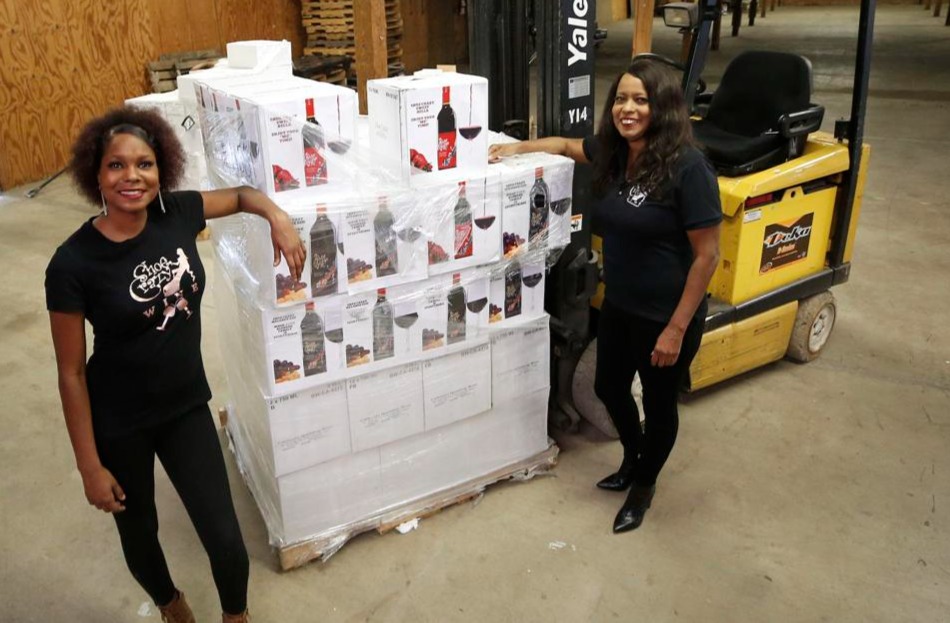
That habit of naming people says something about her operating style. Hurt presents as the front-of-house storyteller, a role for which her shoe collection and frankness make her unusually well dressed. Behind the story sits a distributed set of skills. The brand benefits from the warmth of family, but its growth depends on clear jobs, retailer relationships and the stubborn logistics visible in a warehouse pallet.
By 2022, Shoe Crazy Wine was sold through retailers including Total Wine & More, Sam's Club and Walmart, with reach reported across 11 states and Washington, D.C. That year Hurt was one of 42 women selected for Virginia Business's Women in Leadership honors. She had also produced wines for three other women of color, part of a larger ambition she stated plainly: “Our goal, as always, is to support and help grow women in the industry.”
“Passion and tenacity are tantamount to surviving in any industry.”Gwen Hurt
The takeawayMake the memory useful
Hurt calls herself an “encore-preneur,” a charming phrase with a serious implication. A second act does not begin at zero. Her palate developed during global travel. Her scale instincts came from technology. Her brand came from childhood. Her co-founder came from family. Even the television moment that helped Brittny frame the possibility of a wine company became raw material.
The useful lesson is not to mine every difficult memory for content. It is to notice which memory already contains a promise. For Hurt, the gold kitten heels represented choice, pleasure and proof that circumstances could change. Shoe Crazy Wine gave that old promise a commercial shape without sanding away its personality.
Then she did the less cinematic work. She learned the category, refined blends, studied shelves, carried bottles, heard no, watched cash and built distribution. The shoe got attention. The operator kept walking.