At 24, Guy Pearson was offered a partnership in an accounting firm. It was the sort of invitation that makes a career sound agreeably settled. He declined it, went traveling for a year and spent his money. He would eventually come home and start a firm of his own. The accountant had taken a rather expensive interest in freedom.
His objection to the partnership was practical. The firm was moving into a listed group, and he wanted more control over his future. He was interested in business growth, too, and could see cloud software changing what an accounting practice might become. He wanted to find out what happened when you designed around those possibilities from the beginning.
That question has followed him through two businesses. First came Interactive Accounting, now Scendar. Then came Ignition, the software company he co-founded with Dane Thomas. In January 2025, Pearson moved from CEO to Executive Chairman. Across those chapters runs a persistent curiosity: how do you build something that can keep working when you leave the room?
A firm with room for an exit
Pearson grew up in Sydney with sporting ambitions. Basketball and professional bodyboarding appealed. His own assessment of why they did not become careers is cheerfully unsentimental: insufficient talent. Accounting turned out to offer a better match for his abilities with numbers and relationships. He earned a commerce degree in accounting and qualified as a Chartered Accountant.
There was another education happening alongside the formal one. Working with entrepreneurial clients gave him a view of how businesses operated, and an early boss let him take on new challenges. Pearson has credited those opportunities with encouraging his own appetite for starting things. Between his accounting firm and Ignition, he founded three other businesses that did not survive.
Interactive Accounting began in 2009. He ran it from his home in Sydney’s Freshwater, using cloud tools wherever he could. A server for tax software remained an irritating exception. His interest was in a firm whose systems could accommodate more clients, rather than one that required him to perform a fresh administrative rescue with every arrival.
The calendar needed a laboratory
One of Pearson’s more useful observations about accounting is that a firm needs research and development. The phrase sounds grander than the work can look. In his own practice, it included confronting a monthly reconciliation process that was manageable at ten transactions and painfully slow at 200. More customers were revealing a problem in the machinery.
Within the first 18 months, he says, he hired an accountant, a tax director and a CFO, and stopped doing client work himself. That made room to study and improve the business. After three years, the practice was generating more than AU$2 million in annual revenue. By then, he had become a shareholder with a team running it.
There is an unfashionable patience in that sequence. Before another tool comes the time to understand the work. Pearson’s advice is to reserve time for R&D as deliberately as any other recurring obligation. Otherwise, the task that feels most urgent today gets to design the company you will have tomorrow.
“I planned as if we were gonna win.”
Guy Pearson
The shortcut between yes and paid
A coffee conversation in 2008 had introduced Pearson to Xero. His best friend and his friend’s father, both in technology, mentioned the New Zealand cloud accounting company. Pearson went home to investigate. Eventually he was running a Xero practice, with an ecosystem of tools around the ledger, and looking for a smoother way to manage client proposals.
Software was already part of his working life. Turning an idea into a software business was another education altogether. He has described the difficulty of moving from an accountant’s perspective to product execution, and learning to accept that other firm owners might want to operate differently. Personal experience could identify a problem; it could not settle every customer’s preferences.
Ignition officially launched in Sydney on 19 February 2013. Pearson and Thomas were addressing the space between agreeing to do work and receiving the money for it. A firm might be good at advising clients while still spending too much effort getting an agreement signed, making its billing clear and following up afterward. The ordinary parts of doing business had become a business opportunity.
- 01 Propose
- 02 Agree
- 03 Bill
- 04 Collect
One client relationship. Fewer separate handoffs.
The product brought digital proposals and engagement letters together with payment details and signatures. Connected applications could then carry the work into onboarding and invoicing. For the client, the attraction was a clearer transaction. For the accountant, it was the prospect of spending less time conducting an expedition through separate systems.
Payments also made geography a product problem. Ignition integrated Stripe for US payments in 2015 and migrated its integrated payments globally to Stripe in 2019. Moving into another country required support for how people there actually paid. The ambition might travel readily; direct debit arrangements required more attention to detail.
Accounting, with a dress code for orbit
Early on, the company made an unusually literal effort to stand out. Pearson and his colleagues appeared at industry conferences in spacesuits. People came over, took pictures and remembered them. An accountant in astronaut clothing is a reasonable cause for curiosity, particularly when everyone else is trying to explain a workflow on a retractable banner.
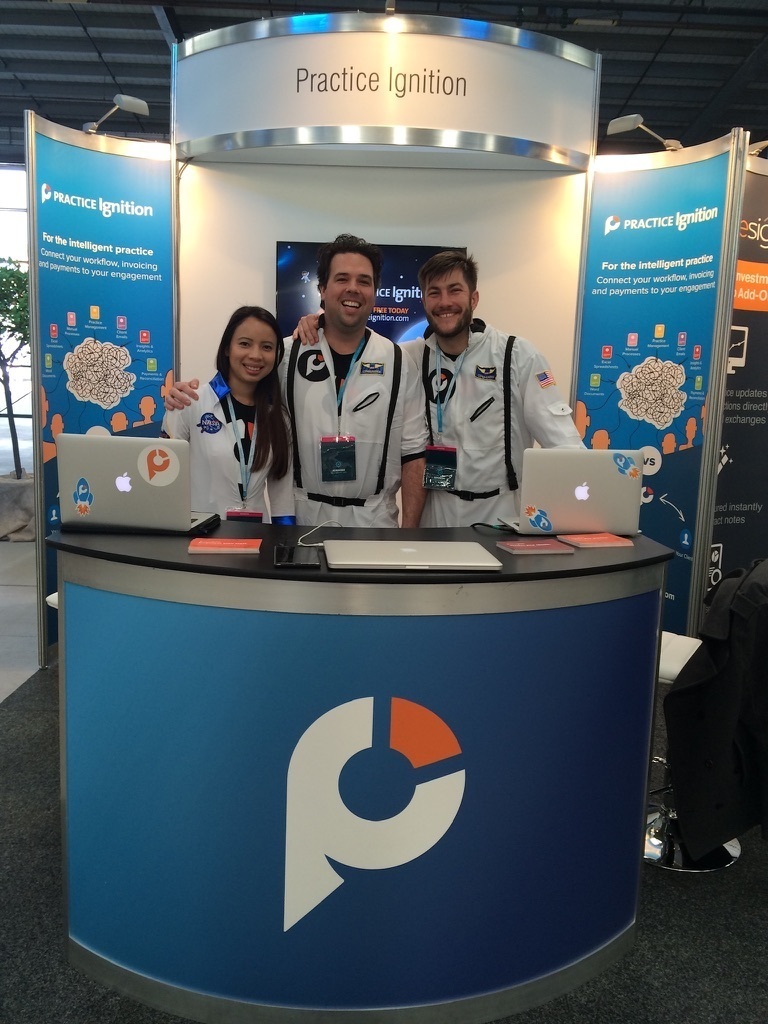
The photograph is a useful record of a company before its story became tidy. Laptops sit on the counter. The old Practice Ignition name curves over the stand. The people selling the software are also the attraction. It is hard to imagine anyone confusing this particular accounting exhibit with the next one.
The business grew beyond that early name. In 2022, Practice Ignition publicly introduced itself as Ignition, reflecting a broader client engagement and commerce proposition. The shorter name suited an expanding idea: the same awkward journey from agreement to payment occurred across professional services. Accountants had supplied the starting point.
The people on the other end of the call
Going overseas meant finding people who could learn a market. One of those relationships started long before the company. Pearson and Tom Maxwell knew each other as teenagers in Sydney, bonding over bodyboarding. In 2014, Pearson contacted Maxwell, who had moved to Canada, about helping Ignition build there.
Maxwell had worked across marketing, business development, project management, sales and customer experience. Pearson saw someone suited to the varied demands of an early overseas operation. A decade later, he celebrated his friend’s contribution as VP of Customer Experience, remembering inconvenient flights, odd meeting hours and questionable accommodation. Expansion, in this telling, involved a great deal of showing up.
Pearson’s interests also extended to backing other founders. By a 2020 podcast appearance, he had invested in more than 20 startups since 2013. That conversation described an Ignition with more than 120 staff and $35 million raised to that point. The accountant’s view had widened to encompass teams, capital and the partnerships that help a product travel.
A better price for a familiar skill
Pearson’s advice to accountants often returns to pricing. As early as 2015, he was explaining how to break services into components and build packages around different client needs. It is a distinctly operational way to approach the subject: work out what goes into the service, who delivers it and how frequently the client needs advice.
He later offered a pointed example from his own practice. During the financial-year-end period when he stopped being active in the team, the firm increased prices by 25%. He recalled losing about one client among hundreds, while revenue rose. It is his account of one firm’s experience, rather than a promise about what another firm should charge.
The larger argument is that accountants need enough confidence in their work to explain its value and agree a price. Pearson carried that conversation into an Accountex London appearance in 2023, challenging firms to leave room for investment in their own operations. A business that habitually underprices its work has less freedom to improve how it works.
Revenue generated by Ignition’s 7,000+ customers through the platform that year.
By 2023, Ignition’s customers were generating US$2.1 billion through the platform annually. The figure describes their revenue. Alongside it were more than 2.3 million client payments processed that year. Behind the scale remained the same small sequence of events: someone understands the work, agrees to it, and pays.
The last process to redesign
In January 2025, Pearson announced that Greg Strickland, previously Ignition’s Global President, would become CEO. Pearson would move to Executive Chairman and concentrate more on strategy. He described removing himself as the final bottleneck as a natural part of building a business. The advice he had given accounting clients had reached his own desk.
“It’d be a shame not to follow my own advice.”
The change left him involved as an owner and thought partner. It also completed an unusually consistent arc, from refusing a partnership that offered too little control to building companies with people capable of carrying the work forward. Pearson had spent years studying the handoffs. Eventually, he made one himself.
His story still has room for breweries, wineries, family, friends and time near water. Those are the interests listed alongside the professional biography. The young accountant who went traveling had wanted more room to choose what happened next. After the proposals, the payments and the spacesuits, that remains a fairly understandable ambition.