A solar panel needs sunlight. It also needs someone, or something, to clear the dirt off it. That second, less glamorous problem is the business territory of Pitcon Renewable, a startup incubated by GUIITAR Council at GSFC University in Vadodara. The council announced that the company secured a ₹13 lakh government grant for a universal solar-panel cleaning robot intended for residential rooftops. Here is an innovation story with a refreshingly specific job description: clean the panels.
GUIITAR occupies the space between a promising technical idea and a business capable of delivering it. Established by GSFC University, the nonprofit company brings together laboratories, workspace, mentors and routes to public support. Its name expands to GU Incubation Innovation Technology and Applied Research. The acronym is musical; the work involves prototypes, applications and the patient business of getting something to function.
For a young founder, those pieces belong together. A machine without a customer is an expensive project. A business plan without a working machine is a presentation. GUIITAR's proposition is to help people develop both, using a university as the place where the technical and commercial conversations can meet.
The campus is part of the product
The council's origins are institutional. A university order places its establishment as a Section 8 company in August 2020. The activity archive reaches further back: GSFC University recorded an Idea Junction competition in October 2019. That distinction matters. Entrepreneurship activity was already taking shape before the formal company provided a structure for it.
The university subsequently constituted its Institution's Innovation Council in June 2021. In December 2024, it established a student-managed Entrepreneurship Club. These are different pieces of the same educational setting: an incubator that supports ventures, a university innovation body and a student organization that can bring new participants into the room.
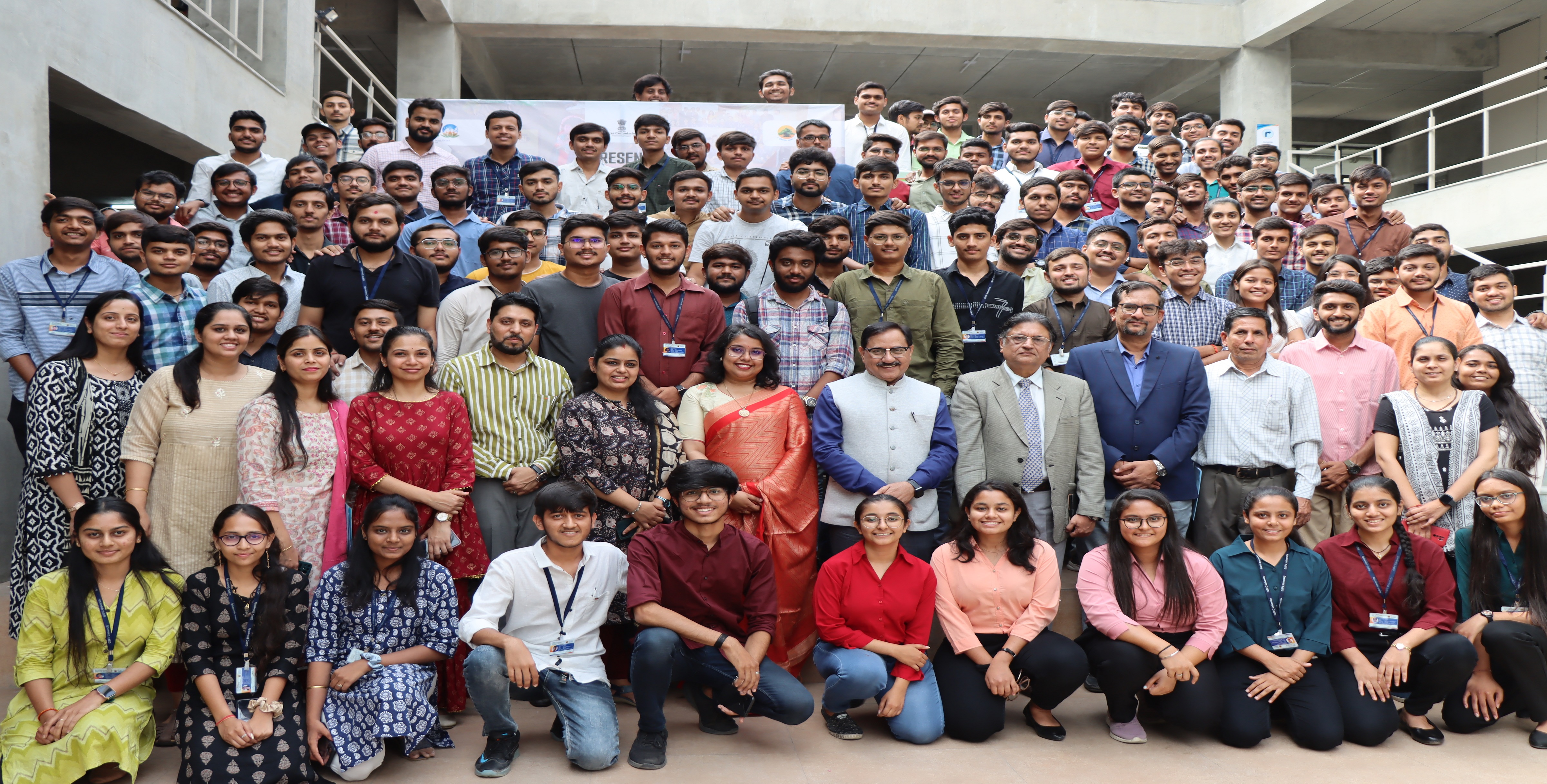
The practical offer includes dedicated or flexible desks, Wi-Fi, meeting rooms and secure access. Its coworking description also specifies pay-as-you-go access to a prototyping lab with 3D printers and a laser cutter. A founder can therefore consider the workspace alongside the equipment needed to build something, rather than treating them as separate searches across the city.
GUIITAR's infrastructure inventory gets satisfyingly concrete. The maker lab lists vinyl cutting as well as laser cutting and 3D printing. There is a design and IoT lab, an advanced drone lab and a Param Shavak DL GPU system for work in machine learning and deep learning. An outdoor collaboration space has its own name, Surjan. Even a campus incubator apparently needs somewhere to escape the meeting room.
That collection helps explain the company's market position. It offers a university setting for technical development alongside business assistance. Ordinary office rental solves the desk problem; founders here can also investigate access to equipment, academic expertise and incubation support. The useful comparison is the work a venture must accomplish in its next few months.
Banana stems, hydrogen and the roof
The companies around GUIITAR give its broad sector list some texture. Alongside Pitcon's cleaning robot, the council has highlighted AquaWelder HyEnergy, which is developing hydrogen combustion solutions for industrial decarbonisation. Its public update reported a ₹10 lakh Grant-in-Aid from Gujarat's Industries Commissionerate. The university named Nitinsinh Raulji as the founder.
Another incubatee, Esha Sutram, is working on plant-based fibres made from banana stems. A university announcement shared through the council reported ₹8 lakh in grant support and named Jayshree Shah and Umesh Patel as founders. Agricultural biomass becomes the starting material for a proposed manufacturing business. The idea is easy to describe; making a material buyers will repeatedly purchase is the demanding part.
These examples make GUIITAR's interests in clean technology, manufacturing and environmental applications tangible. They also show why the incubator's beneficiaries are better understood as builders than as a single industry segment. A rooftop device, a combustion system and a fibre product have different development problems. All can need help connecting technical work to a commercial proposal.
Government grant awards reported by the council/university. These are startup awards, not GUIITAR's own fundraising or product sales.
The distinction between an award and a market result is essential. Funding gives a team resources to continue development. A repeat order would answer a different question about customer demand. Readers considering these ventures should keep those milestones separate, just as they would for a much larger company announcing a research grant.
A grant ceiling is not a cheque
GUIITAR has been recognized as a Nodal Institute by Gujarat's Industries Commissionerate under the startup assistance scheme associated with the Gujarat Industrial Policy 2020. Its role is to assess, validate and recommend proposals to the commissionerate. That makes the council an intermediary with a defined evaluation function.
Its published scheme page lists seed support of up to ₹30 lakh per startup, alongside allowances and assistance for skills, acceleration and social impact. These are scheme provisions for approved applicants. The number at the top of a funding page is a ceiling, and an individual project's approval determines what it actually receives.
Students have another route. GUIITAR's SSIP 2.0 page describes proof-of-concept or minimum viable prototype support of up to ₹2.5 lakh, with separate provisions for school-level projects and intellectual property. The stated policy period runs from January 2022 through March 2027. Eligibility includes specified student, alumni and dropout groups up to age 35.
The practical lesson for an applicant is to begin with the project stage and eligibility category. A student testing a first prototype and a registered startup developing a product may arrive at different application routes. Preparing a clear account of what the money will test is more useful than building a plan around the largest advertised figure.
The price includes obligations
The published startup policy divides the process into Spark-up, Grooming, Incubation and Graduation. Applicants describe an idea, face evaluation and develop a business proposal. The later stages introduce prototype or pilot review, registration and reporting. It is a structured relationship, with obligations on the venture as well as support from the incubator.
Costs depend on that relationship. The policy provides for commercial charges for departmental resources and case-specific equity or revenue sharing. Seed loans depend on eligibility and available funds. It also describes an 18-month stay unless extended. A founder comparing offers should put equipment charges, ownership terms and reporting commitments on the same page before signing.
The organization's operating model also includes an ambition to earn income. A university recruitment document for its incubation chief explicitly includes revenue-generating entrepreneurship and training programs, resource mobilization and corporate social responsibility fundraising among the responsibilities. Nonprofit status and earned income can coexist in this model; the mission is supporting enterprise development.
The experts have different day jobs
GUIITAR's published team page identifies university provost G. R. Sinha as CEO, with Kirankumar Parmar as senior manager, Bhuvan Vyas handling incubation management and Amit Duggal in a senior technical role. The wider roster includes faculty, technical associates and laboratory staff. It shows how the council draws on people working across the university.
The industry mentor list brings another set of perspectives. It includes Dhruv Nath of Lead Angels Network, intellectual-property professional Bhavik B. Patel of INFINVENT IP and Brijesh M. Garala of Oviyan Cast & Forge. Their listed backgrounds span investment, IP and manufacturing. A founder's useful question becomes specific: which person can help resolve the next decision?
Training offers a glimpse of that expertise in use. A February 2024 3D-printing workshop drew 75 students from technology, science and management, according to the university's report. Shaurin Patel of Vexma Technologies delivered the session, which covered printers, materials, software parameters and post-processing. That final topic is a welcome detail. The object coming off a printer is not always the finished object.
A January 2025 session addressed a different problem: reaching customers. Led by GSFC alumnus and Hiraeth Tech founder Shubham Solanki, it brought 45 participants into a discussion of target audiences, branding, marketing channels and campaign choices. It suggests a program willing to spend time on the commercial work around an invention, as well as the invention itself.
Teach the mistake before it gets expensive
In September 2026, GUIITAR promoted a student activity called Startup Detective: investigate a business mistake, propose a fix and explain it in a short Instagram Reel. The exercise gives failure a classroom format. It asks participants to make a diagnosis and defend it, which is a useful discipline even before they have a company of their own.
“Innovation is not to repeat a success story but to celebrate a failure.”G. R. Sinha, in his published provost's message
The event calendar supplies other connections to the wider startup community. It lists a January 2026 faculty entrepreneurship program with TIDES at IIT Roorkee and a My Startup Story session with eChai. The summer schedule includes venture creation, drone training and laser-cutting and 3D-scanning activities. Together, these are opportunities to practice, meet people and return with a more precise problem.
The transferable idea is fairly modest: put access to tools, commercial feedback and application support close enough together that an early founder can use all three. Another institution could start by mapping its available equipment, assigning people to help with access and arranging focused conversations with practitioners. A long list of facilities becomes useful when someone can turn it into a next appointment.
This approach fits ventures that still need experiments, prototypes and guidance. A business whose immediate need is a large sales organization or a production plant will have a different shopping list. For GUIITAR's intended users, the immediate opportunity is more concrete: bring a problem, identify the next test and find the people and equipment needed to run it. The clean solar panel is a good place to remember what all the paperwork is for.