Guanchun Wang had a butterfly problem. In July 2022, writing to mark Laiye’s seventh birthday, he reached for the familiar image of a company emerging from its cocoon. Then he supplied the inconvenient domestic detail: his son’s silkworms had failed to make it through. Their supply of mulberry leaves had been cut off in Shanghai. Even a metaphor, apparently, needs a functioning supply chain.
It was a small admission in a letter full of expansion, new colleagues and new markets. It also made the chairman sound like a person. The transformation he wanted for his business was possible, he said, but hardly guaranteed. A founder could draw the butterfly on the presentation slide. He still had to feed the silkworm.
Wang, also known as Arvid, is Laiye’s co-founder, chairman and chief executive. His working life has moved from electrical engineering to movie recommendations, from Baidu to software that handles office tasks. The recurring question is wonderfully ordinary: what would people rather be doing with their time?
First, what shall we watch tonight?
Wang was born in Shanghai. His early personal biography lists Gaoyi Elementary School and Nanyang Model Middle School, followed by Shanghai Jiao Tong University and Princeton. It also records internships at McKinsey and Goldman Sachs. That is a fairly polished route into professional life. The first business he went on to lead, however, addressed a less solemn matter than a balance sheet.
After receiving his Princeton doctorate in electrical engineering in 2011, he co-founded Jinwankansha. Its name means “what to watch tonight.” The service recommended movies using tastes and friends. Someone with a technical education had decided to tackle the evening argument over the remote control. There are worse introductions to the difficulties of understanding human preferences.
He was its co-founder and CEO. The company was founded in 2012, and Baidu acquired it in November that year. Wang then led Baidu’s HCI APP operation. The move carried him from an independent recommendation business into a much larger technology organization, where human-computer interaction was part of his remit.
Consider the distance between choosing a film and processing an invoice. The objects are different; the hope of reducing a tiresome interval is recognizably similar. That continuity is a way to read Wang’s career, rather than a claim that he planned every subsequent turn. A useful assistant earns its place by making the next step easier.
An assistant, ahead of its time
In 2015, Wang founded Laiye with Gu Ji and Hu Yichuan. The company began with Xiaolai, a personal assistant chatbot on WeChat. In 2017 came Wulai, a chatbot platform. The early shape of the business was conversational: software that could take a request in language people already used.
Years later, looking back after ChatGPT had arrived, Wang described the original ambition as a chatbot with comparable power. His explanation for the gap between ambition and execution was brief: “But the technology was not there yet.” It is a useful sentence from an AI founder. A compelling idea can arrive before the means of making it work.
That admission matters to the story because Laiye did not spend the intervening years selling conversation alone. The business expanded into tools that could carry out repetitive actions and interpret documents. Wang’s assistant gradually acquired more chores. Talking to a computer was the beginning of the request; completing the request required other abilities.
Giving the conversation a pair of hands
The consequential turn came in 2019. Laiye merged with Awesome Technology and launched its UiBot robotic process automation product line. The company also announced a $35 million Series B+ round led by Cathay Innovation, with participation from Wu Capital and Lightspeed China Partners. Li Wei, previously UiBot’s CEO, became co-CEO and president of Laiye.
Wang’s description of the combination was bodily and memorable: bots with “both brains and hands.” Conversational software could understand a request; process automation could perform the sequence of actions. The attraction was in joining those abilities. A helpful answer has limited value when a person must still perform every subsequent click.
The merger also brought people with experience building automation products and a developer community. That detail is easy to lose behind a financing number. Wang was bringing together two kinds of expertise, with colleagues who had spent years on the practical business of making software act.
The photograph that HR should not have to chase
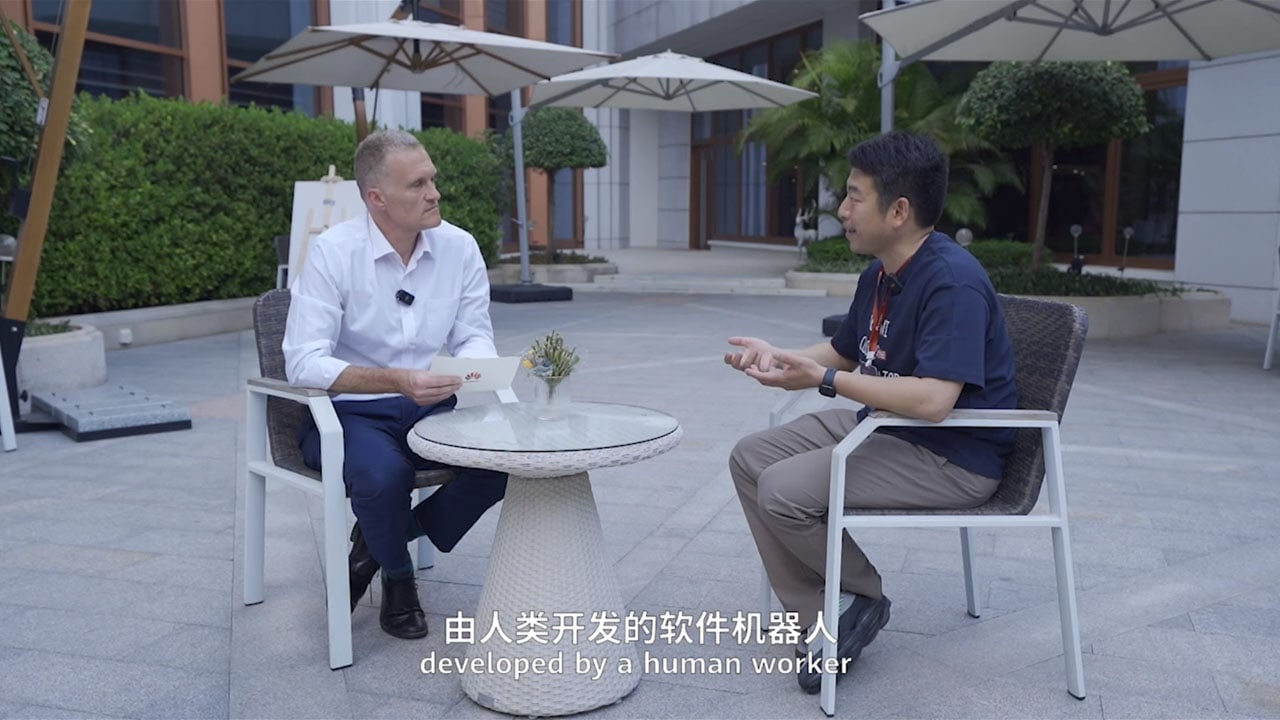
For all the grand language attached to artificial intelligence, one of Wang’s examples was an employee photograph. Laiye required staff to upload actual photos to its company software. Checking everyone’s compliance and sending individual reminders created work for HR. A digital worker could handle that chase.
It is almost aggressively unglamorous. There is no cinematic machine, no thunderous demonstration of intelligence. There is a missing picture and someone who would otherwise have to send another reminder. The example makes his argument legible: the office contains plenty of work whose importance is real and whose repetition is tedious.
In the same discussion, he described automating financial reconciliation, reimbursement and billing, as well as account setup for new employees. His team paid attention to how customers actually used the products. Selling the software was one event; seeing it become useful in a customer’s working routine was another.
Read as a statement of priorities, these examples suggest a founder interested in the connective tissue of an organization. They are about the jobs between the jobs. Wang’s case for accessibility begins there: people who understand the business should be able to use the tools, without first acquiring an elaborate new technical identity.
A Paris chapter, and a first live interview
In April 2022, Laiye acquired Mindsay, a European chatbot and voicebot platform based in Paris. The deal came with plans for a Paris research and development hub. Mindsay co-founder Guillaume Laporte was to lead Laiye’s international chatbot business; his colleagues Ilias Hicham and Pierre Pakey took product roles. Expansion had names and responsibilities attached to it.
The same month, Laiye announced that its Series C financing had reached $160 million across the round’s stages. The final tranche was $70 million. Its announcement put the international team at more than 100 employees and the registered developer community at more than 600,000. Those were company figures for that moment, rather than a census of today.
Total Series C financing across its stages.
The closing tranche accounted for $70 million.
Wang discussed the funding and expansion with Martin Soong on CNBC’s Squawk Box Asia. Afterwards, he wrote that it had been his first live television interview. That brief confession supplies a different scale for the same milestone. The company had an international financing story; its chief executive was also doing something for the first time.
His post credited the team and expressed anticipation for the journey ahead. It is worth keeping that human proportion in view. Acquisition announcements can make growth look like movement on a map. A business still expands through people taking unfamiliar meetings, accepting new roles and learning to explain themselves to new audiences.
Seven years behind the first attempt
In March 2023, Laiye entered Gartner’s Magic Quadrant for Enterprise Conversational AI Platforms as a Niche Player. Asked about being included on its first attempt, Wang shifted attention to the seven years spent improving the product. The debut in a report was a public occasion; the work behind it had a much longer calendar.
He also addressed the arrival of ChatGPT. He saw opportunity for enterprise software that incorporated stronger language capabilities while attending to accuracy and data security. A general conversational model and an organization’s working requirements had to be brought together. The exciting new capability still needed to fit the customer’s job.
That is a more demanding ambition than simply making an assistant sound agreeable. In an office, a plausible response can start a process that affects other people. Wang’s emphasis on enterprise requirements places obligations around the conversation. The assistant has to be useful within the organization that employs it.
“To make work less work and make human more human.”
Guanchun Wang / July 2022
The quieter milestone
By February 2026, Wang’s public letter had a different center of gravity. He reported that Laiye had achieved sustained profitability in the previous year for the first time since its founding. He acknowledged that the preceding years had been uneven and credited focus, patience and the company’s employees.
The same letter emphasized three requirements for enterprise agents: “security, determinism, and governability.” Laiye had introduced Agentic Document Processing and Agentic Process Automation during the previous year. Wang wanted agents operating in controlled environments and working reliably with existing systems. His account of progress gave stability a prominent place beside capability.
In August 2026, that attention appeared in a particularly mundane product update: native Excel handling, PowerPoint processing and automatic separation of mixed document layouts. The company described removing preparation steps that people otherwise performed by hand. An assistant’s usefulness was being pursued inside the spreadsheet and the presentation deck, where a great deal of office life resides.
The butterfly image from four years earlier now reads differently. Wang had allowed uncertainty into the anniversary celebration. By 2026, he was writing about endurance and the demands of keeping a business useful over time. His career had begun by helping people decide what to watch. Its current chapter asks what software can take off their desks. The request is bigger. The person still gets to choose what comes next.