The machinery below ordinary life
The first robot in Gregory Penza’s story was a disappointment. In 1994, the Long Island pipeline contractor bought what he described as the only machine on the market for reopening residential service connections after a sewer main had been relined. It crawled through the new lining, or was supposed to, and cut holes where homes rejoined the main. Penza’s review was brisk: “It didn’t work.” There are worse beginnings for a robotics company. Failure, when it arrives on a paid job with a crew waiting, is an unusually specific form of market research.
Penza tried to repair the machine with a couple of machinists. When that effort ran out of road, they built their own. The episode did more than produce a replacement tool. It put a durable idea in his hands: difficult construction work could be made competitive by changing the method, and the people closest to a broken method were well placed to invent the next one.
He had learned the first half of that idea much earlier. Penza grew up around heavy construction and ran summer projects for his father. In that world, novelty without utility is expensive decoration. A machine earns respect when it removes a crew from danger, reaches a place a person cannot, shortens a closure or avoids opening the same street six more times. The work is physical; the scorecard is plain.
“I bought the only pipeline robot on the market. It didn’t work.”Gregory Penza, recalling the purchase that changed his direction
The hole is the clue
Penza founded ULC Robotics in 2001. The company that grew around him did not fit the familiar image of a robotics startup: no immaculate showroom, no charming humanoid, no need to make the machine wave. ULC’s robots went into old pipes beneath busy streets, where conditions were damp, dark, pressurized and indifferent to a polished demo. Its customers were utilities with aging networks, strict procedures and a public that would prefer not to meet them behind a barricade.
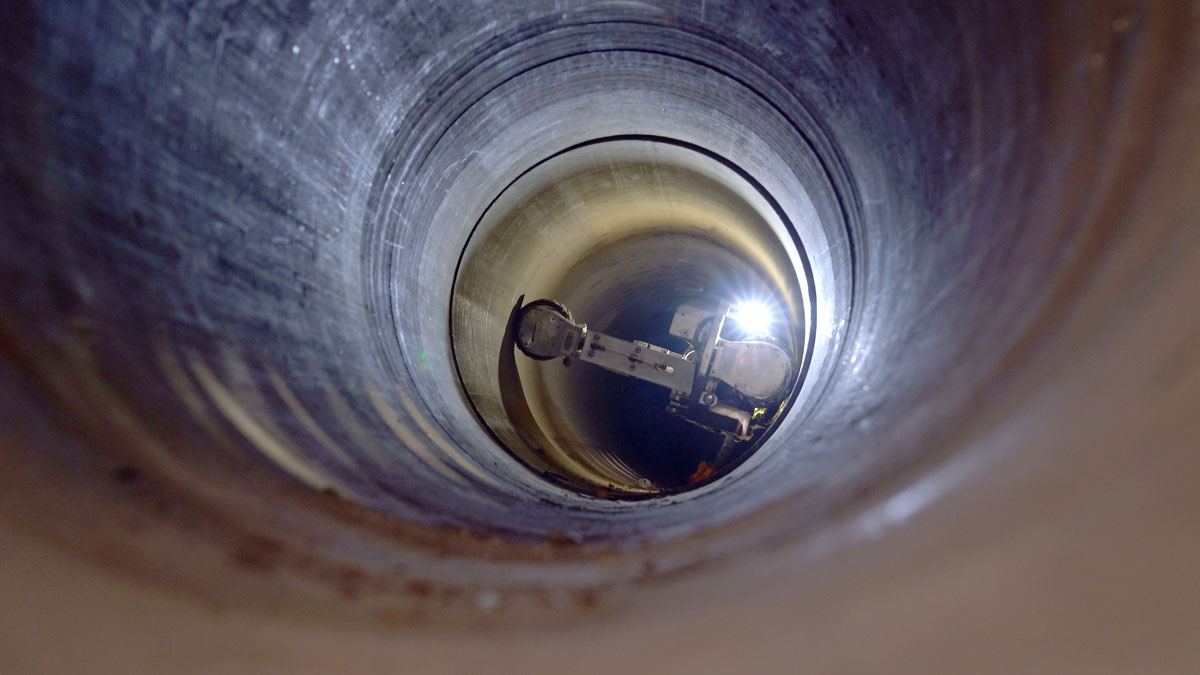
CISBOT, the cast-iron joint sealing robot, became the clearest expression of the business. Launched through a compact excavation, the system travels inside a live gas main and works on leaking joints from within. A conventional approach can require repeated street cuts, pavement restoration and traffic control. CISBOT changes the geometry: one access point can serve a long stretch of pipe. The robot is the visible invention. The avoided holes are the product.
One opening, a longer reach
By 2008, Penza was discussing CISBOT demonstrations with Con Edison, KeySpan, Washington Gas, UGI and PSEG in an EPA industry publication. The technology had crossed the awkward space between prototype and utility procedure. Ten years later, U.S. and U.K. operators were using ten CISBOT systems. National Grid executive Kenneth Daly credited the technology with $35 million in customer savings and a reduced environmental footprint. His compliment was telling: the innovation was “user friendly and practical to implement.” In utility work, practical is not faint praise. It is the threshold between an invention and a Tuesday.
A street excavation is never only a hole. It is permits, plates, traffic plans, restoration crews and a queue of irritated neighbors. Every additional opening multiplies the choreography. Internal repair attacks that multiplication. The benefit reaches people who will never learn CISBOT’s name: the bus driver who keeps a lane, the restaurant that keeps its curb and the resident who keeps a quieter morning. Industrial technology often makes its case in technical specifications. Here, the clearest specification may be the smaller patch of asphalt left behind.
A laboratory with muddy boots
Penza’s description of ULC was equally practical: “We are an R&D company - and then we commercialize the products we develop.” The order matters. Research was not a separate theater of speculative objects. It fed robotic pipeline inspections, utility field services and aerial work; those deployments, in turn, returned real constraints to the engineers. By 2018, 40 of ULC’s 89 employees worked in research and development. The same company employed the people who had to make the machines behave outside.
That structure created a useful loop. A field crew discovers that access is worse than the drawing suggested. An engineer sees how a seal, wheel or sensor responds to debris. A customer measures whether a work zone actually shrank. The next design carries those lessons back underground. Penza’s title said founder and CEO, but his public record reads like an operator who kept the workshop close to the contract.
The patents show how far the operating question traveled. Penza’s name appears on systems for pipeline inspection, pipe insertion, cross-bore detection, robotic utility maintenance and pressurized-pipeline launch hardware. Later filings stretch above ground: machine-learning asset maps, vacuum excavation, solar-module installation and equipment that wraps fiber-optic cable around a power-line conductor. The applications vary, but the nuisance remains consistent. Infrastructure is costly when it is hard to see, hard to reach or dangerous to touch.
One question, many awkward places
- Live-pipeline inspection
- Cast-iron joint renewal
- Cross-bore detection
- Robotic excavation
- Utility asset mapping
- Power-line fiber installation
- Solar-module handling
- Pressurized launch systems
The company grows up
Recognition arrived without changing the basic pitch. In 2017, Innovate Long Island named ULC and Penza winners in its makers and manufacturers category. Penza thanked his engineers, machinists and field crews, then framed their work in the language of operations: lower costs, better efficiency and improved safety. Engineering News-Record named him one of its Top 25 Newsmakers for 2018, citing pipeline rehabilitation and CISBOT. At the time, ULC held 17 patents and had 30 active applications, many naming Penza as an inventor.
His instinct was to move the spotlight forward. An observer noted that Penza talked more about what was in development than what had already happened. This is often described as visionary behavior, a word loose enough to fit anyone near a whiteboard. In Penza’s case, it seems closer to a contractor’s impatience. Yesterday’s robot has already met yesterday’s pipe. The next job is waiting with an uglier bend.
He also made room in the organization. In 2019, ULC promoted longtime technology leader Robert Kodadek to president, with Penza continuing as founder and CEO. Penza said Kodadek was qualified to lead growth, enter new markets and keep innovation moving. Delegation can be a founder’s least photogenic engineering problem. The machine is the organization, and one person cannot sit at every control.
The robot is the visible invention. The avoided holes are the product.
In September 2020, SPX Corporation acquired ULC Robotics. At the time, the company had about 160 employees, a substantial U.K. presence and approximately $40 million in revenue over the prior twelve months. SPX singled out two parts of the model: recurring CISBOT robotics-as-a-service work and custom research and development. The combination explains the company better than either label alone. ULC did not merely sell clever hardware, and it did not merely rent labor. It packaged specialized machines, practiced crews and accumulated field knowledge into an outcome a utility could buy.
The service model also solved a quiet adoption problem. A utility did not need to become a robotics company to use robotics. It could hire a trained team, a maintained machine and an established procedure together. Each deployment added operating experience; that experience improved the next deployment. The robot acquired an institutional memory made of crew judgment, engineering revisions and customer confidence. Recurring revenue was the financial description. Repeated competence was the useful one.
Penza called the transaction a step forward, pointing to SPX’s resources and its ability to commercialize products. There is a neat symmetry in that conclusion. The contractor who built a machine because the available one failed eventually sold a company whose attraction was not invention in isolation, but invention made repeatable.
Better Tuesdays, from below
The least corporate anecdote about Penza may say the most. In 2014, he won a trenchless-industry raffle for a $5,000 Caribbean vacation voucher. He donated the prize back to the association’s educational fund. It is a small event beside an acquisition or a patent portfolio, but small choices make decent windows. Construction had been his education; he redirected a holiday toward someone else’s.
His career offers a compact operating manual. Start close enough to the work that failure is impossible to romanticize. Treat a broken product as a precise complaint. Build with the people who will deploy the result. Measure innovation in excavations avoided, hours returned and procedures improved. Then keep the laboratory close enough to the street that neither side becomes imaginary.
Cities rarely applaud the machinery that keeps them ordinary. The gas arrives. The intersection stays open. A shop door remains reachable. Somewhere below, a robot inches through a pipe whose best feature is that almost nobody has to think about it. Penza built a business in that peculiar silence. The machines are ingenious. The calm Tuesday above them is the finer trick.