By September 2024, Greg Daily had spent forty years in the business of helping money move. Then i3 Verticals, the company he founded in 2012, sold its merchant-services business to Payroc. The cash paid at closing was approximately $438 million, subject to adjustments. A substantial piece of the enterprise was leaving. Daily was staying.
It was an interesting move for someone whose résumé could serve as a short history of card processing. Co-founder of PMT Services in 1984. Founder of iPayment in 2001. Founder of i3 Verticals in 2012. The names changed; payments kept returning. Now his third company was making a deliberate turn toward the software that runs particular kinds of organizations.
There is a familiar version of the serial entrepreneur’s story: build, sell, repeat, preferably with a photograph beside a bell. Daily’s career contains the companies, the transactions and the bell. The more revealing part is what happens between them. Experience supplies capital and connections. It also supplies reasons to change your mind.
Three beginnings, one city
Daily earned a Bachelor of Arts at Trevecca Nazarene University in Nashville. His subsequent career has remained closely associated with the city, even as the businesses he built reached well beyond Tennessee. Nashville provides a geographical thread through a working life whose corporate structure has been considerably less stationary.
At PMT Services, a credit-card processing company he co-founded in 1984, he served as president until its sale to NOVA Corporation in 1998. He then remained vice chairman at NOVA until 2001. The sequence matters: a sale did not immediately end his involvement. There was another organization to help oversee after the transaction closed.
In 2001 he founded iPayment and became its chairman and chief executive. He departed in 2011. Both PMT and iPayment had been publicly traded companies. By the time he started his next venture, he had already lived through the transition from founding a business to answering for it in public markets.
PMT Services
iPayment
i3 Verticals
Another beginning followed in 2012: i3 Verticals, LLC, originally called Charge Payment, LLC. The listed corporation arrived later, in January 2018. That distinction gives the business two dates worth keeping straight. The enterprise began in 2012; the public-company structure was built around an operation already several years into its life.
The work before the bell
In June 2015, i3 was thirty-one months old and had completed eight acquisitions. It had spent $65 million since inception. An initial public offering was a possibility, but Daily’s emphasis was on the work still required. “We still have a lot of execution to put together,” he said.
That is a rather less photogenic ambition than ringing an exchange bell. It is also the part on which the photograph depends. An acquisition adds another set of people, processes and customers. A company assembled from several businesses must somehow produce a result that can be understood as one business.
The practical side shows up in i3’s accounting history. The company moved from QuickBooks to Sage Intacct as it expanded. Its finance team described being able to bring a newly acquired company’s financial function into the system immediately and include its results in the following month’s close.
Consolidating accounts is unlikely to draw an audience in Times Square. Yet a buyer’s ability to understand what it owns has consequences for every subsequent purchase. In Daily’s story, the machinery behind acquisitions deserves a place beside the acquisitions themselves. Someone has to close the books after everyone else has closed the deal.
When i3 completed its IPO on June 25, 2018, the final offering included 7,647,500 Class A shares at $13 each. Net proceeds after underwriting discounts and commissions were approximately $92.5 million. The numbers describe a financing event. For Daily, the event also marked another return to the demands of a listed company.
Nashville roots, scattered desks
As i3 expanded, Daily did not insist that its technology employees move to Nashville. In 2015, he described an operation whose activities were concentrated in Georgia. A Nashville headquarters could coexist with expertise somewhere else. The location on the letterhead did not have to become everybody’s moving address.
By April 2018, the company was also planning an operations facility in Murfreesboro. The proposed investment was approximately $500,000 and the announced plan called for forty-two new jobs. It was a regional expansion, with an 8,500-square-foot facility to renovate and occupy.
Daily pointed to an experienced local workforce and to graduates of Middle Tennessee State University as reasons for choosing Rutherford County. He also described i3 as having been founded and largely capitalized in Middle Tennessee. Local relationships were useful inputs to a company whose market was much larger than its home region.
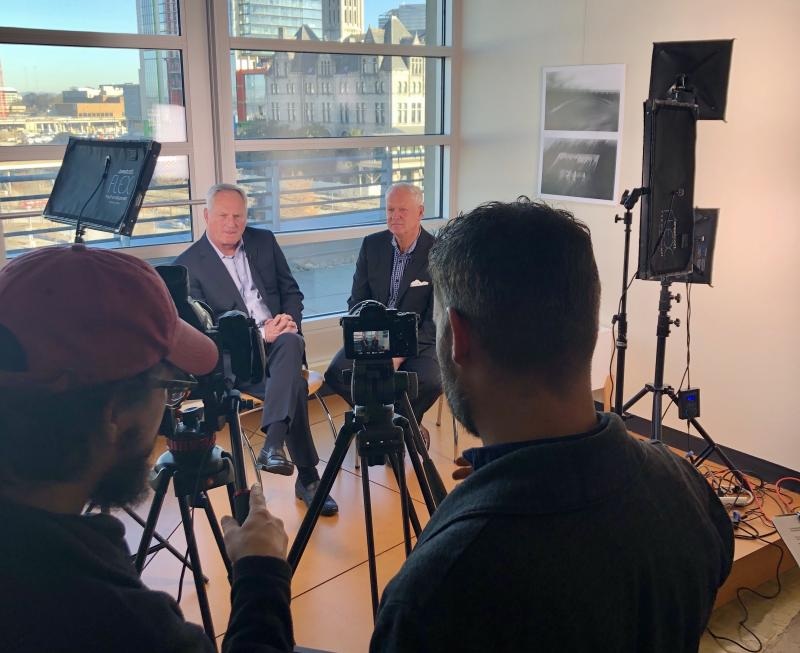
A photograph from late 2019 catches the less ceremonial version of corporate visibility. Daily and president Rick Stanford sit before cameras while a production crew works around them. The occasion was preparation for i3’s national sales conference in Nashville. The executives get the chairs; the cameras get most of the room.
A buyer with a long memory
In 2017, Daily described a buying process that included reviewing dozens of pitch decks and having dinners with entrepreneurs and their spouses. The meals were part of getting acquainted before a transaction. His account makes acquisition work sound less like a shopping spree than a lengthy series of introductions.
He also spoke about employees who had joined his previous businesses and what changes of ownership had meant for them. His own financial outcomes had not erased his concern about their experience. That memory helps explain why the future of an acquired team belongs in the story alongside the price.
Daily’s public language about company culture takes the same concern into more formal territory. In the introduction to i3’s code of conduct, he places fairness, responsibility and accountability beside growth and profitability. He describes a workplace where “doing the right thing” should be valued above everything else.
“Growth and profitability are not the only measures of success at i3 Verticals.”
Greg Daily · introduction to i3’s code of conduct
A code of conduct records an expectation; people still have to meet it. For a business that acquires other businesses, that expectation has particular weight. Employees arrive with existing loyalties and ways of working. Financial consolidation can happen on a timetable. A shared understanding of how to behave requires daily attention.
The payments company changes its brief
By fiscal 2022, software and related services accounted for 49 percent of i3’s revenue, compared with 39 percent the year before. Payments represented 45 percent, down from 53 percent. The business was already shifting its balance before the merchant-services sale made the change so conspicuous.
That year’s expansion also included an approximately $85 million acquisition of an enterprise-software provider serving motor-carrier and motor-vehicle markets in the United States and Canada. For a founder associated with card processing, it was another step into the specialized systems organizations use to get their work done.
The 2024 Payroc transaction accelerated the change. It transferred the merchant-services operation and its associated proprietary technology. Daily’s response included a wish that the departing employees would do well at Payroc. The corporate strategy and the people leaving under it appeared together in his announcement.
By his fiscal 2025 shareholder letter, Daily described i3’s destination as public-sector software, paired with integrated payments tools. Courts, public administration, utilities, transportation and schools supplied the setting for the next chapter. The ambition was a more focused company, with resources concentrated on systems its customers depend on.
The next chapter has a quarterly report
For Daily, that ambition now comes with the ordinary discipline of reporting progress. In the quarter ended June 30, 2026, i3 generated $53.1 million in revenue from continuing operations, up 2.2 percent from a year earlier. Annualized recurring revenue reached $174.1 million, an increase of 8.3 percent.
Continuing operations
revenue growth
The picture contained friction as well as progress. Management reduced its full-year revenue outlook to $216 million-$221 million. Professional-services delays, including work in utilities, were weighing on performance. Software subscriptions could grow while other revenue moved more slowly. A narrower business still has several moving parts.
Those figures give the latest chapter some necessary resistance. The future has to be delivered by teams, installed for customers and reflected in results. A strategic decision may fit neatly into a sentence. Carrying it through takes considerably longer, especially when the customer’s own schedule enters the conversation.
Daily remains chief executive and chairman of i3 Verticals. The company describes thousands of software installations across all fifty states and Canada. His working territory now includes the systems behind public services, extending a career that began with processing payments into the software surrounding them.
Across the three beginnings, there is an accumulating set of responsibilities: to customers who need things to work, to employees whose working lives change with ownership, and to investors who expect an account of the results. Starting again does not remove those obligations. It gives an experienced founder another chance to decide how to meet them.