Grant Canary’s career makes sense once you stop asking what industry he is in. Green buildings, wind turbines, insects, drones, tree nurseries and carbon credits look like a collection assembled by a particularly restless conference programmer. The connecting idea is simpler: find an environmental problem that refuses to fit inside one department, then learn enough of the system to change its economics. His latest system begins where a wildfire ends, with scorched soil, dead timber and a landowner staring at a bill that may run into millions.
Mast Reforestation, the Seattle company Canary founded as DroneSeed in 2016, was first easy to understand because its machines were wonderfully conspicuous. The company flew eight-foot drones over burned land and planted seeds with compressed air. Canary called drones “forestry’s tractor.” The pitch compressed a sprawling problem into a memorable scene: flying robots bringing trees back. It worked as an image. It was incomplete as an operating model.
A forest cannot be restored by spectacle. The right native seed must exist. Someone has to collect it in the right place and at the right time, preserve it, grow it into a seedling, match it to elevation and climate, clear dangerous burned timber, write a plan for the site, put crews on difficult ground, monitor what survives and find money patient enough to pay for all of this before a mature forest exists. The drone was one verb in a very long sentence.
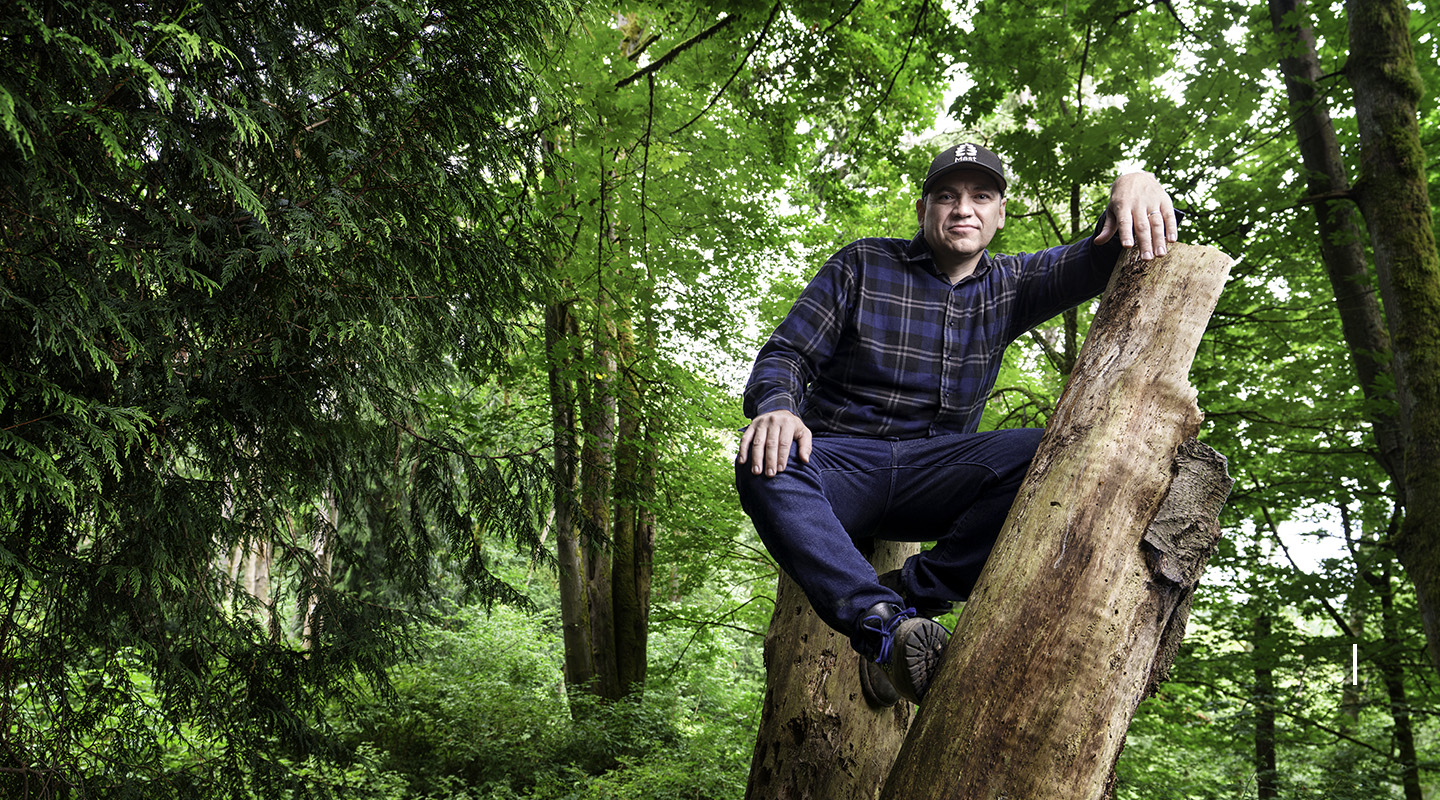
The education of a systems founder
Canary grew up in Oregon. His childhood heroes were Davy Crockett and Robin Hood; there were two tree forts. At Occidental College in Los Angeles, he studied sociology and minored in urban and environmental policy. He captained the men’s water polo team and served as vice president and president of the student Programming Board, which brought Jane Goodall to campus in 2004. The mix is useful context: institutions, environmental policy, teamwork and the practical art of getting a notable person onto a stage.
After graduating in 2005, he worked briefly with the U.S. Green Building Council. A decade abroad followed. He joined a management development program at Vestas Wind Energy and worked on projects in China and Denmark. In Bogotá, he earned a master’s in engineering design and process from Universidad de La Sabana, completing the coursework in Spanish. Graduate school also supplied the laboratory for a venture that sounds comic until the economics appear.
BioSystems Co. fed Bogotá’s food waste to black soldier fly larvae, then processed the larvae into protein for fish feed. Canary had modeled the price of fishmeal and believed pressure on wild-caught inputs would make insect protein competitive. The company built a pilot, learned to breed the flies in captivity and published what it learned. BioSystems was acquired by Canada’s Enterra Feed Corp. in 2012. Canary then worked across fundraising, business development, project management and expansion as the operation grew toward a 60,000-square-foot factory.
He tells the story with the delighted specificity of someone who still finds the larvae charming. He also draws a clean business lesson from it: examine the macroeconomic driver, locate a waste stream, and make the supply chain work in your favor. The material changed when he returned to the United States. The method did not. A friend joked that Canary would wind up a hippie planting trees. Prophecy occasionally arrives wearing a cheap joke.
When the product gets smaller than the mission
DroneSeed began in Beaverton, Oregon, with angel backing and support from the City of Beaverton before entering Techstars Seattle. The early company developed heavy-lift aircraft, mapping software and protective vessels for seeds. It won attention because its answer to laborious planting could be photographed in flight. Canary was named to the 2021 Grist 50, where the mission was already explicit: make reforestation scalable and reduce the damage climate change would bring.
Then came a founder decision that reveals more than a pristine origin story. Canary allowed the mission to outrank the original product. DroneSeed acquired Silvaseed, a company whose roots stretch back to the nineteenth century and whose seed inventory covers the Western United States. Mast later acquired Cal Forest Nurseries, an established California grower. The startup had bought its way into biological infrastructure older than venture capital and slower than software.
The recovery chain / one landscape, five linked constraints
The renamed Mast Reforestation became an integrated operator. It collects wild seed, runs nurseries, works with consulting foresters, manages planting and monitoring, and structures finance. The consulting foresters matter to Canary because they know the terrain like family doctors know patients. A replanting “prescription” draws on seed zones, geographic data and ecological models. Native species are chosen for a particular microclimate rather than treated as green decoration available by the pallet.
At the Henry Creek watershed in Oregon’s Cascade foothills, the work followed the 2020 Beachie Creek fire. Mast collected seed near the burned area and planted more than 150,000 seedlings across over 1,000 acres it manages there. The land is habitat and a watershed for nearby Salem. This is Canary’s larger argument about forests: their value is not exhausted by timber or scenery. They filter water and air, hold carbon, support pollinators and shelter wildlife. He calls that infrastructure.
The burned wood ledger
The newest turn in Canary’s supply-chain logic starts with material nobody wants. After a severe fire, dead trees can block safe planting and fuel another blaze. In remote landscapes, damaged wood may have no buyer and no practical route to a mill. The cheapest disposal method is often to pile and burn it, sending its stored carbon back into the atmosphere. Reforestation still needs financing, while a future timber return might sit sixty or eighty years away.
Mast’s MT1 Wood Preserve project in southeastern Montana joins these two liabilities. The 2021 Poverty Flats Fire hit a 3,200-acre family ranch and destroyed most of its trees. Mast buried ten million pounds of unmerchantable, fire-killed wood in a 1.1-acre engineered chamber designed to remain low in oxygen. A legal easement and continuous monitoring support long-term storage. The carbon-removal credits help fund native reforestation on the same land.
MT1 / from burned biomass to measured storage
Bars are visual indexes, not a shared numerical scale. Figures reflect Mast’s reported MT1 project data as of 2026.
Mast announced a $25 million Series B in February 2025, co-led by Pulse Fund and Social Capital, to expand this approach. By 2026, its MT1 page reported 4,277 carbon-removal credits delivered, more than a century of verified durability and an A rating from BeZero Carbon. The company said the first issuance sold out, with buyers including Bain & Company and BMO, and that planting followed on the landscape in spring.
Carbon markets invite suspicion, and Canary does not argue that every credit deserves belief. His position is narrower: methodologies differ, removals need money, and private capital can complement public funding when the clock is uncooperative. The practical appeal of MT1 is the joined-up ledger. Dead timber is cleared. Carbon is kept out of circulation. New seedlings get room and financing. Monitoring continues after the ribbon-cutting impulse has gone home.
A future with room for jokes
Canary’s public manner is a useful counterweight to the time horizons. He has played chess and poker and trained in improv. He says improv is funny when you make a mistake and learn how to be funny while making it. In interviews he can pivot from carbon-accounting nuance to the alleged cuteness of black soldier fly larvae without losing the argument. The humor keeps seriousness from curdling into solemnity.
Davy Crockett and Robin Hood, plus the practical luxury of two Oregon tree forts.
Chess for position, poker for incomplete information, improv for recovering in public.
Analyze the economics, trace the supply chain and find where discarded material can become useful input.
Make reforestation scalable and describe a low-carbon future people would actually choose.
That last part matters to him. Canary has said climate change is the problem to which other problems report, a formulation learned from a high-school English teacher and sharpened by friends and colleagues. Yet he resists selling action only through dread. His preferred communication offers a compelling future worth fighting for. In founder language, doom has poor conversion. People must be able to picture the life beyond mitigation.
The arc from larvae to seedlings is therefore less eccentric than it appears. Both businesses begin with stranded material and a system failing to value it. Both require biology, machinery, logistics, capital and patience to cooperate. Mast is the larger and more difficult expression of the idea. A drone can cross a burned slope in minutes. A forest asks for decades. Canary’s work is to make sure all the slow things have somewhere to begin.