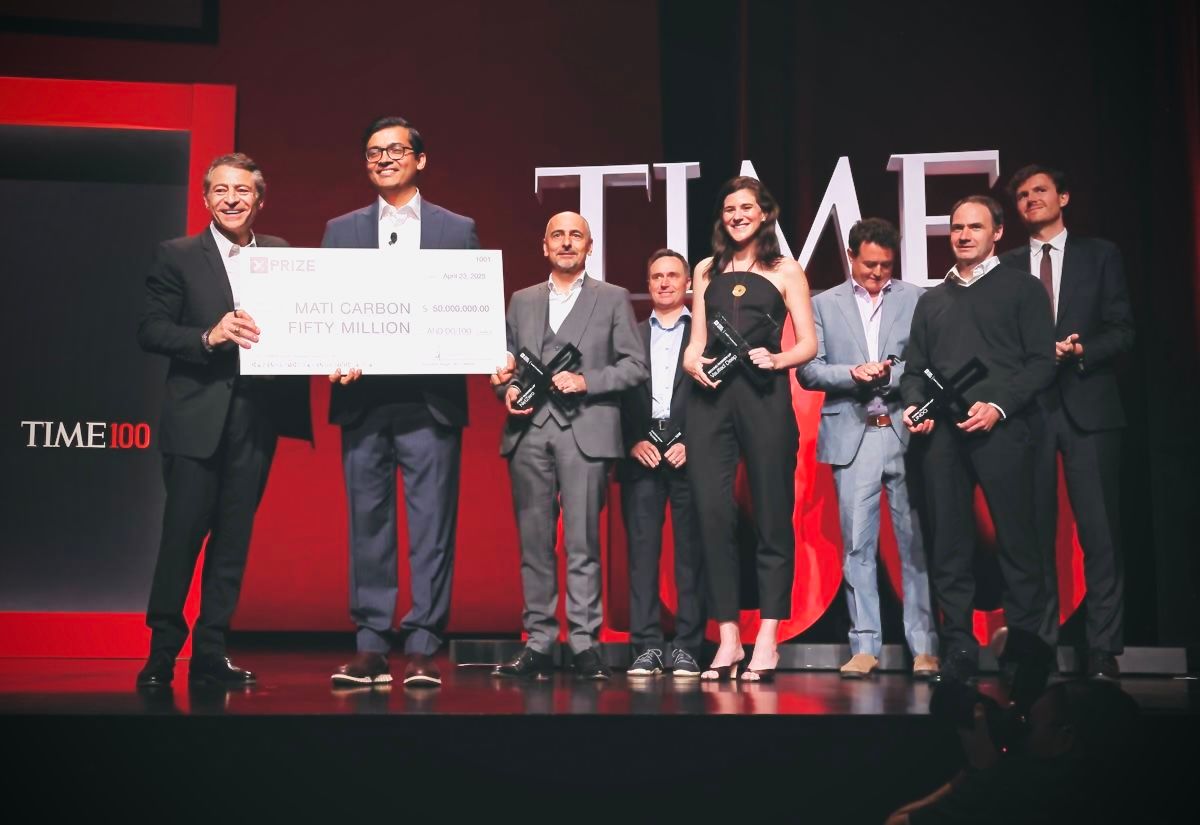
Fifty million dollars is an unusually handsome reward for spreading dust. In April 2025, Mati Carbon won that sum as the grand prize in the XPRIZE Carbon Removal competition. Its founder and CEO, Shantanu Agarwal, had arrived at the contest with finely ground volcanic rock and a proposition about smallholder farms. The rock could help remove carbon from the atmosphere. The farmer would receive it free. Somewhere else, a company would pay for the removal.
There is a pleasing reversal here. Agarwal had previously helped launch Sustaera, a business built around machines that extract carbon dioxide from ambient air. His newer venture works with a process that already takes place in the landscape. The engineering has moved into fields, sampling systems, delivery routes and the difficult business of persuading someone to let a stranger put crushed rock on their livelihood.
Seen from a distance, this is a career in carbon removal. Up close, it is a story about changing the question. Once you have decided that something needs doing, how attached should you remain to your first idea for doing it?
An engineer learns the price of things
Agarwal studied chemical engineering at the Indian Institute of Technology Roorkee and earned an MBA at Harvard Business School, where he studied from 2008 to 2010. The combination gave him two ways of examining a technology: what happens inside the process, and what happens when somebody has to finance it.
His earlier work was firmly inside the energy industry. At Schlumberger, his roles included lead engineer, engineer in charge of offshore well-construction services and business development manager. These are useful places to discover that a diagram and a functioning industrial operation have different requirements. Equipment needs people, budgets and a route into use.
He subsequently worked in energy investing at EV Private Equity. His professional history includes board roles at businesses such as PanGeo Subsea and SageRider, alongside responsibilities for originating investments and overseeing portfolio companies. The underlying activity was familiar: find a technology, assess the business around it, help it grow. Carbon removal would ask him to apply that experience to a different end.
The experiment before the company
Around 2017, his attention shifted toward climate work. Together with scientists in North Carolina's Research Triangle area, he started developing Susteon as an incubator for research. Raghubir Gupta was a central scientific collaborator. They examined ideas in carbon capture and carbon utilization, looking for research that might survive the journey into commercial equipment.
Sustaera emerged from that work, including collaboration with Columbia University. By December 2021, Agarwal was signing a securities filing as its CEO. That month, the company announced a $10 million Series A led by Breakthrough Energy Ventures and Grantham Trust’s Neglected Climate Opportunities LLC. The money was intended to help take direct air capture beyond the laboratory.
The proposed design used abundant materials, renewable electricity and repeatable modules. At the time, Agarwal described plans for systems starting at ten tons of capture per day, which could be multiplied into larger facilities. The company also set a cumulative ambition of 500 million tons over twenty years. These were plans for deployment and scale, rather than a count of carbon already removed.
“My journey is more accidental than planned, I would say”
Shantanu Agarwal, 2022
By November 2022, Mary Haas had taken over as Sustaera's CEO, and Agarwal described his own role as co-founder and board member. A founder handing over the operating job is a useful detail in this story. His involvement in a company and his continued pursuit of a problem could follow different timetables.
The electricity question leads to a field
Direct air capture brought a constraint into focus for Agarwal: energy. In his later account of the transition, he questioned the near-term logic of scaling energy-intensive removal where clean electricity was still scarce. He continued to see a place for developing the machines, especially where surplus renewable power was available. He also wanted a route that could expand under the conditions already at hand.
A visit to a smallholder farm in Chhattisgarh helped point him toward enhanced rock weathering. The method offered a link between carbon removal and agricultural income. Small farmers could participate in an international market for a service that companies elsewhere needed to buy. The attraction was practical as well as chemical: there was already farmland, already a crop, already an annual routine.
That observation changed the design brief. The land would continue producing food. Farmers would receive an intervention without paying for its delivery. Buyers of verified removal would support the work. A business trained to think about returns was now considering how the return could reach a person with a few acres and little room for a failed experiment.
- 01 · GrindBasalt becomes fine rock dust.
- 02 · ApplyField teams spread it on farmland.
- 03 · ReactWater and CO₂ weather the minerals.
- 04 · MeasureSampling supports removal accounting.
Carbon-removal buyers → deployment funding → no charge to farmers
Geology, with a delivery schedule
Mati uses basalt, a volcanic rock. Grinding it exposes more surface area to weathering. Through reactions involving water and carbon dioxide, carbon is converted into dissolved bicarbonate, which can move through groundwater and waterways. The pathway is intended to keep that carbon out of the atmosphere for long periods.
Basalt also supplies minerals to the soil. Mati's proposition joins that agricultural benefit to the sale of carbon-removal credits. It is a neat arrangement on paper. On the ground, a credit has to be supported by records of what was applied, where it went and how the resulting chemistry is measured. An invoice cannot substitute for a reaction.
The operational work has its own technology. Mati's software platform, matiC, connects farmer onboarding, field locations, transport information and sampling records. Its applications are designed for places with limited connectivity. The system ties basalt applications to individual fields and dates, giving field teams and auditors a way to follow an operation whose physical footprint is scattered across many small farms.
The offer that sounds suspiciously generous
Free material is not automatically a persuasive offer. A farmer depends on the plot that an unfamiliar organization wants to treat. Suspicion is a reasonable response. Agarwal has described the importance of working through trusted local organizations and showing results through trials before expecting broad adoption.
That creates a different rhythm from selling a downloadable product. Seasons have to pass. Crops provide evidence. Local experience carries weight. The question becomes whether the organization can keep its commitments long enough for a useful result to travel from one farmer to another.
In India, Zambia and Tanzania, Mati has had to work with different infrastructure, settlement patterns and agricultural calendars. Dense networks can help one deployment; dispersed farms can complicate another. The unglamorous parts of the model matter enormously. A truck arriving at the right time may contribute more to a farmer's confidence than another polished explanation of atmospheric chemistry.
A prize buys room to work
The XPRIZE competition ran for four years and drew more than 1,300 teams from 88 countries. Mati received the $50 million grand prize in April 2025. The distinction matters: the overall competition distributed $100 million. Agarwal's company won half that total, rather than a personal fortune or the whole prize pool.
The award provided funding for the work required to make carbon removal repeatable. Science, infrastructure and field operations all need investment before a larger network can deliver reliably. A prize announcement occupies an afternoon. A dependable operation has to show up again the following season.
Recognition followed beyond the competition. Agarwal appeared in TIME100 Next in September 2025, with a tribute by Wendy Schmidt, whose foundation supports Mati. The goal described there was expansive: reach 100 million farmers and remove more than a billion tons of carbon dioxide by 2050. Those numbers describe an ambition. Their scale makes the smaller units of execution more consequential, not less.
Counting progress without counting promises
Mati's December 2025 account of its year reported more than 120 team members and over 200,000 tons of basalt deployed cumulatively. It described engagement with more than 30,000 smallholder farmers through meetings, trials, deployments and measurement work across more than 500 villages. Engagement covers several activities; it is a broader measure than completed application alone.
The company also reported average yield improvements of 15 to 25 percent across deployed regions. Those reported results belong to particular operations and conditions. For Agarwal, the significance lies in connecting the outcome a carbon buyer purchases with an outcome a farmer can use. The two audiences have very different reasons to ask whether the work is succeeding.
His public conversation has continued into 2026. In July, he discussed Mati's approach on The Impact Equation podcast. In September, MATI released individual accounts from farmers in India and Zambia about the growing season and their expectations for the next one. The accounts were presented as personal testimony, rather than a survey. Giving farmers room to describe their own experience is a fitting extension of the work.
Agarwal's career has moved through offshore engineering, investment committees, an air-capture startup and agricultural field operations. The connective tissue is a willingness to keep revising the route while holding on to the problem. There is something quietly demanding about that. A machine can be redesigned on a drawing board. A useful enterprise has to earn its place in other people's plans, one delivery, one field and one season at a time.
Keep following the work
- Mati Carbon
- Sustaera
- Susteon
- X / Twitter
- Personal profile
- Watch: Climate Chat with Shantanu Agarwal
- Listen: Climate Rising, 2022
- Read: The 2025 interview
- XPRIZE award announcement
- TIME100 Next profile
- Mati’s 2025 review
- The field operations interview
- Listen: The Impact Equation, 2026
- 2026 farmer accounts announcement