A donation bag has an unusually busy afterlife in Southern California. It may become a bargain on a rack, a listing online, material for an upcycler or feedstock for a recycler. More quietly, it may help pay for a resume workshop, an interview coach, a bus pass or a training room built to look exactly like a pharmacy. Goodwill Southern California has spent more than a century arranging those outcomes into one operating system.
The storefront is the part everyone recognizes. The organization behind it is a tax-exempt regional nonprofit, legally Goodwill Industries of Southern California, serving Los Angeles County north of Rosecrans Avenue and all of Riverside and San Bernardino counties. It is autonomous from other local Goodwill organizations, though it belongs to the international Goodwill network. That territorial detail matters. A Goodwill in Long Beach, Orange County or the Bay Area may belong to a different nonprofit with different programs, prices and management.
Goodwill SoCal's job is to connect people who face barriers to employment with education, training, work experience and placement. The phrase “barriers” covers a wide field: disability, military-to-civilian transition, youth without experience, homelessness, job displacement and a history in the justice system. Its customers are just as varied. They include thrift shoppers, people clearing their closets, employers looking for candidates and organizations buying printing, landscaping, custodial, assembly or fulfillment services.
A supply chain built from everybody else's maybe pile
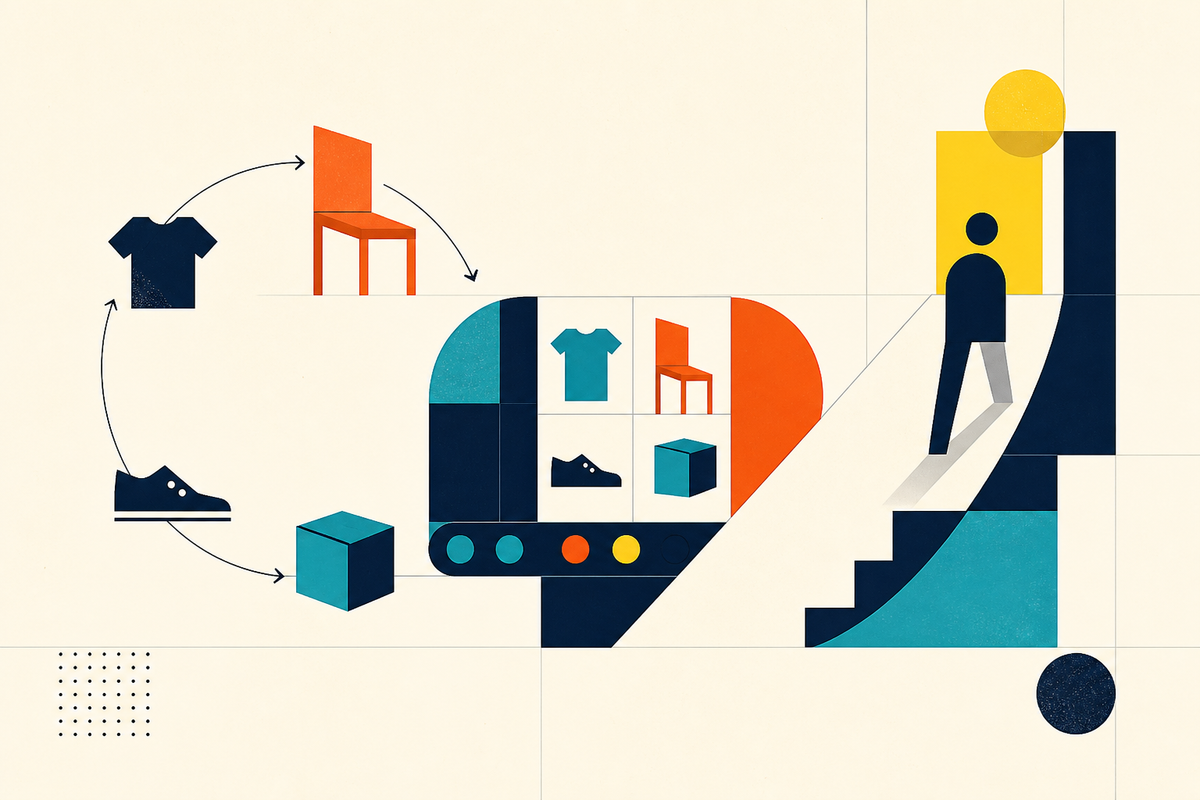
Unlike a conventional retailer, Goodwill does not begin with a seasonal buying plan. Much of its supply arrives in trash bags and cardboard boxes, one unpredictable car trunk at a time. The organization collects, transports, sorts and processes those goods, then routes them through stores, clearance centers and e-commerce. In 2024, the audited value of contributed goods was $98.6 million. Inventory at year-end stood at $12.7 million.
The weirdness of that supply chain is also its advantage. Donors provide most merchandise without charge. Shoppers get low-cost goods and the sport of discovery. The region avoids some demand for newly manufactured products, and reusable material stays out of disposal streams. A 2025 company release reported 117 retail locations, about 16 million shoppers a year and more than 165 million pounds of material diverted from landfill. The network is both a retailer and a piece of reverse-logistics infrastructure.
This is where Goodwill differs from a consignment app or neighborhood thrift shop. Its physical collection network, industrial sorting capacity and public workforce programs are designed to reinforce one another. Independent shops may curate more tightly. Peer-to-peer marketplaces may return more money to an individual seller. Municipal recyclers may process a narrower waste stream. Goodwill SoCal combines convenience, broad acceptance, high-volume retail and a stated employment mission.
The model also turns four separate audiences into participants in the same exchange. Donors supply the inventory. Shoppers convert it into revenue. Job seekers use services that revenue helps sustain. Employers provide the destination - and sometimes buy Goodwill's services themselves. Each group can enter through a different door without needing to understand the whole machine. A bargain hunter may arrive for a jacket, not a workforce policy. The purchase still moves the policy forward. That quiet alignment is more durable than asking every customer to behave like a philanthropist.
“Not Charity, But a Chance.”A Goodwill slogan in use since the 1920s
The retail engine pays for the less visible work
The 2024 accounts show the shape of the enterprise. Total revenue, support and other income was $280.6 million. That large top line includes the noncash value assigned to donated merchandise. Operating revenue was $177.4 million, led by $149.4 million in retail sales. Contract services contributed $8.1 million. Workforce-development revenue and government grants added roughly $19.5 million. Contributions were just under $3 million.
What produced operating revenue in 2024
The organization spent $266.9 million on program services out of $285 million in total expenses under its audited functional presentation. Goodwill SoCal expresses the same idea for shoppers by saying 95 cents of every sales dollar goes toward its mission. It is an easy line to remember, but the balance sheet supplies the more useful lesson: thrift alone is not the entire business. Public workforce funding, business contracts and philanthropy help carry programs, while the store network supplies scale, employment and recurring unrestricted income.
Career help gets specific when it is useful
At Goodwill employment centers, the menu begins with ordinary, essential things: one-on-one counseling, resume writing, interview workshops, computer access, job leads and referrals to education. It can extend to textbooks, transportation and other work tools. Employers can receive candidate screening, skills assessment, recruiting assistance and on-the-job training support. The organization says it prepares and places thousands of people into sustainable employment each year through campuses, career resource centers, WorkSource centers and specialized youth and veteran programs.
The newer programs make the method tangible. In June 2026, Goodwill SoCal and CVS Health opened a Career Skills Lab at the Los Angeles campus. It contains a full replica of a CVS Pharmacy retail store, down to fixtures, products and equipment. Small groups prepare for pharmacy-technician and customer-service work, while receiving career exploration, mentoring, tutoring, technology access and job-preparation support. The lab expects 60 to 80 participants a year. It is less like a lecture hall than a dress rehearsal.
For employers, Goodwill's offer is not limited to hiring. Its contract teams provide printing, custodial and building services, landscaping, assembly and fulfillment. These are competitive commercial services that also create closely supported employment for people with disabilities and other vocational challenges. The pitch on its business-services page is unusually blunt: do not hire Goodwill because it feels good; hire it because the work is good.
Reuse is easy. End-of-life is the harder assignment.
Reselling a wearable coat is straightforward. A destroyed sneaker, made from glued layers of foam, rubber and fabric, is not. In October 2025, Goodwill SoCal worked with The Footwear Collective on a pilot across 50 Los Angeles County collection sites. Wearable pairs went toward resale. Shoes beyond use were sorted for testing, material separation and recovery research. The participating ecosystem included brands and retailers such as Brooks, Crocs, New Balance, Target, Vans and Steve Madden.
That pilot hints at Goodwill's place in a changing market. Secondhand shopping competes with low-cost new fashion, online resale and a growing field of branded take-back programs. California's textile-recovery rules are also pushing producers and recyclers toward larger collection systems. Goodwill enters that conversation with something difficult to build quickly: familiar neighborhood drop-off behavior and a century of experience deciding what still has use.
The organization does not solve every circularity problem. Donated items still require labor, transport, leases and disposal; the 2024 accounts include $2 million in trash expense. Nor can every training program erase structural barriers in the labor market. The model is useful because it makes those costs visible inside a working business, not because it makes them disappear.
For an individual, the practical entry points are deliberately ordinary. A shopper can stretch a clothing or household budget. A donor can clear usable items without arranging a sale. A job seeker can use computers, coaching and local job leads at no cost, then ask about a program suited to a particular age, disability, veteran status or career goal. An employer can recruit candidates or contract for operational work. The useful question is not “What does Goodwill sell?” but “Which part of the loop do you need?”
Its origin story fits that practical temperament. Katherine B. Higgins arrived in Los Angeles by train with her widowed mother and began collecting goods in burlap coffee sacks in 1916. She was the first woman to found a Goodwill organization. The first local store opened near today's Olvera Street in 1918; 200 shoppers spent $126 that day. The Los Angeles campus later rose on land donated anonymously in the 1930s.
A century later, the sacks have become a three-county network. But the underlying transaction remains recognizable: take something the market has overlooked, apply sorting, training and attention, and return it to circulation with more utility. Goodwill SoCal does that with shirts and sofas. Its harder work is doing it with talent.