At an America's Thrift store, the oddities arrive by the minute. A bread maker that survived one kitchen craze. A navy blazer with somebody else's tailor marks. A lamp that looks vaguely presidential. Fourteen new objects, on average, can reach the sales floor in the time it takes to read this paragraph. The company says each location adds more than 10,000 items a day. That torrent explains its line, “Where it's a new store every day,” but the line leaves out the harder part: making a store full of other people's decisions feel navigable.
America's Thrift Stores is a private, for-profit chain based in Irondale, just outside Birmingham, Alabama. Founded in 1984 by James Buford Salmon, it announced its 36th location in June 2026, up from 24 stores when private-equity firm TZP Group led a majority recapitalization with Nuveen's Global Impact Fund in 2022. The footprint stretches across Alabama, Georgia, Louisiana, Mississippi and Tennessee. The business employs more than 1,500 people and works with six charities focused largely on children's health and addiction recovery.
The storefront is only the bright end of the pipe. Inventory begins in closets and garages, enters through store drop-offs, staffed drive-up centers, freestanding bins and scheduled home pickups, then moves through sorting and pricing before reaching a rack, shelf, online listing, wholesaler or recycler. Traditional retailers forecast demand and order another case. A thrift operator must turn unpredictability into dependable supply.
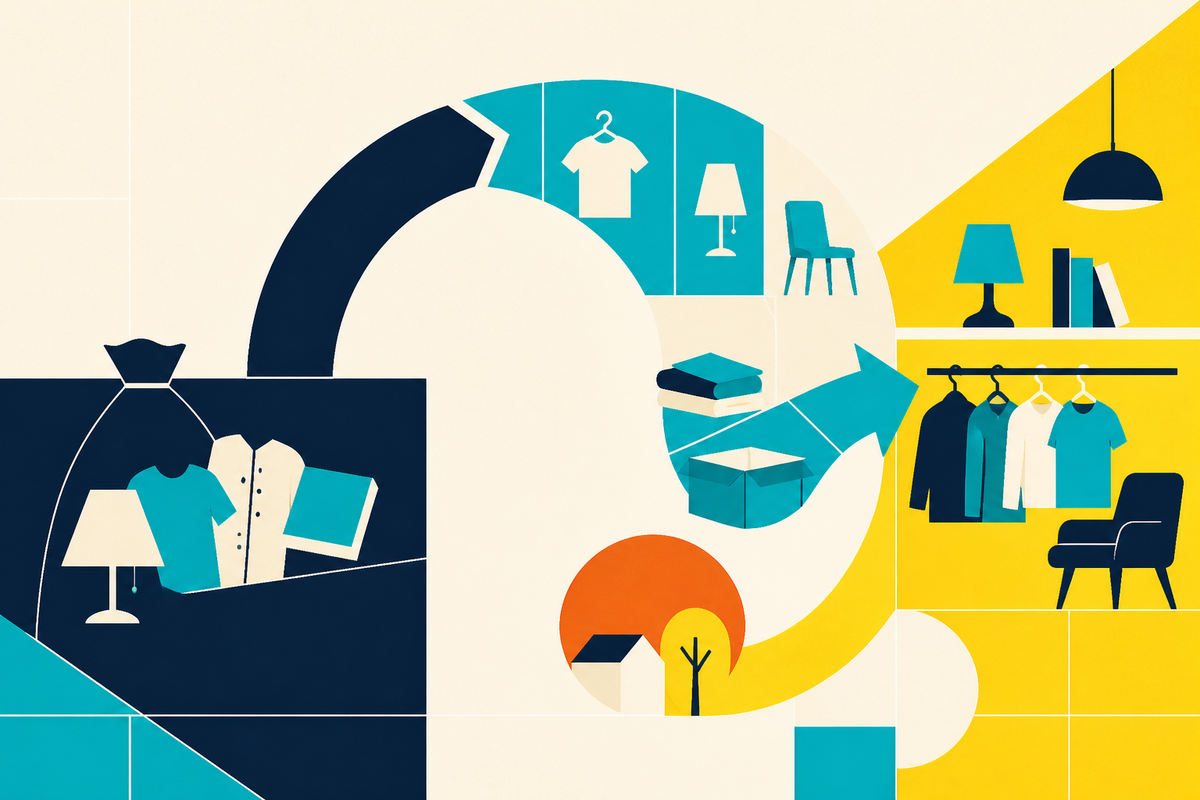
The chair has no loyalty. It goes wherever the sorting table sends it.
The inventory cannot be reordered
Secondhand retail has a peculiar constraint. A shopper may love the faded Levi's on the endcap, but there is no purchase order that can summon 200 identical pairs. Every object is effectively a one-unit SKU, arriving in unknown condition and at an unknown time. America's Thrift addresses that uncertainty with density and speed: a wide donation network, continuous processing and frequent replenishment. The resulting promise is not that a particular product will be waiting. It is that something worth examining probably will be.
Organization is the other half of the formula. The company says its apparel floors break into 44 women's categories, 30 men's categories and 41 children's categories, sorted by size. Picture frames have a place; workout gear has another. This sounds ordinary until one remembers that the input stream was not packed to a planogram. It was packed by thousands of households. The system must discover a taxonomy inside the mess, quickly enough to keep yesterday's donations from becoming tomorrow's backlog.
The treasure hunt is customer-facing. Behind it sits a data-driven supply chain fed by donated goods.YesPress analysis
That makes the business closer to reverse logistics than a conventional apparel chain. Drivers, donation attendants, processors and retail associates form one continuous operation. The company's expertise lies in acquiring supply without standard wholesale buying, judging it at speed, routing the best channel for each item and keeping enough novelty on the floor to create repeat visits.
One network, several customers
The obvious customer wants a low price. Families can outfit children, replace cookware or furnish a room without paying full retail. Daily color discounts and discounts for seniors, military members and educators add another layer. But the aisle also serves the recreational treasure hunter, the vintage buyer and the reseller who sees inventory as raw material. For them, inconsistency is entertainment. The possibility of a find is the reason to return before the weekend.
Donors are customers of a different service. They want space back, a convenient handoff and confidence that usable goods will not go straight to waste. America's Thrift reduces the friction with free pickups in eligible areas and thousands of collection points. Community groups are another constituency. Through Bags for Bucks, schools, churches, teams and nonprofits collect used goods and receive money based on the weight gathered. It turns the neglected half of a fundraiser - sourcing something to sell - into a neighborhood clean-out.
America's Thrift is not a nonprofit. It is a tax-paying retailer that collects goods through charity-linked arrangements, sells them and provides financial support to partner organizations. A purchase is retail revenue; the charitable mechanism sits in the donation partnership.
Those partners include Make-A-Wish Alabama, Children's Healthcare of Atlanta, Home of Grace, Adult & Teen Challenge Mid-South, Make-A-Wish Middle Tennessee and Louisiana Adult & Teen Challenge. The company says it gives more than $3 million to charity partners annually and has set a goal of $100 million over 10 years. In Tennessee, it reported more than $700,000 contributed to Make-A-Wish Middle Tennessee since that relationship began in 2019.
That mission also gives a repetitive, physical workplace a visible point beyond the rack. Public career materials describe an upbeat, promote-from-within culture, while employee stories highlight people who have moved from temporary or frontline roles into long tenures. The work itself is less sentimental: trucks run routes, attendants handle bags, processors make hundreds of small judgment calls and store teams race the arriving carts. But the charity relationship and reuse tally give those motions a score. For management, culture is not separate from throughput. Retaining people who recognize quality, spot damage and understand local demand can improve both the shopping floor and the amount of usable material recovered.
The model solves different problems with the same object. The donor loses clutter. The shopper gains an affordable good. The partner receives funding. The retailer earns revenue and pays the labor, rent, trucks and processing costs required to make the exchange work. If an item does not sell, it can move to a wholesale partner and be separated into textile, plastic, metal or wiring streams rather than immediately joining a landfill.
Selling the hunt without selling chaos
America's Thrift competes in several aisles at once. Goodwill, The Salvation Army, Savers/Value Village and regional chains compete for donated supply as well as shoppers. Ross and TJ Maxx compete on price without asking customers to accept wear or uncertainty. Poshmark, Depop, thredUP, eBay and ShopGoodwill bring searchable inventory to the sofa. Local consignment stores offer tighter curation, sometimes with cash or trade for the seller.
The company's answer is a hybrid: the scale and operating hours of a chain, the price and irregularity of donated inventory, and a cleaner, more categorized floor than the dusty stereotype implies. Its selective online channel lists jewelry, electronics, designer purses, shoes, apparel and collectibles - goods whose value can justify photography and shipping. The stores keep the broad, tactile assortment where discovery is part of the purchase.
Store growth after the 2022 recapitalization
The 2022 investment framed America's Thrift as a circular-economy company, not merely a discount retailer. At the time, it operated 24 stores and more than 2,500 donation sites. TZP and Nuveen said they would help extend the store and donation network, and the count has since moved through openings in Murfreesboro, Rome, Madison and Gainesville. Chris Homewood took over as chief executive in August 2025 after Ken Sobaski's nearly 12-year tenure; Sobaski moved to the board.
The environmental numbers have risen with the footprint. Older company materials referred to more than 45 million pounds of donatable goods kept out of landfills each year. By 2026 opening announcements used more than 70 million. Those are company-reported figures, but the direction shows what management wants the market to notice: scale creates impact only when the collection and processing machine grows along with the storefronts.
A reason to come back tomorrow
For shoppers, America's Thrift can help stretch a household budget, source costumes and vintage pieces, furnish a first apartment or supply an online resale side business. For donors, it provides a convenient exit for usable things. For a coach or choir director, Bags for Bucks offers fundraising without a catalog of wrapping paper. The common utility is circulation: moving an object from a person who has stopped valuing it to one who has not.
Its edge is not a secret supplier or an exclusive label. It is the choreography of abundance. Collect enough locally, sort it finely, price it to move and return to the floor all day. The better that choreography works, the more likely a shopper is to believe the next visit will be different. In a standard store, inconsistency is a failure. In thrift, managed inconsistency is the product.
That is where America's Thrift fits in the market: between the nonprofit charity shop, the off-price department store and the digital resale marketplace. It borrows purpose from the first, organization from the second and endless novelty from the third. Then it roots the whole apparatus in the physical geography of the Southeast, where the next piece of inventory may be waiting in a donation bin three streets away.