The gold was there. In the late summer of 2009, Goldrich Mining ran a trial at Little Squaw Creek in Alaska and recovered 593.5 ounces of raw placer gold. The plant had something to wash, and the washing recovered something worth selling. Then the water got dirty. Fine sediment clogged pumps and spray jets. The operation had to stop and wait for the silt to settle.
- Goldrich controls roughly 23,000 acres at Chandalar, with placer deposits and hard-rock exploration targets.
- Its former mining joint venture raised output through 2018, then dissolved over contractual payment requirements.
- A proposed $20 million financing package and later reclamation plans describe the work of attempting a restart.
It is an excellent place to begin understanding this company. A gold-bearing deposit is only one part of a mine. Water, machinery, weather, money and agreements determine what happens to it. Goldrich’s history makes those usually invisible dependencies unusually easy to see.
The pond had a vote
The 2009 plant processed about 89 cubic yards an hour. Its intended capacity was roughly twice that. More damaging, the water problem limited operations to four to six hours a day. Good recovery from the material that entered the plant could coexist with disappointing use of the plant itself. The bottleneck was circulating through the pipes.
The company’s reported final pilot cost was approximately $1.137 million, against an original estimate of about $870,000. Goldrich attributed the increase to acquiring a larger wash plant and modifying and transporting it. A bigger machine had changed the budget. It had not removed the need for a system that could keep feeding it.
“We believe the toughest part of getting started is behind us.”Richard Walters, then Goldrich president, 2009
In 2010, the remodeled plant consistently handled only about 29 bank cubic yards an hour. Higher rates brought overloading and breakdowns. Limited capital prevented a second plant from coming online. The practical lesson is wonderfully unromantic: test sustained operation under site conditions before treating equipment capacity as production capacity.
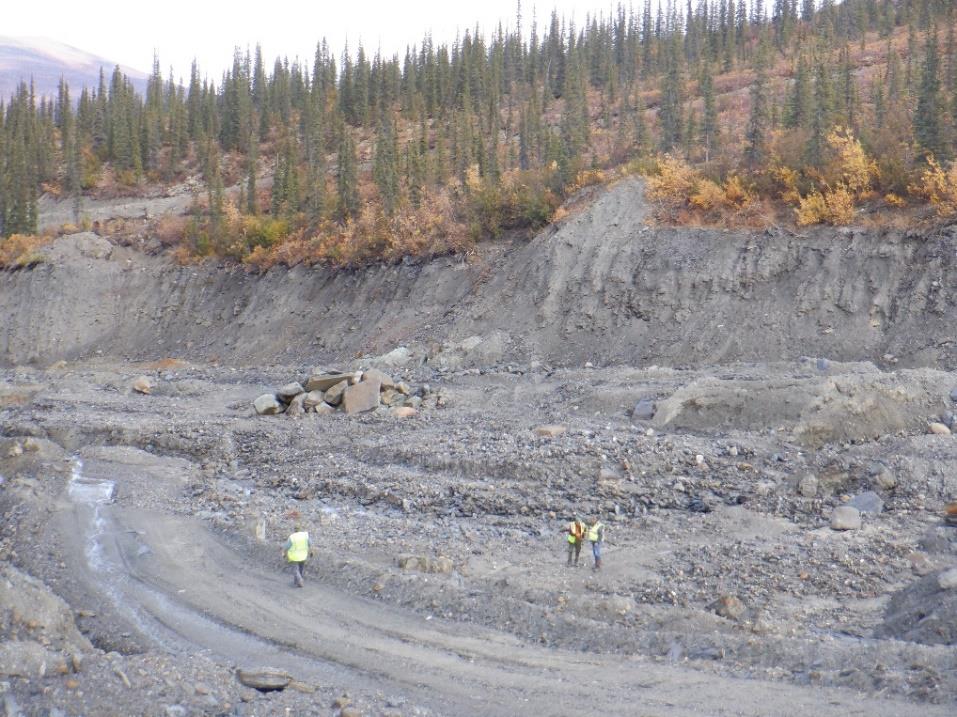
Two kinds of gold. Two kinds of patience.
Goldrich is a mineral exploration and development company whose central asset is Chandalar. Its corporate predecessor dates to 1959, when Eskil Anderson incorporated Little Squaw Mining Company. The Goldrich name arrived in 2008. The business has a much longer memory than its current branding suggests.
Its strategy follows a geological relationship. Placer gold sits in transported material, including creek gravels. Lode gold remains hosted in rock. Recovering the former offers a possible source of cash while exploration investigates the latter. The attraction is understandable: use a known gold-bearing landscape to support the search for a larger discovery.
Goldrich’s exploration work has included mapping, soil and rock sampling, airborne surveys and drilling. The company describes more than 30 high-priority prospects. In 2014, detailed examination of drill-core minerals helped refine its geological model toward an intrusion-related interpretation. That is a specific example of evidence changing the search: the interpretation of how gold arrived influences where the next hole should go.
This places Goldrich among junior resource developers competing for investment and operating partners. Its distinction is the combination of a concentrated district-scale property, historical mining infrastructure and both gravel and bedrock targets. Those attributes offer several avenues for development. They also concentrate the company’s fortunes in one district.
The ounces went up. The agreement came apart.
In 2012, Goldrich and NyacAU formed a 50/50 placer venture managed by NyacAU. Fine-gold extraction rose from approximately 8,200 ounces in 2016 to 12,300 in 2017 and 17,100 in 2018. Read those numbers alone and the story appears straightforward.
2019: joint venture dissolved. Output and contractual payments were different measures.
But the agreement required minimum payments to Goldrich expressed in gold ounces. The company reported that those requirements were not met. The venture dissolved effective June 3, 2019, terminating its mining lease. Most equipment had already left the site. A rising production chart had not answered the question of what reached the property owner.
The business model matters here. Goldrich’s work involves advancing mineral assets and arranging capital and operating relationships. Historical gold entered a smelter-refinery channel; investors and potential operators occupy another side of the business. Goldrich offers no consumer product catalogue. Its commercial proposition rests on mineral potential, recoverable output and the terms under which development gets financed.
The calendar adds another constraint. Goldrich described its normal production season as roughly June through mid-September, subject to weather, with stripping and stockpiling possible beyond that interval. Lost operating hours therefore spend a finite seasonal allowance. A repair that would be inconvenient at a year-round plant can consume a larger share of the useful working window here. That makes the relationship between plant reliability and cash generation especially consequential.
The price of another attempt
An April 2023 settlement addressed the arbitration that began in 2017. Subject to a $105,000 payment, it resolved outstanding disputes. A separate option offered a route to permits and remaining facilities, with a $1 million escrow requirement and assumption of reclamation liability. Future production payments were also part of the arrangement. These were conditional terms, rather than evidence that every step had been completed.
In October 2024, Goldrich engaged Castle Placement to seek up to $20 million: half through equity at five cents a share, half through forward gold sales at $1,200 an ounce. Equity would exchange ownership for cash. Forward sales would commit future gold for present funding. The announced 2025 restart depended on completing that financing.
A July 2026 reclamation narrative describes proposed mining during 2026-2030, with cleanup proceeding as areas become available. That document is a proposal. It does, however, put restoration into the operating sequence, alongside excavation and water management.
The transferable idea is to assess the whole chain: recoverable material, sustained throughput, payment obligations and eventual cleanup. Goldrich’s approach depends on financing, workable permits, reliable equipment and recovery through a short seasonal window. A weaker gold price or higher costs can narrow the room for error. At Chandalar, the next useful milestone will be one that connects the gravel to cash.