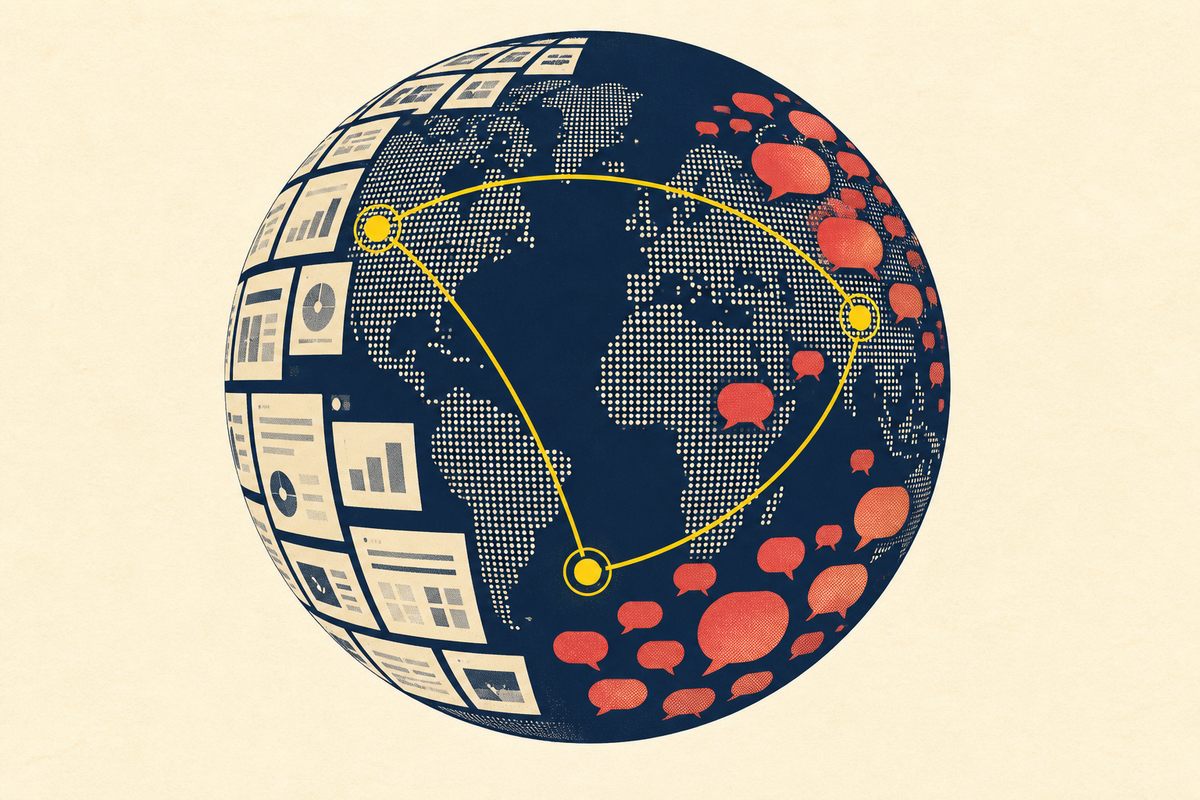
A product leader in London publishes an onboarding change before lunch. A customer in Osaka encounters it after dinner. By the time a researcher in California opens the feedback dashboard, comments about the change have arrived in Japanese, German and Spanish. Everybody is working on the same product. They may still be looking at three different realities.
This is the quiet problem behind global software operations. Translation attracts attention because it is visible. A clipped button label is obvious. A reporting boundary is not. It hides in the subscription region, the definition of a day, the account currency, the permissions model and the taxonomy used to label customer complaints. Those settings decide whether a company learns globally or merely operates in several places.
Pendo and Thematic make a useful pair because they address opposite directions of the loop. Pendo helps teams observe product behavior and deliver guides or Resource Centers in a visitor's preferred language. Thematic takes open-ended feedback from different markets and translates it into a common analytical language. One shapes the experience going out. The other organizes the evidence coming back.
Guide, onboarding, help
Survey, ticket, review
Theme, metric, action
Pendo sends the product outward
Pendo's localization starts with metadata. Its web or mobile SDK can capture a visitor's language, or a team can point localization at another metadata field. The platform then displays the matching version of a guide or Resource Center. Locale fallback handles the practical messiness: if Spanish for Mexico is missing but general Spanish exists, the broader version can appear. Teams can also choose whether to show the default language when no match exists or hide the content instead.
The translation workflow offers three routes. Editors can type translated copy directly, use Pendo's AI localization, or export and re-import XLIFF 1.2 files through a translation service. That last path matters to companies with established linguists, terminology databases and approval gates. AI output can be reviewed before it becomes public, while a public guide's saved translation can publish immediately. Resource Center structural copy and the guides inside it are managed separately, a detail that belongs in the release checklist.
Language support is broad because Pendo uses Google's translation services, but the edges need testing. Pendo's documentation says right-to-left guide translations have limitations even though teams can create right-to-left guides. Custom code inside a Sandbox module is not pulled into the standard localization workflow. Changing the default language with support also removes attached translations, creating a re-import job rather than a harmless preference change.
The global operating model breaks when a local exception quietly becomes a second source of truth.
Thematic brings the customer voice inward
Thematic begins where a guide platform stops: the words customers volunteer in surveys, tickets, reviews and other feedback channels. It automatically detects language, translates non-English comments into English and runs analysis on that common representation. The vendor says it can process hundreds of languages through its integrated Google Translate service. Users can inspect comments in their original language or in translation, and can download either version.
That design makes cross-market comparison possible. A complaint in Polish and one in Spanish can contribute to the same theme instead of becoming two regional anecdotes. Thematic can translate theme names back for local consumption, while its Theme Editor lets authorized users correct names and resolve awkward translation. The method is not native-language analysis, and buyers should preserve that distinction. Machine translation adds a layer between the customer and the model. Keeping the original comment available is what makes the result auditable.
The governance mechanism is the shared taxonomy. Multiple datasets and dashboards can provide local views, while themes keep their meaning across channels. Roles and per-dataset or per-dashboard permissions distinguish people who can edit themes, download data, manage users or simply view a dashboard. Scheduled email digests and editable PowerPoint exports can carry a filtered view to a regional team without requiring it to rebuild the analysis.
| Decision | Pendo | Thematic |
|---|---|---|
| Language job | Deliver localized in-app guidance | Normalize multilingual feedback for analysis |
| Translation control | Manual, AI, or XLIFF 1.2 with review | Automatic detection and English translation; original retained |
| Global reporting | Cross-app views inside one subscription | Shared themes across datasets and dashboards |
| Governance | Subscription and app-level roles; teams | Roles plus dataset and dashboard permissions |
| Regional boundary | Each subscription belongs to a region | Each account is assigned to one hosting region |
Residency is where unity gets expensive
Both vendors document regional infrastructure, but a region is not a cosmetic selector. Pendo places a subscription in a specific region with its own data center. Within one multi-app subscription, product teams can filter or roll up behavior across web and mobile apps, use a single set of visitor and account records, and give people different roles by app. Separate subscriptions do not communicate, share users or share underlying guidance and analytics. Pendo also warns that historical data does not move automatically when an organization starts a new regional subscription.
Thematic says customer data is stored and processed in the single AWS region assigned to the account, with options in the United States, Frankfurt and Sydney and region-locked endpoints. This is a clear residency boundary. It also means a multinational that requires different data to remain in different jurisdictions should ask how a global report will be assembled across those accounts. The public documentation supports regional confinement; it should not be stretched into a promise of live cross-region aggregation.

Time and money need house rules
Follow-the-sun teams often discover that midnight is a product decision. Pendo's hourly activity widget uses the subscription time zone. Some nightly integrations run after local midnight, while Data Sync exports complete UTC calendar days. Pendo cautions that changing a subscription time zone shifts day boundaries across reports and dashboards and triggers reprocessing. A Paris team and a New York team may therefore see different freshness at the start of their workday even when the export policy is consistent.
Currency creates a similar trap. Pendo lets an admin map one account revenue field and select its currency at the subscription level. That supports revenue-weighted segmentation across apps, but it does not remove the need for a company conversion policy. If regions pass local currencies into a field treated as one currency, the prioritization becomes numerically tidy and economically wrong. Thematic dashboards can incorporate business metrics such as NPS or CSAT and metadata filters; buyers with revenue analysis should verify currency normalization upstream rather than assume the feedback platform performs foreign-exchange accounting.
These are less glamorous than an AI translation demo, yet they determine whether the morning handoff works. The outgoing team should leave behind a named report, stable filters, a governed theme definition, the source comments and a note about data freshness. The incoming team should be able to continue the investigation without exporting its own copy and renaming the problem.
The demo script worth stealing
- Change a public guide, then show how every translation becomes reviewable and how missing locales fall back.
- Submit the same complaint in three languages and trace the unified theme back to each original comment.
- Restrict one regional editor, then prove what that person can publish, rename, download and share.
- Cross midnight in two time zones and explain the dashboard and export boundaries.
- Split data between required hosting regions and demonstrate exactly what remains globally reportable.
Design the boundary before buying the tool
The cleanest deployment starts with a matrix, not a feature score. Put markets down one side. Put customer-facing language, source feedback language, hosting requirement, reporting time zone, revenue currency, publishing authority and taxonomy owner across the top. Mark which elements must stay local and which must remain common. Only then decide whether one subscription, multiple apps, multiple datasets or separate regional environments fit the rules.
Pendo is strongest in this comparison when a company wants localized product communication tied to behavioral analytics across a known portfolio of apps. Thematic is strongest when multilingual feedback needs to become a comparable, inspectable body of evidence. They can complement one another, but the connection requires deliberate identifiers and metadata. Market, language, account and product fields must mean the same thing on both sides.
The larger lesson is that global scale is not achieved by copying a workspace for every country. It comes from separating presentation from meaning. Let local teams translate the message, apply the right cultural judgment and work inside the required data boundary. Keep metric definitions, account identity, theme governance and handoff conventions shared wherever law and architecture allow. Local autonomy then becomes faster action on a common record, not a license to produce another dashboard.
Frequently asked questions
Do Pendo and Thematic solve the same globalization problem?
No. Pendo primarily localizes in-product guidance and analyzes product behavior. Thematic primarily translates and analyzes multilingual feedback. They cover opposite directions of a global product-learning loop.
Can Pendo unify several products in one report?
Yes, inside a multi-app subscription, with consistent visitor identities and the right app access. Separate subscriptions are separate data and governance environments.
Does Thematic analyze every language natively?
No. Its documented process detects the language and translates non-English feedback into English before analysis. Users can still view or export the original text.
Does regional hosting guarantee global reporting?
No. It addresses where data is stored and processed. A buyer must separately verify whether and how reporting can combine data across required regional environments.
What should a follow-the-sun team standardize?
Standardize IDs, metric definitions, taxonomy ownership, report filters, local-day and UTC boundaries, translation review status and a written handoff that links decisions to source evidence.