Glenn Turner has a complaint about the chief executive’s to-do list: it can be evidence that the chief executive is doing the wrong job. For a founder, this is an inconvenient position. Building a company tends to reward the person who picks things up. Running a larger one requires that same person to put things down. The desk may look less industrious. The business might work better.
Turner, the founder and CEO of RBS, has had ample opportunity to practise both movements. Before hospitality software, there was FireStream WorldWide, a business serving the petroleum industry. PDI acquired it in 2017. Then came another company, another collection of operational problems, and eventually a portfolio spanning ranches, hotels, restaurants and retail. His working life has changed scenery while remaining interested in the machinery behind somebody else’s day.
“If I’m an effective leader, I don’t have a to-do list.”
Glenn Turner
The next company began with an old problem
The FireStream chapter gives the hospitality story some useful context. At the time of its acquisition, FireStream served more than 170 clients selling over 20 billion gallons of fuel a year. Its work covered wholesale petroleum, logistics and supply chains. These are businesses where a misplaced number can travel some distance before anyone enjoys the consequences.
PDI announced the transaction on April 4, 2017, alongside the acquisitions of DataMax and LOMOSOFT. FireStream brought software for petroleum wholesalers, lubricant suppliers and propane marketers into that combination. For Turner, the sale closed one period of company building. He subsequently worked at PDI before returning to entrepreneurship.
The next opening arrived through a friend who ran a hospitality business and wanted better information and control. Turner spent time looking at its finances and technology, then acquired a software supplier serving that operation. The route into a new market was specific: hunting and fishing lodges and dude ranches, with older software that he wanted to move onto the web.
There is something pleasingly unromantic about this beginning. Hospitality sells the prospect of leaving ordinary complications behind. The people delivering it must still reconcile a booking, arrange an activity and send a correct bill. The guest may be escaping administration. Someone remains responsible for doing it.
RBS’s own history places its beginnings in 2019 and traces the product back to a lodge in Montana. YellowStone launched in 2022. Reservations, scheduling, billing and reporting became part of a system designed for ranches, lodges and outfitters. The setting mattered: an activity and the person qualified to lead it belong in the operational picture alongside the room.
The colleagues who came before the portfolio
Companies acquire product names. People accumulate working relationships. One of Turner’s connections reaches back to 2006, when FireStream acquired TMI and he met software developer Hasan Ahmad. Over the next 13 years, their work included software for the convenience-store industry. Ahmad moved from Fort Worth to St. Louis in 2013 to take on a larger development role.
Those details put some human scale into a career otherwise easily reduced to transactions. A company changes ownership on a particular day. The ability to make a product depends on people learning how to work together over years. The announcement is brief; the shared vocabulary takes longer.
Ahmad started Pale Blue Software in December 2019. RBS became its first customer, and the two businesses began developing YellowStone as a web-based property management and enterprise resource planning system. Turner’s new direction therefore drew on an established relationship as well as a new market. The next venture had an unfamiliar customer problem and a familiar collaborator.
A world beyond the company name
Turner had carried an international ambition for years. When he founded FireStream WorldWide in 2001, he wanted a company whose team could follow the sun. He later reflected that the team did spread internationally, while the customer base remained largely American. The name had travelled a little farther than the sales map.
Working at PDI gave him experience with a global customer base. When he started Romeo Bravo Software, he hoped to serve customers internationally again. The Winsar acquisition supplied a concrete moment for that ambition: Turner welcomed 2,100 hotels in 35 countries into the business. He also explicitly renewed the company’s commitment to the ranches, lodges and outfitters already there.
That second part deserves attention. A company can expand its addressable market with a sentence. Existing customers still need the product they bought. An outfitter does not acquire a hotel’s requirements merely because the two now share a software owner. Growth adds constituencies, each with a reasonable expectation of being understood.
During 2025, the portfolio widened through WinCloud, Smart Hotel Software and Hashmato. The RBS umbrella brought different products together: hotel management, outdoor hospitality, foodservice and retail. Turner was moving into adjacent operations while retaining distinct systems for the people doing the work. The company’s range had become broader than its original ranch-and-lodge remit.
properties in 35+ countries, as reported by RBS when it announced the Zeko acquisition.
The guest is at the other end
On April 27, 2026, RBS announced its acquisition of Zeko, a guest engagement platform led by founder and CEO Manit Deep Prashar, with Umesh Sharma as vice president of growth. The deal extended the company’s interest beyond managing an operation into the exchanges surrounding a guest’s stay.
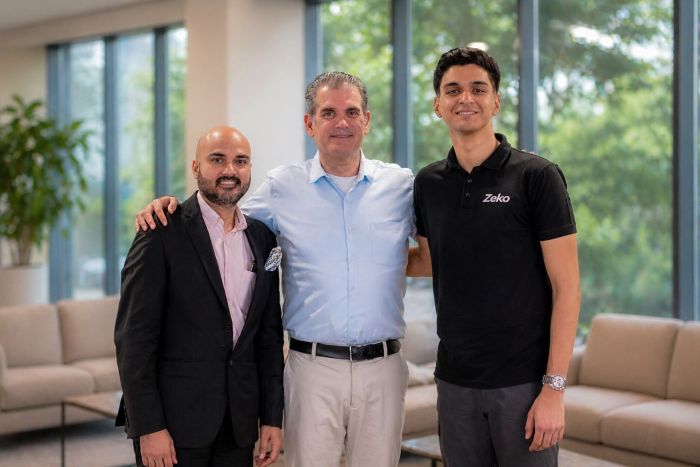
Zeko’s capabilities included WhatsApp automation, digital check-in, concierge features and upselling, working alongside property management systems. The distinction between the back office and the guest-facing business becomes smaller here. Information entered at one point in the stay can shape what someone is offered, asked or told at another.
The acquisition terms were undisclosed. Its stated purpose was clearer: add guest engagement to an expanding hospitality platform. A reservation establishes that someone is coming. There are many conversations left before that person goes home. Turner’s company was buying another way to handle them.
Earlier that month, RBS appointed Prasad as chief technology officer, elevating him from director of global engineering. Turner’s statement emphasized practical AI adoption in engineering, quicker product delivery and stronger accountability. The appointment put responsibility for technology strategy and global development with a leader already working inside the organization.
For a founder discussing delegation, that is a useful organizational detail. Responsibility needs somewhere to land. Product strategy, delivery and engineering standards cannot remain an informal collection of things the founder will inspect when he finds a spare afternoon. The management structure has to become as deliberate as the product structure.
A demonstration still needs a conversation
At Chennai’s Foodpro exhibition, Turner described the benefit of meeting prospective customers in person. They could see a product, touch it and ask questions. He also spoke about referrals and sales teams visiting prospects. For a business selling digital systems, the route to understanding an operator remained strikingly physical.
The product he was discussing there was Hashmato, the point-of-sale platform for food, beverage and retail. Loyalty, gift cards and payment methods were among the trends he identified. These are concrete points of contact between software and a customer’s purchase. A demonstration gives the prospect something more useful to interrogate than a promise of future efficiency.
His public appearances offer another view of that interest. A boutique-hotel owners’ conference listed him for a 2025 session about guest technology and profitability. He has also discussed the business with Prashant Mishra on RBS’s Connecting the Dots. The audience changes, but the conversation keeps circling the relationship between operating systems, staff and commercial results.
The YellowStone award feature in Travel and Hospitality Tech offers a compact expression of his product philosophy: “It was never built to replace hospitality; it was built to protect it.” The test implied by that sentence is demanding. An operator has to feel a useful difference in the work. A guest has to receive the service. Adding technology creates another obligation to make those two experiences fit together, particularly when the people using it are busy with the next arrival.
Six questions for the person in charge
Turner has also put his approach into Guest-OS, a hospitality leadership framework and book. It organizes the business around six pillars: vision, people, data, process, profit and execution. The subject has moved from which application an operator uses to how that operator runs the organization around it.
The framework addresses owners, general managers and leadership teams, with weekly measures and a regular operating rhythm. Its proposed peer groups bring together hospitality leaders who are not geographic competitors. The intention is practical exchange: compare performance, discuss decisions and build relationships with people facing related problems.
Putting a book beside a software portfolio reveals something about the problem Turner has chosen to work on. Installing an application leaves plenty for a leader to settle. Somebody must own a task. People need a shared expectation. A report needs a reader who can act. The system on the screen and the system of responsibility have to meet.
A guest rarely asks how a department is organized. The question tends to be whether the promised thing happened. Turner’s career puts him among the people designing the less visible arrangements behind that answer. The task gets more complicated as the product list grows, while the guest’s expectation remains quite straightforward.
That returns the story to the chief executive’s list. Turner’s challenge is recognizable at every scale of hospitality: how to make service dependable when one person cannot stand over every handoff. He began this chapter with the difficulties of a particular operation. As the company grows, the work is to keep those individual difficulties visible - and give someone the authority to solve them.