A hospital scanner can complain for days before anybody calls it broken. Its complaints are buried in log files: a warming component, a change in pressure, a recurring error, another warning that seems too small to interrupt a full appointment book. The machine is speaking. The trouble is that it speaks in a dialect few people have time to read.
- Glassbeam turns machine logs and imaging operations data into alerts and usable dashboards.
- Its Clinsights software serves hospitals, imaging centers, equipment makers and independent service teams.
- The company sells a shared view across manufacturers, where each maker's own service tools usually stop at its own machines.
- Gateway Diagnostic Imaging says the system helped recover 70–80 productive hours per machine annually.
Glassbeam built software for precisely that translation. Its cloud platform collects data from connected medical devices and, depending on the product, from scheduling, imaging and clinical systems. It parses the jumble, looks for patterns, and sends an engineer an alert that can lead to a repair before a machine loses an afternoon. The same data can tell a radiology manager that one scanner is booked solid while another sits underused.
The first failure is usually a conversation
Consider what happens when an MRI goes down. A patient needs a new appointment. A technologist's schedule changes. A service engineer has to travel, diagnose the fault and find a part. The department may have another scanner, but only if someone can see its open capacity and move the exam. Equipment failure becomes a small bureaucratic opera, with everyone holding a different score.
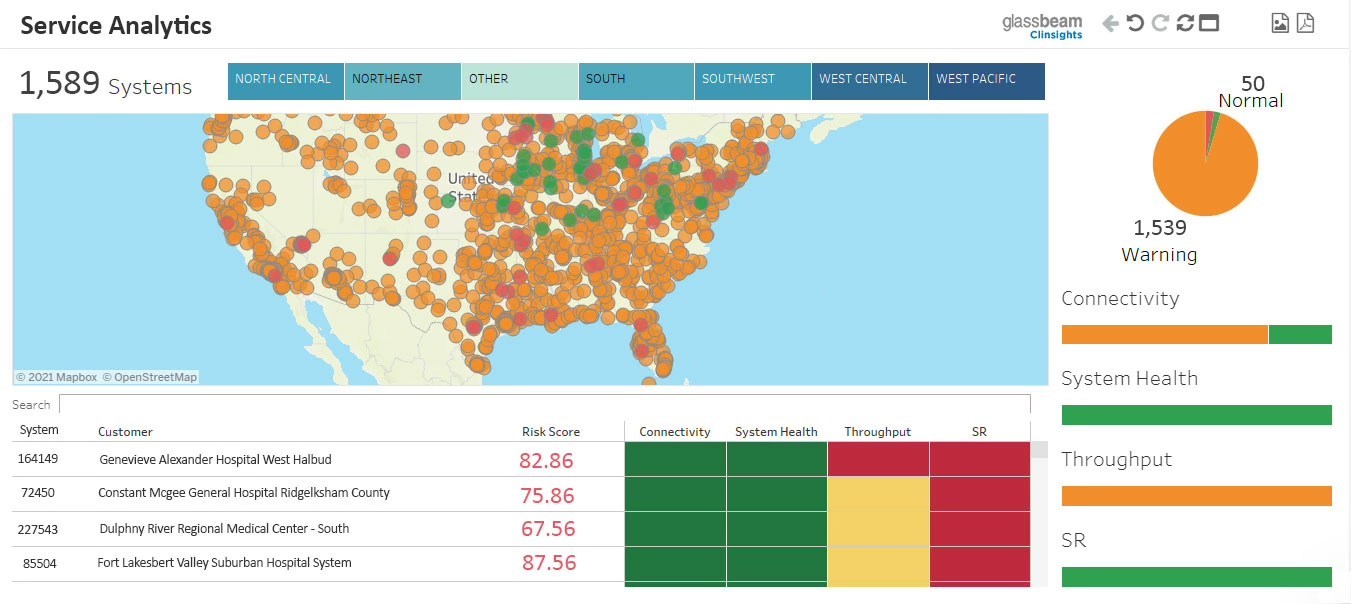
Glassbeam's Clinsights Service Analytics focuses on the machine side of that story. It monitors logs and system-health signals, applies expert rules and machine-learning models, and presents alerts, remote diagnostics and service workflows. Its public materials name surprisingly physical indicators: MRI magnet pressure, helium level and cold-head temperature; CT tube warnings; cooling and environmental conditions. These are less glamorous than "AI" and more useful to the person deciding whether to book a repair window.
The important word is planned. Predictive maintenance has a modest, measurable ambition: move work from the moment a patient is waiting to a time the department can absorb it. A warning without a service process is just another notification.
A hospital rarely buys one brand of everything
This is where Glassbeam's positioning becomes clearer. Manufacturer service portals can tell a hospital a great deal about that manufacturer's equipment. Real hospitals own mixed fleets: an MRI from one maker, a CT from another, cath-lab equipment from a third. Glassbeam sells the view across those boundaries. For a clinical engineering team, that means fewer separate windows and a better chance of noticing a pattern across sites.
The approach grew from an older, broader business. Co-founder Puneet Pandit has said the Glassbeam brand began in 2009 within an IT services company, studying complex data from connected products. In 2014 it reappeared as a pure cloud SaaS offering for industrial IoT. Storage equipment and networking hardware were once part of the story. Medical imaging gave that skill a sharper purpose: a machine's data could be tied to an appointment a patient might actually miss.
“Before the Glassbeam Clinsights solution manual processes predominated.”Al Moretti / RENOVO Solutions
RENOVO Solutions, an independent healthcare equipment service company, wanted one view of a fleet spanning vendors and modalities. Its published case study describes remote monitoring, predictive alerts and a rollout to more than 1,300 customer locations in 49 states. It also reports 99.9% machine uptime. Those are RENOVO's case-study figures, not a promise that every hospital will see the same result. The telling detail is the original problem: staff had been mining service data manually when contract renewals and customer demands called for something more systematic.
The idle scanner is a clue, too
A working scanner can still be a costly scanner. Glassbeam's second Clinsights product, Utilization Analytics, looks at exam volume, staff productivity, turnaround, referrals and scheduling. It can combine machine logs with DICOM imaging data, HL7 messages, radiology systems, electronic records, billing and schedules. The practical question is less "How much data do we have?" than "Which room has capacity on Thursday?"
At Gateway Diagnostic Imaging in the Dallas area, the problem had two halves. The company wanted fewer surprise breakdowns and better decisions about how its machines were used across outpatient centers. Its Glassbeam case study says the software helped recover 70–80 hours of revenue-producing time per machine each year, with an estimated $70,000–$80,000 in avoided lost revenue per machine. The estimate is Gateway's, built around its own economics. The broader lesson is portable: count unavailable hours, trace why they happened, then compare that with the cost of watching the equipment more closely.
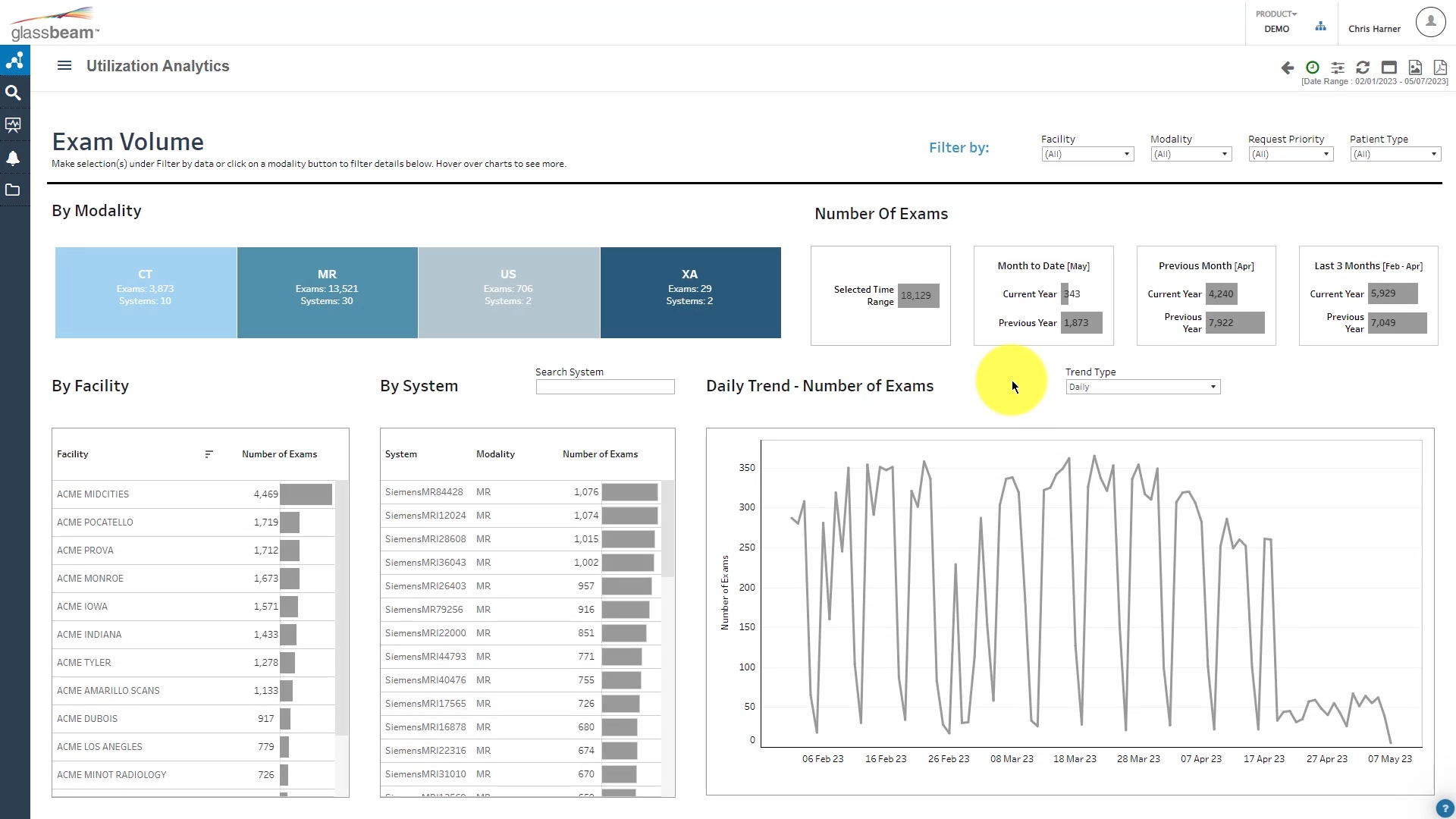
The utilization view can also expose uncomfortable human questions. Are repeated exams associated with a protocol or training issue? Are scheduling gaps clustered by day? Has a referral pattern changed? A dashboard cannot answer those by itself, but it can make the right person ask. That is a different sale from maintenance software, and it helps explain why Glassbeam talks to radiology leadership as well as engineers.
What it costs to hear the warning
Glassbeam is sold to organizations, not patients. Its published Service Analytics comparison lists Advanced and Premium modules; remote troubleshooting and CMMS integration sit in the latter. Buyers are directed to sales for pricing, and the company's SaaS terms refer to fees and billable units. For a buyer, the useful cost exercise is to price the subscription against three local numbers: unplanned downtime hours, engineer travel and diagnostic time, and the exams those interruptions displace. Gateway's claimed recovery illustrates the calculation, though its result should not be borrowed wholesale for another fleet.
The company has had help reaching those fleets. Siemens Healthineers joined its strategic reseller program in 2020, explicitly to offer Clinsights Service Analytics to providers with mixed-vendor equipment. Canon Medical appears among its named customers and service partners. MultiCare Health System participated in Glassbeam's $10 million Series B in December 2021; the company said the financing would expand its commercial and product teams. These are unusually revealing partnerships: an equipment maker, a health system and a software company each have a different reason to want the same warning a little earlier.
In January 2025, Glassbeam announced a U.S. Department of Veterans Affairs Authority to Operate for Clinsights and cited a deployment in VISN 2. That matters because a hospital's operational data cannot be treated like a casual website metric. A federal authorization does not settle every security question for every buyer, but it is a concrete step in selling cloud software to a particularly demanding customer.
A useful idea for anyone with expensive machines
The part worth copying is a sequence, not a model. First, gather the logs that already exist. Then join them to service tickets and schedules. Find a small set of failures whose early signals are understandable. Decide who acts on an alert and what they are authorized to do. Finally, measure whether the hours actually move from emergency downtime to planned work. Without connected devices, readable data, and a team able to respond, the cleverest prediction is only a more punctual alarm.
Glassbeam's business rests on a plain observation: hospitals cannot schedule around what they cannot see. The scanner may have been trying to tell someone. The company sells the interpreter - and, at its best, a better moment for the conversation.
Keep looking
Glassbeam website · Service Analytics · Utilization Analytics · Customer results · Dashboard demos · LinkedIn · X · Facebook