Giorgia Longobardi had a choice of research topics. One offered the comfort of an established field. The other involved gallium nitride, a semiconductor material with questions still attached. She chose the unfamiliar one. Years later, the choice would have a company name, customers and chips that could sit on a desk. At the beginning, it mostly offered work.
There was another complication. She had come from Naples to Cambridge with little English. Learning how to discuss semiconductor physics in a new language is a fairly thorough way of discovering whether you enjoy a challenge. Longobardi stayed. She finished her doctorate in 2014, then helped build a business around making the use of electricity more efficient.
Today she is co-founder and chief marketing officer of Cambridge GaN Devices, usually shortened to CGD. She led the company as CEO before handing that job to Fabio Necco in January 2026. Her continuing task brings her back to the question that gave the research its purpose: how do you get a useful scientific idea into equipment people actually use?
The unfamiliar option
Longobardi graduated from the University of Naples Federico II in 2010 with a master’s degree in electronics engineering. A semiconductor physics class had caught her attention. An Erasmus project brought her to Cambridge for thesis work, opening a route into the university’s research community and, eventually, a PhD.
Her doctoral work involved NXP Semiconductors. That connection put practical products within sight while she studied the behaviour of semiconductor devices. It gave the research a second audience beyond the university: people with applications, markets and requirements to satisfy. A transistor could be interesting on paper and still need considerable work before anyone would put it into a product.
That distinction would keep returning. Longobardi’s career grew through exchanges between academia and industry, including consulting for Infineon and Vishay. The scientific question remained compelling. The customer’s question began to matter just as much. What would this technology allow someone to build, and what would make them willing to use it?
“I like a challenge!”
Giorgia Longobardi
A company needs a different education
After the PhD came support for translating research into commercial work and a Junior Research Fellowship at Gonville & Caius College. Longobardi co-founded CGD in 2016 with her doctoral supervisor, Professor Florin Udrea. The partnership paired her device research with the experience of a professor who had already helped create businesses.
In the same year, CGD shared first prize in Cambridge’s Postdoc Enterprise Competition. Each of the two winners received £20,000 in investment. Five finalists had pitched to an audience of 100. For an academic learning to explain a business, that is a different examination from defending a thesis. Someone has to understand both the invention and the reason to back it.
The early company also coincided with an opportunity abroad. Longobardi spent a year in Japan on a research fellowship, working with Kyushu Institute of Technology and Toshiba. She has described that experience as an education in how differently people can think and work. Travel supplied more than a change of scenery. It challenged assumptions that had felt ordinary in Europe.
The Japan plan required some explaining. Longobardi has recalled pitching Cambridge Enterprise for a £75,000 convertible loan and announcing, on the same day, that she intended to leave for a year. She persuaded the organisation that the experience would benefit the company. It was an early exercise in asking supporters to see value in a route that was hardly the obvious one.
Cambridge doctorate begins
£20,000 competition investment
GaN product family
Continues on the board
Later, she would describe looking at the chips on her desk and thinking back to simulations started a decade earlier. There was now a product, customers and knowledge held by employees. The object was small enough to overlook. The work behind it was a sizeable piece of her life, gradually becoming something another engineer could pick up and use.
The switch has to earn its place
The machinery behind Longobardi’s ambition is less mysterious than the terminology suggests. Power electronics control and convert electricity. Inside those circuits, semiconductor devices act as switches. Energy is lost as the system does its work. Reducing those losses can help equipment deliver the same useful task with less waste.
Gallium nitride, or GaN, offers advantages for fast switching. It can also help designers make power systems more compact. The applications reach from consumer power supplies to industrial equipment, data centres and electric vehicles. These are places where a small component participates in something much larger than itself.
CGD’s answer is called ICeGaN, short for Integrated Circuit Enhancement Mode GaN. Its approach puts interface circuitry and the GaN power device onto the same chip. Compatibility with conventional gate drivers gives designers a familiar way to control the device. The business proposition includes the effort required to adopt a new material.
gate driver
+ GaN power switch
For Longobardi, explaining that connection is part of making the technology useful. A customer needs more than a promising semiconductor property. The device must work in a design, be available in the required quantities and arrive with a supplier the customer can trust. The path from laboratory to market contains a surprising amount of reassurance.
More partners than employees
One early undertaking gives a sense of the scale of that job. CGD led GaNext, a €10.3 million project bringing together 13 industrial and academic partners. Longobardi recalled that when the company won the project, it had more partners than employees. The organisation chart must have required rather small lettering.
The consortium worked on intelligent GaN power modules. Its structure reflected an industrial reality: a device company depends on knowledge and capabilities spread across other organisations. Building a semiconductor business means persuading those capabilities to work together, while also building a team of your own.
Recognition arrived along the way. In 2019, Longobardi was one of five recipients of the RAEng Engineers Trust Young Engineer of the Year award. Her work also extended to STEM outreach with school students in Italy, the UK and Japan. The engineer developing a business was helping younger people see a route into engineering themselves.
CGD raised $9.5 million in Series A funding in 2021. Its first commercial family of 650 V GaN power transistors reached launch and mass production in 2022. A $19 million Series B followed that year. These were distinct hurdles: financing development, introducing a product and supporting production in volume. A successful pitch alone could accomplish only the first part.
Series C, announced 18 February 2025, supporting expansion in Cambridge, North America, Taiwan and Europe.
The Series C expanded the resources available for the next stage. It also made the customer question more pressing. Capital can finance people and development. The commercial test still takes place in the equipment a customer chooses to build. Longobardi’s role has repeatedly required her to connect those two conversations.
Learning to leave room
She has been unusually direct about the awkwardness of company growth. Processes can become outdated almost as soon as they are established. The founder’s knowledge of the original invention does not automatically supply every skill the larger organisation needs. People have to join, take responsibility and contribute experience the founder does not possess.
Longobardi joined the Royal Academy of Engineering’s SME Leaders programme in 2020. Coaching and conversations with other entrepreneurs offered somewhere to work through decisions. She has valued the opportunity to hear a different perspective. Leadership, in that account, includes finding people with whom the leader can think honestly.
Her writing on company culture makes a related argument. Clear values need room around them for different thinking. She has described learning the languages of industry bodies, standards committees, politicians and supply-chain partners. Technical fluency is one language in a company’s life. The list grows when an invention begins moving through the world.
The question of who gets to speak matters to her, too. Longobardi has discussed the experience of being the only woman in a room of investors or customers. Her advice encourages women to recognise their own strengths and bring complementary skills into a team. The engineering profession becomes more approachable when people can see what its work changes outside the laboratory.
“Own your own diversity.”
Giorgia Longobardi
A different seat at the same company
In January 2026, CGD appointed Necco as CEO. Longobardi moved to CMO and remained a director. She described wanting to concentrate on bringing advanced, efficient power electronics solutions to market. The change fits a career that has gradually widened from understanding a device to helping other people put it to use.
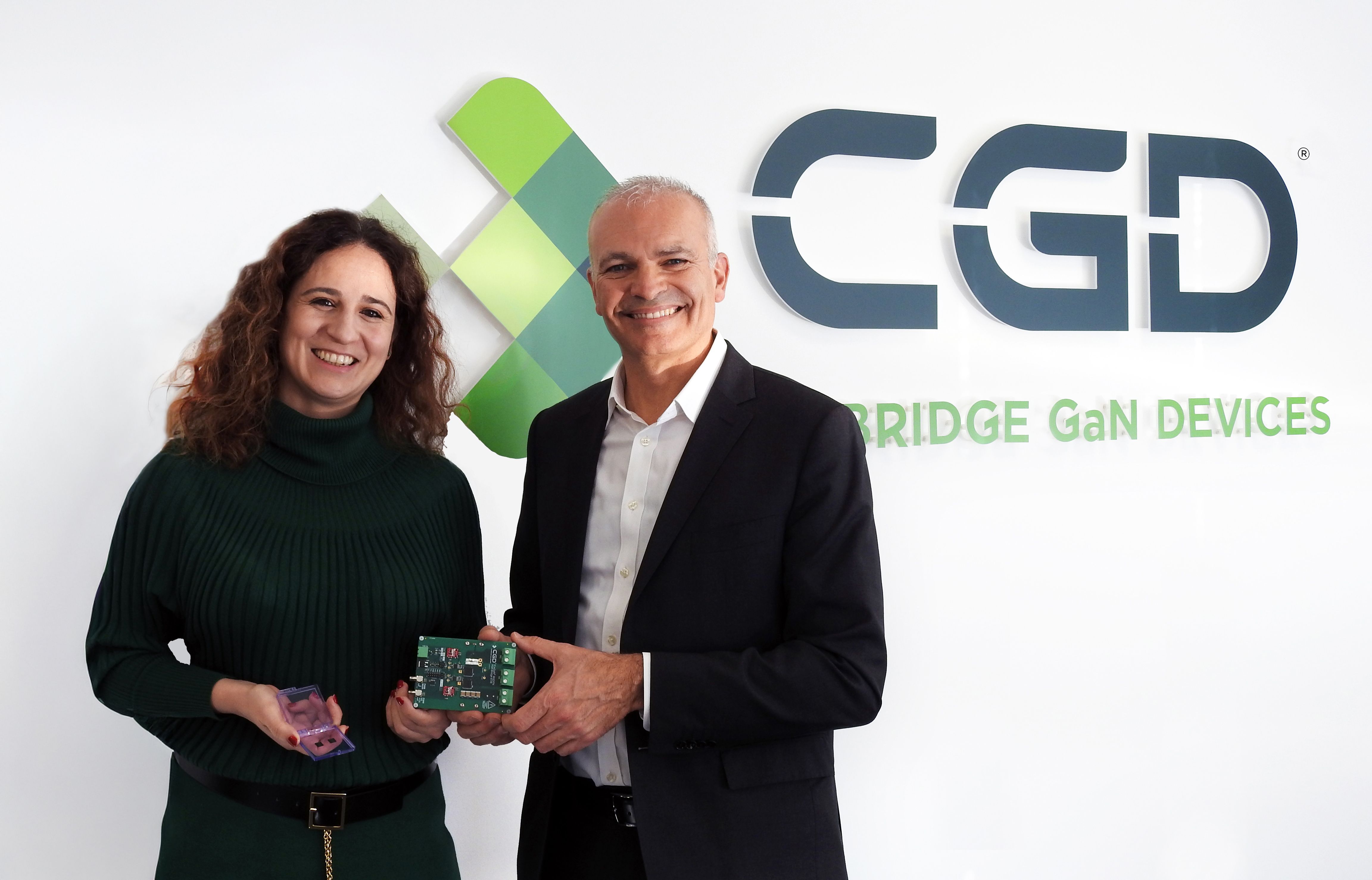
In June, CGD announced a long-term collaboration with NXP on power-conversion solutions for data centres, automotive and industrial applications. The relationship brings CGD’s GaN expertise together with NXP’s product portfolio and system knowledge. It is another version of a recurring theme in Longobardi’s work: research travels further when someone connects it with the people who can use it.
Outside work, she is a rescue, wreck and deep diver. She enjoys cooking pasta with potatoes and has expressed distinctly Neapolitan reservations about pineapple on pizza. Her appetite for unfamiliar territory appears to have a culinary boundary. There are, apparently, some experiments the household need not fund.
Her ambitions include driving an electric vehicle powered by CGD technology. It is an appealingly concrete wish for someone whose work began inside semiconductor physics. After the research, the company, the financing and the negotiations, there would be a car to get into. Somewhere within it, a device would be doing the work she once chose to study.