Four phones, one inconvenient question
In 2010, Gil Bouhnick owned four smartphones and usually carried at least two. A conversation about enterprise software could therefore begin with a modest question: which pocket? His enthusiasm had a practical outlet. At ClickSoftware, he was helping build mobile tools for people whose working day did not happen conveniently beside a desk.
One example he gave was a service technician in an elevator shaft. Connectivity could disappear; the job still needed doing. The software had to let someone retrieve information and record work without a reliable connection. A handsome interface that stopped functioning underground would make a rather expensive decoration.
That early problem provides a useful way into Bouhnick's career. The setting keeps changing, from field service to a beauty-services marketplace to advertising measurement. The recurring question is plain: what happens when the product meets the conditions people actually live and work in? His answers have become more interesting whenever the conditions refused to cooperate.
Leaving a product he had watched grow
By July 2015, Bouhnick had spent 16 years at ClickSoftware. In his public farewell, he described ClickMobile as an initiative that had begun small and become a platform used by more than 200 large enterprise organizations. He was leaving something he had helped nurture over a decade, with customers, partners and a substantial history behind it.
His work had also brought public recognition. The 2011 Mobile Star Awards named him a winner in the enterprise mobile software or services visionary category. In 2014, as vice president of mobility, he was presenting ideas about using game mechanics to encourage adoption in enterprise software. His concerns already extended beyond making an application run: people had to choose to use it.
The next choice was his own. He announced a move into a consumer startup, asking readers to cross their fingers. With Maya Gura, he co-founded Missbeez, a marketplace connecting customers with independent beauty professionals. The enterprise builder was now on the consumer side of the screen. A procurement department could no longer explain what a customer wanted. The customer could simply leave.
The checkout had a vote
Missbeez offered a particularly intimate kind of product feedback. Bouhnick recalled evenings his wife arranged for friends and neighbors to try the service. They could enjoy discounted beauty appointments and a glass of wine; he could observe what happened when a real person used the app. The convivial atmosphere did not make the credit-card request any less awkward.
People who knew his wife still hesitated to give an unfamiliar app their payment details. Would it charge them immediately? Could they pay another way? Familiarity with a person had failed to transfer automatically to familiarity with a product. The interface needed to earn its own confidence.
He later described adding a short explanation near the booking action to make clear that the charge would come later. It is a small intervention with a substantial editorial lesson: the important text can be the sentence beneath the impressive button. A customer needs to understand the commitment before accepting it. The developer's knowledge of the payment process does very little for someone who cannot see that process.
A release is only the beginning
Even a finished improvement had another obstacle to overcome: arriving on the customer's phone. In 2018, Bouhnick reported that more than 80% of active Missbeez customers were still using older versions two weeks after an update. For a team shipping regularly, the new product and the product in circulation were different things.
His domestic evidence was less dignified and more memorable. He had discovered 45 pending app updates on his wife's phone and joked about whether she even had that many apps. Technical users might regard updating as routine housekeeping. Other people had perfectly good reasons to get on with their day.
The practical consequence was a long tail of old versions that still needed support. Bouhnick explored ways to manage that tail, including server-controlled rules for workflows that genuinely required newer software. The underlying discipline is easy to underestimate. A launch marks the team's progress. Adoption depends on the customer. Between those two events lies a stretch of work that a release announcement rarely photographs.
When the experiment catches the wind
A two-sided marketplace made simple improvements treacherous. At Missbeez, moving the request for payment details until after booking looked promising: customers would be more committed by then. The change modestly improved the drop-off, Bouhnick recalled, but also left professionals waiting on bookings that customers had not completed. A tidier customer funnel had created a mess for the other side.
He also described an early assumption that customers wanted a choice between home appointments and salon visits. Interviews supported it. Actual orders did not: the salon option attracted none in the first two months and just one after three. Software had faithfully implemented demand that barely existed.
By 2019, he was writing about the limits of interpreting experiments in a changing market. His analogy was a paper airplane launched from a window: alter the wings, try again, and the flight may change for reasons outside your design. Weather, acquisition campaigns and the composition of users could disturb the result. Measurement needed comparison groups and patience. Confidence in a dashboard was insufficient protection against the wind.
“Soon enough you realize it's not you, it's the wind...”Gil Bouhnick, on interpreting product experiments
The host who will not let you sit down
Bouhnick's writing often starts with a nuisance rather than a grand theory. Consider his description of a party host who insists on a house tour, introductions and appetizers before a guest can settle in. He gave the software equivalent a name, the host syndrome: a product so eager to display its features that it makes arrival exhausting.
There are familiar symptoms. A newsletter demand appears before the visitor has read anything. Permission requests pile up. A walkthrough blocks the screen and marches a newcomer past features they never asked to inspect. The product team sees its hard work. The visitor sees a queue of obligations.
His prescription is a matter of timing: let people experience value, ask for permissions when their task requires them, and offer small hints they can dismiss. The same attention to the visitor appears in his critique of deceptive interfaces. His catalogue of 20 dark patterns examines hidden costs and misleading controls. A completed transaction can leave a disappointed customer behind. The number alone does not describe the quality of the encounter.
“Value first, commitments later”Gil Bouhnick, The Mobile Spoon
A chart can behave badly, too
Words and charts receive the same scrutiny. In his guest essay on UX writing, Bouhnick treats text as part of the interface's visual construction. Length, alignment and emphasis matter alongside meaning. His 2018 typography guide came with a pleasing admission: he had made its mockups in PowerPoint. The tool was ordinary; the decisions still needed care.
In a later essay about misleading graphs, he turned that scrutiny on reporting. Change the baseline, omit the newest period or display cumulative totals, and real numbers can tell a flattering story. He also examined how a strong early customer group could keep aggregate activity looking healthy while newer groups weakened.
The essay uses mischievous language about manipulating a presentation, then tells readers to inspect the dates, filters and cohorts. Its joke depends on recognizing a serious temptation. A chart can be accurate at every plotted point and still invite the wrong conclusion. That is a useful warning from someone whose work increasingly concerns the machinery that turns activity into a business explanation.
From a mobile screen to three screens
At AppsFlyer, Bouhnick's published role is director of product, with responsibility for privacy-preserving attribution. Attribution is the business of deciding which marketing interaction receives credit for an outcome. His explanations make the practical stakes visible: a later advertisement can complicate the credit due to an earlier one; privacy protections can change the detail available to measure either.
In October 2024, he and Yifat Niv published a guide to the noise introduced into Privacy Sandbox reporting. In his writing about Apple's AdAttributionKit, he discussed overlapping re-engagement windows, attribution settings and testing. These are engineering details with managerial consequences. A marketer's next spending decision depends partly on what the measurement system can say, and how its rules assign the result.
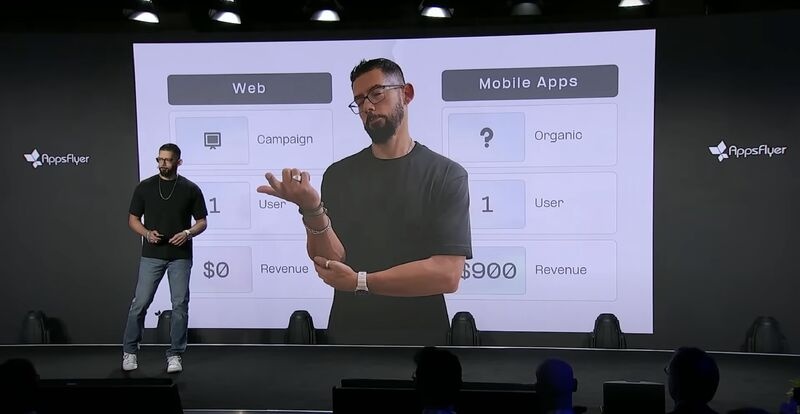
His remit has also widened. In November 2025, he said his team had built two products among ten AppsFlyer announcements, describing an expansion beyond mobile and last-click attribution. In May 2026, he announced Web Performance Measurement at MAU Vegas and said he had been tasked the previous year with leading the broader effort across platforms, including web and connected TV. The journey now crosses screens as well as customer choices.
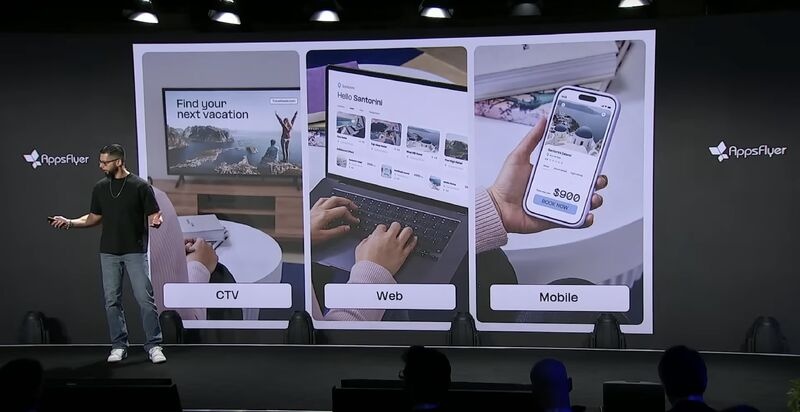
How should credit follow a journey across screens? Conceptual illustration of the scenario in his presentation.
Keep the idea small enough to test
Bouhnick has begun considering another interface: conversation. In his AppsFlyer essay about ChatGPT and commerce, he argues that applications may increasingly be reached through a conversational layer. He asks product teams to consider how their workflows, APIs and measurement fit that possibility. It is a proposal about what may develop, rather than a declaration that the future has already arrived.
His earlier writing supplies a useful restraint. In an essay about the visionary's curse, he recalled a company where a founder's plans moved so far ahead that the team struggled to follow. His advice was to write the assumptions down, divide ambition into achievable steps, seek evidence and take colleagues' objections seriously. A vision needs a route that other people can walk.
There is a smaller example on his own phone. After dealing with thousands of screenshots, he created iOS shortcuts to sort new captures into useful albums. Research images, bug reports and moments worth keeping had accumulated together. The answer was a modest intervention in an irritating daily routine.
That is a fitting place to leave him: among the working details. A phone that cannot connect. An update nobody installs. A button that asks for trust before explaining itself. An idea gains substance when someone discovers where it breaks, makes the adjustment and tries again. Bouhnick has given those adjustments much of his career, and enough jokes to make reading about them a pleasure.