On paper, a house and a smartphone have little to discuss. One has joists, grout and a suspicious socket behind the refrigerator. The other has apps. Jesse Lindeman has spent much of his career dealing with both, and the connection is less peculiar than it first appears. Each becomes complicated when many people need it to work, nobody agrees on the rules, and the customer would prefer not to become an expert just to get through Tuesday.
Lindeman’s public career begins in the language of networks. He studied information management and technology at Syracuse University, then earned a master’s degree there in telecommunications and network management. In 2003, while working as a lab manager and graduate research assistant at the university’s Center for Emerging Network Technologies, he received the John R. Weitzel Award for Information Systems Research. The subject matter was technical. The habit underneath it was practical: find the bottleneck, understand the moving parts, make the system behave.
A year later he joined Airespace, a wireless-networking startup, as a technical marketing engineer. Cisco acquired Airespace in 2005, and Lindeman moved into technical marketing and product-line management roles there. Wi-Fi at the time was graduating from office convenience to essential infrastructure. Connectivity had to be reliable, observable and manageable. The trick was making a dense network feel ordinary to the person holding a laptop.
A career in four operating systems
Wireless networks
Device fleets
Enterprise software
Renovation projects
The phone becomes the office
In 2009, Lindeman joined MobileIron. The timing was excellent and inconvenient, which is often when product people become useful. Smartphones were pouring into workplaces. Employees liked their speed and intimacy. Information-technology departments saw a portable collection of corporate data that could be left in a taxi. Businesses needed rules for applications, access and security without turning the beloved new device into a bureaucratic brick.
Lindeman rose to vice president of product, leading product management and user experience as MobileIron grew and eventually went public. He also became a named inventor on a series of patents involving mobile applications, device security and policy management. The patent language is predictably austere. The human problem was vivid: how can a company maintain control while letting people use the small computer they carry everywhere?
“Mobile is becoming the primary computing platform for our customers who want to transform their businesses.”Jesse Lindeman, while VP of Product at MobileIron
He spoke publicly about rules that could respond to a device’s context and about giving workers immediate, secure access to their content. His preferred territory seems to have been the seam between invisible infrastructure and visible ease. The software had to carry the administrative burden without constantly reminding the employee that an administrator existed.
Apple hired him as Head of Enterprise Software in 2017. The move placed Lindeman inside the company whose devices had helped create MobileIron’s market in the first place. By then, enterprise mobility was no longer a novelty. It was plumbing. Lindeman had traveled from the wireless layer to device management to the platform itself. Then, in 2020, he stepped into a business where the plumbing might be literal.
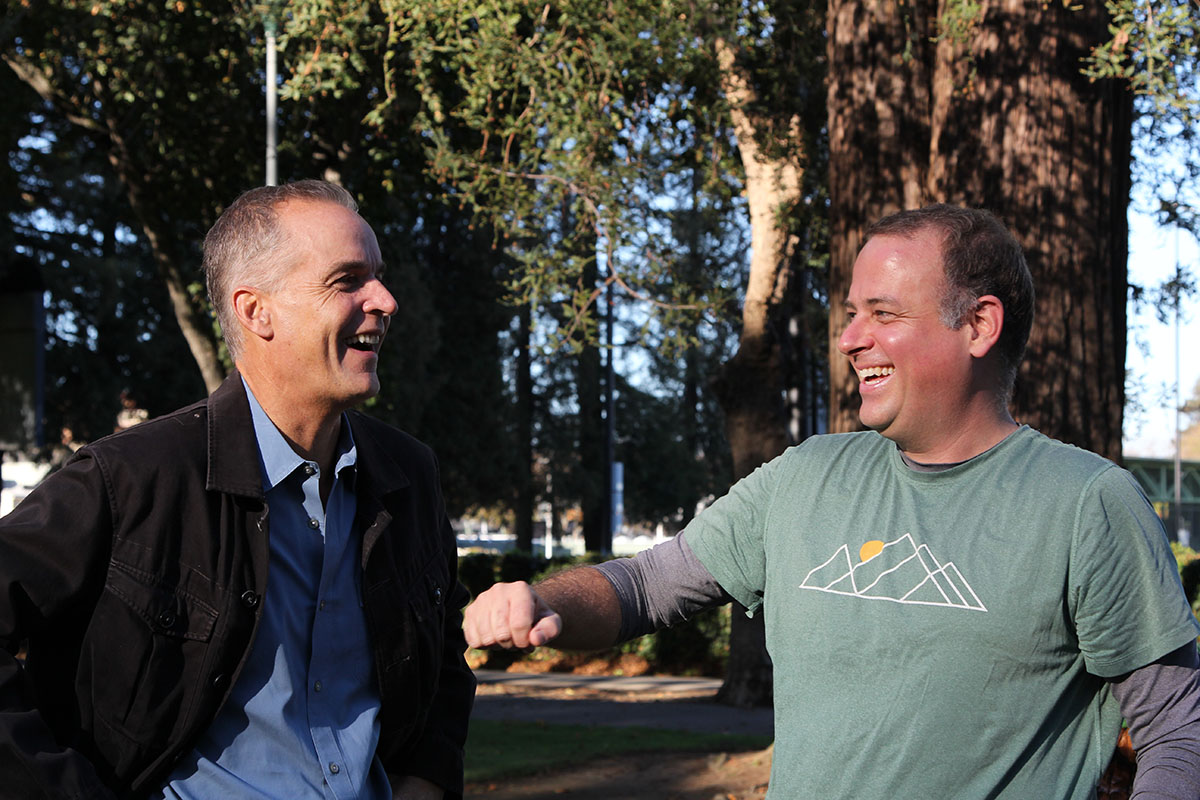
A founder pairing, served from the grill
Freemodel’s origin has the pleasingly local proportions of a short story. Lindeman and John Garner worked together on a fundraiser barbecue for the Washington Elementary School Dad’s Club. It went well. Amid the civic logistics of feeding families, they noticed that they made good business partners. In May 2020, they started Freemodel.
Garner brought experience in residential real estate and lending. He had watched house flippers buy properties from owners who lacked the cash, expertise or patience to renovate before a sale. The flipper captured the upside because the seller could not bridge the gap between a tired house and a market-ready one. Lindeman brought a career spent making multi-party technical systems manageable. Their résumés met neatly at the problem.
Freemodel’s promise is easy to repeat. The company works with agents and homeowners to decide which improvements to make before listing. It coordinates design and construction, pays the project costs upfront, and is reimbursed from escrow when the house sells. There is no traditional credit check and, according to the company’s 2023 funding announcement, no predetermined project-budget cap. A local project director serves as the on-site point of contact.
The presale renovation relay
It is tempting to call this a financing product. It is also a design service, a construction-management operation and a marketplace of local expertise. The real product is the handoff between them. Anyone who has remodeled a kitchen knows that a simple drawing can summon a parliament: designer, contractor, painter, electrician, supplier, inspector, agent and owner. Every participant is reasonable. The collective calendar is a minor gothic novel.
Lindeman’s career makes more sense here than the industry jump suggests. Mobile device management was a response to a fleet of individually owned, constantly changing objects entering a controlled environment. Renovation management deals with individually owned, stubbornly unique objects leaving one. In both cases, policies must survive local conditions. Specialists need clear authority. The end user wants progress, not a seminar.
The interface wears sensible shoes
Freemodel’s most interesting interface may be a person. Its project directors meet agents and owners, select finishes, build scopes, hire trusted subcontractors and inspect the work. The company’s software can track a project, but somebody still has to notice that the tile arrived in the wrong shade of hopeful beige. The local director turns a platform into accountability.
That structure also produced an unexpected workforce. Freemodel has said that women came to represent more than 90 percent of its project directors. The founders initially imagined a model centered on contractors. Early work with Garner’s sister, an interior designer, showed that experienced designers could run entire projects while Freemodel absorbed much of the administrative machinery. The job combined autonomy, creative control and a local book of business.
This is product design expressed as organizational design. Instead of asking customers to navigate a roster of trades, Freemodel gives one person responsibility for the result. Instead of forcing the project director to build billing, marketing and finance systems, the platform supplies them. Everyone gets a smaller number of things to worry about, which may be the most honest definition of convenience.
A deceptively simple sentence
Lindeman describes his professional aim in one line: “Solving complex, high-value problems with deceptively simple software.” It reads like a product manifesto, although the word “deceptively” does considerable work. Simplicity at the surface tends to require ferocious complexity underneath. A button looks calm because somebody else stayed late arranging the consequences.
Freemodel’s 2023 Series A put $19.5 million behind that proposition. QED Investors led the round, with LL Funds and a group that included RWT Horizons, FJ Labs, 1984 Ventures, 1Sharpe Ventures and Crossbeam Venture Partners. The company said the investment would support expansion from California into Texas and Florida and further development of its technology platform. At the time, Freemodel reported work with more than 60 brokerages and more than $33 million in additional profit for agent and homeowner clients.
Lindeman initially served as co-founder and Chief Product Officer. More recent corporate records list him as CEO and president. The title change is a tidy marker for a broader second act. His first decades were spent inside enterprise technology, where scale means thousands of devices accepting a policy at once. In housing, scale arrives one address at a time, with different floor plans, local contractors and owners who may have lived there for years.
The software can organize the renovation. The product earns trust when the renovation stops organizing the owner’s life.
There is something personal hiding in that difference. A phone fleet is important to a company. A house sale can be inheritance, departure, relief, ambition or all four before lunch. The work has a balance sheet, but it also has a front door someone chose and a height chart someone painted over. Improving the asset means handling the attachment with care.
Lindeman’s path is therefore less a pivot than a change of materials. Networks became devices. Devices became enterprise software. Software became the coordinating tissue around lumber, labor and lending. The recurring question stayed put: how much complexity can the system carry so the customer does not have to?
A dated house rarely needs a lecture on digital transformation. It may need paint, flooring and a kitchen that no longer whispers 1987. Jesse Lindeman has built a career around the machinery behind simple experiences. At Freemodel, that machinery now ends with an open house, fresh walls and, if all goes well, one less reason for the seller to keep the contractor’s number pinned to the refrigerator.