Twenty-eight days is a long time to look for somewhere to put your suitcase. Oleksiy Lubinsky had spent years helping businesses negotiate transactions. Yet finding rental housing in San Francisco, while working on his startup CityHour, left him dealing with a process he considered remarkably primitive. The photographs were online. Much of the actual business still happened elsewhere.
“It took us 28 days to find housing,” he recalled in 2022. That stretch of apartment hunting became part of the origin story of Rentberry, the company he co-founded in 2015 and still leads. Alex, as he is often called in his earlier interviews, had found a transaction that offended his professional instincts: plenty of information at the entrance, uncertainty all the way to the finish.
His proposed remedy was to keep the work together. Search, apply, negotiate, sign, pay. A prospective tenant should be able to proceed through those steps without constantly starting a new conversation. The front door was the destination. The paperwork had somehow acquired a life of its own.
Lubinsky’s recollection of the search that helped inspire Rentberry. A personal experience, not a platform performance statistic.
Before the lease, a lunch appointment
Lubinsky’s route into technology passed through finance. After studying economics at the University of California, Berkeley, he worked at Seven Hills Partners, Deloitte Consulting and Raiffeisen Investment. He became director of mergers and acquisitions at BIC Securities in 2010. The work involved finding deals, checking the details and bringing buyers and sellers to agreement.
That background gave him a network as well as a vocabulary. Business development depended on people who could introduce him to other people. His public career profile also lists advisory roles at Pantry and Rallyware. He brought the habits of a dealmaker into businesses whose products required quite different kinds of expertise.
CityHour, his earlier venture, tried to solve a small inconvenience of travelling for work. You could search for a lawyer in London and discover thousands. Discovering one who could meet you at lunchtime was another matter. The app sought to match professional interests with a particular place and available time. A directory could tell you who existed; an appointment required another layer of information.
He had travelled widely himself. In 2014, Lubinsky said he had visited more than 40 countries. He spoke warmly about the Bay Area’s concentration of founders and creative people, and described his wife as a business partner who contributed ideas and product direction. For someone building an app, he placed conspicuous value on meeting people away from the app.
CityHour and its technology were sold in January 2015 after failing to attract enough of an audience. Rentberry followed that August. The pivot did not require him to invent a frustration: the rental search had already supplied one. In each venture, the useful question was what happened after a person had found the information they wanted.
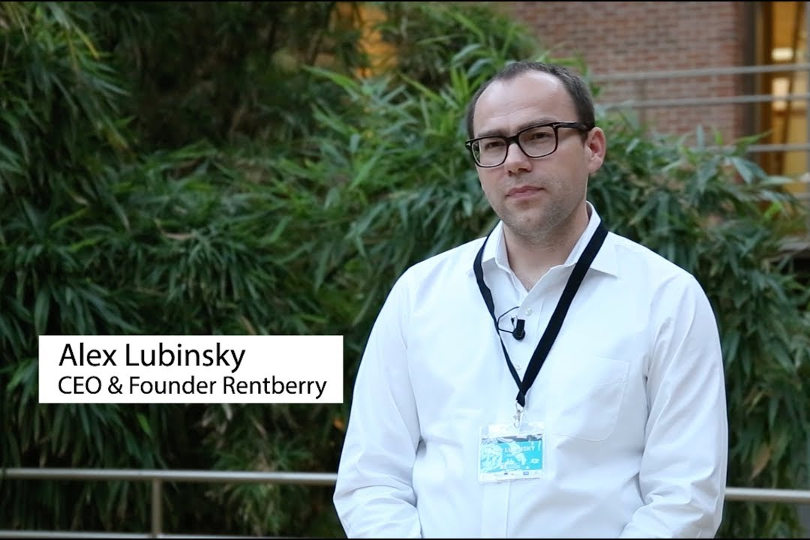
The company also reflected his connections to Ukraine. In 2018, he explained that he and his partners had family and business ties there. Hiring a larger Ukrainian team gave them more room to build than a small San Francisco team would have. He put the operational principle plainly: “Cost saving is our top priority.”
There is something pleasingly unromantic about that explanation. The location decision was tied to skills, relationships and how much work a budget could buy. A rental company, after all, ought to understand that an expensive address does not make every activity inside it more valuable.
The argument inside the asking price
Rentberry launched in May 2016. Its early proposition let applicants make custom offers and see demand for a property. Lubinsky’s experience as both tenant and property manager shaped the idea. The prospective renter encountered fees and opaque competition; the person managing the property encountered paperwork. He wanted both to have a clearer route through the transaction.
One distinction mattered to his argument: an asking rent is a proposal. The price on the listing need not be the price eventually agreed. A landlord might accept less from an applicant they considered a good fit. A vacant property might make a lower offer attractive. Putting negotiation online was intended to make those possibilities visible.
- 01Find a home
- 02Make an offer
- 03Apply & sign
- 04Pay & manage
A schematic of Rentberry’s rental workflow. Availability of services varies by market.
In April 2017, Lubinsky reported that custom offers had saved tenants an average of 5.1%. That was an early company figure, rather than a promise about anyone’s next lease. He described landlords accepting slightly lower offers from strong applicants. The same product also included online leases, payments, roommate payment splitting and maintenance requests.
The auction description, however, was much harder to escape than the paperwork. To a renter watching other applicants compete, bidding can sound like an invitation to pay more. The possibility of negotiating down does not remove the fear of being priced out. The product’s central feature carried two quite different emotional meanings.
Lubinsky took the argument into public conversations, including a 2017 discussion of digital markets and affordable housing. A landlord was not required to choose the highest offer. That detail supported his view that the platform allowed a broader negotiation than a simple race to the largest number.
Seattle’s response gave the disagreement practical weight. The city prohibited rental bidding platforms temporarily in 2018, seeking time to examine their effects on equitable access to housing. Rentberry and a landlord challenged the prohibition on free speech grounds. A council record the following year described both the original restriction and the litigation.
For Lubinsky, visibility into supply and demand could help people make better decisions. For critics, housing competition raised questions that a clearer display could not settle. The dispute exposed the limits of an elegant product explanation: people can understand the mechanism and still disagree about whether they want it governing an essential purchase.
A deposit with a passport problem
His ambitions soon extended to moving between countries. In 2017, Lubinsky described a rental experience in which applications, contracts and payments could travel across borders more easily. Domestic credit histories created a particular obstacle: a person arriving from abroad might struggle to support an application with documents that a local landlord recognized.
Security deposits were another target. Rentberry’s historical blockchain proposal included crowdsourced deposits, smart contracts and a common token. These were plans for changing how the transaction could be financed and recorded. They should be understood in that period’s terms, rather than silently folded into a description of today’s product.
The recurring interest is clear enough. Moving is already expensive in time and attention. An application system that treats every border crossing as a fresh introduction adds another burden. Lubinsky wanted a renter’s history to become useful information, rather than something stranded in the place they had just left.
A larger address, and smaller print
By February 2024, the former M&A banker was considering a much larger transaction. Rentberry announced plans to explore an offer for WeWork, backed by Berkeley Hills Capital. The proposed connection was between flexible furnished living and flexible working space. The renter moving between cities might need both a home and a desk.
The idea showed how far Lubinsky’s thinking had travelled from a rental application. It also remained an exploration. WeWork emerged from bankruptcy in June 2024 with a Yardi subsidiary as its majority owner. Rentberry’s public interest did not turn into ownership of the coworking company.
There is a useful discipline in keeping those stages separate. Considering an acquisition, financing one and completing one are different achievements. Lubinsky’s financial career makes the distinction especially relevant to his story. The proposal reveals his strategic appetite; the outcome sets its boundary.
Rounded operating figures. Growth ambitions sit alongside the cost of building the business.
The operating figures tell a more measured story than the language of expansion. Rentberry recorded about $1.72 million in revenue for 2025, alongside a net loss of about $4.77 million. Revenue had increased from roughly $819,000 in 2024. Making the platform useful and making its economics work remain connected tasks.
The assistant that stays after move-in
In May 2026, Lubinsky described a newer chapter: AI assistance across the rental process. He said Rentberry had begun integrating AI into listing analysis in early 2024 and introduced a rental assistant in 2025. The work ranged from recognizing amenities in photographs to identifying duplicate images and helping produce property descriptions.
His account extended beyond the search. The assistant could help communicate with landlords, negotiate pricing, send payment reminders and coordinate maintenance requests. He also described future searches that could weigh commute times, noise and nearby shops together. These are his descriptions of capabilities and ambitions, rather than evidence that every task has been automated in every market.
The distinction matters because the renter’s job continues after choosing an apartment. The light fitting breaks. A payment comes due. Someone needs an answer. A tool that stays useful during the tenancy would have more occasions to earn its place than one that disappears when the lease is signed.
Lubinsky appeared at the Future of Proptech session of London VC Summit in May 2026. In September, Rentberry announced an investor webinar with him and business development head Dan Henyk, covering AI strategy, partnerships and a path toward an IPO. A public listing remains an ambition. The discussions show where he is directing attention now.
The person behind the process
There are glimpses of Lubinsky beyond the transaction diagrams. In 2017, he described enjoying the moment when a problem’s root cause becomes apparent. He also spoke of trying to balance entrepreneurship, social responsibility and personal life. The founder who objects to unnecessary steps has an appetite for the moment a complicated situation becomes legible.
“Plan, plan, plan and do your research!”
Alex Lubinsky, 2014
That earlier advice sounds appropriate coming from someone who once checked deals for a living. His ventures have required something less tidy than a plan, too: changing direction, explaining an unpopular feature and returning to the economics after describing the vision. The career has room for an app that was sold, an acquisition that did not happen and a rental platform still being built.
The original apartment hunt remains a useful scale for judging the ambition. Somewhere behind the listings and investor presentations is a person trying to move. They need a price they can understand, an answer they can rely on and a way through the paperwork. Lubinsky has spent a decade proposing that more of that journey should happen together. The next front door will be a practical test.
Continue the conversation
- Rentberry
- Lubinsky on LinkedIn
- Career profile
- Watch the 2018 interview on YouTube
- From Funding to Fame • 2024 audio interview
- Transformative CEOs • 2026 video interview
- 2014 CityHour conversation
- 2017 rental-market conversation
- 2026 AI interview
- 2025 operating figures
- Seattle’s rental bidding debate
- 2024 funding-announcement investigation