A college football player travels to El Paso, plays in the Sun Bowl and goes home with a hairdryer. As sporting souvenirs go, it is pleasingly domestic. The game supplies the drama; Gerald J. Rubin’s company supplies an appliance that can still be useful when the cheering stops. For more than 25 years by 2009, Helen of Troy hairdryers had accompanied players and coaches out of town.
The gift is a small introduction to a career usually measured in much larger numbers. Rubin co-founded Helen of Troy in 1968. By fiscal 2013, the business had nearly $1.3 billion in annual revenue. Between those dates lie changes of fashion, a famous hairstylist’s name, an expensive kitchenware purchase and a recurring commercial question: where else could the company sell?
Known as Jerry, Rubin built a business whose products often carried somebody else’s name. Vidal Sassoon and Revlon were familiar to shoppers who might never have heard of the executive in El Paso. His hometown, however, had plenty of reasons to know him.
A wig shop meets a change of fashion
Rubin’s undergraduate training was in biological sciences. He graduated from Texas Western College, now the University of Texas at El Paso, in 1965, with a chemistry minor. Graduate study at Arizona State University followed. He also served in the US Army Reserve from 1966 to 1972. The eventual business career took him toward products and customers rather than a laboratory.
He was the son of a beauty-industry wholesaler. A trade show in the late 1960s helped persuade him that wigs offered an opportunity. The El Paso business expanded to six shops. Fashion then performed its customary service to merchants: it changed its mind.
As the natural look gained ground in the 1970s, Rubin moved toward hairdryers and styling tools for salons. By 1978, the retail shops were gone. The professional appliance business had about $6 million in sales, but the salon market offered limited room for expansion. The next customer would have to be found elsewhere.
“Obviously, retail was the place for us, if we wanted to grow,” Rubin said. Going into the mass market meant meeting much larger competitors. General Electric and Gillette already occupied the hairstyling aisles. Having a product to sell was only the beginning; shoppers also needed a reason to recognize it.
The famous name on the box
In 1980, Helen of Troy secured a license to use Vidal Sassoon’s name on appliances. Rubin’s father, Louis, had spotted the opportunity. The company competed for the license against businesses with considerably more money, and accepted a royalty arrangement to obtain it.
The economics were straightforward. Building consumer recognition through advertising cost money Helen of Troy could ill afford. Sassoon brought recognition with him. A shopper could encounter a dryer carrying the name of a hairstylist already associated with beauty and expertise.
There was a price for that familiarity, paid through licensing fees. There was also a useful division of work: the recognizable name helped introduce the product, while Helen of Troy handled the business of supplying it. The company kept its own brand in the professional market.
Revlon became another licensed name in 1992. By fiscal 1996, overseas sales represented nearly a third of revenue. Rubin’s business had found a way to travel without requiring consumers everywhere to become acquainted with the name Helen of Troy first. The mythological Helen was famous already, of course, but her endorsement of electrical appliances would have needed some explanation.
FOUR CHANGES OF SHELF
- 1968Wigs
The first business - 1980Sassoon
A licensed name - 1992Revlon
Another retail route - 2004OXO
An owned business
Five years on the shopping list
Rubin’s interest in OXO did not begin with the successful deal. During a May 2004 earnings call, he recalled trying to buy it five years earlier, when it belonged to General Housewares. Helen of Troy had been outbid. When OXO came up for sale again, Rubin returned.
The purchase closed on June 1, 2004, for about $273 million. OXO brought tools for kitchens, cleaning and other household tasks into the company. It also brought a different relationship with consumers: these were products carrying a brand the company owned through an acquisition.
Rubin described the retail ambition plainly. Helen of Troy wanted to offer more products across more categories and reach more parts of the store. The company could contribute sourcing, warehousing, information systems and international sales capabilities. OXO’s existing leaders and employees would continue with the business.
The attraction was both the name and the organization behind it. A kitchen buyer had different shelves to fill from a beauty buyer. OXO gave Rubin a reason to enter that conversation. In 2005, he talked about reaching $1 billion in company sales through acquisitions within existing divisions. The number was an ambition then; by fiscal 2013, annual revenue had passed it.
Company sales, distinct from Rubin’s personal wealth.
The bowl game with a power cord
While the products traveled, Rubin kept a connection to an event at home. His daughter Kari became the Sun Bowl Association’s Sun Queen in the 1980s. Soon afterward, he began supplying hairdryers for team gift packages. By 2009, more than 6,000 players and coaches had received one.
A hairdryer has comic possibilities in a football gift bag. It also has the advantage of being an actual product from a local company, rather than a souvenir manufactured solely to announce that somebody attended something. The oddness made it memorable.
Helen of Troy signed on in December 2003 after the bowl lost its title sponsor. The sponsorship covered the 2004 through 2009 games: Vitalis for the first two, then Brut. The names belonged to product lines. A hometown commitment also became a place where the company’s brands could appear before a national audience.
In 2009, Rubin became a Legend of the Sun Bowl. He was its first honoree who had not been a player, coach, CBS staff member or game administrator. His place in football history arrived through an unusual combination of underwriting and grooming equipment.
“The Sun Bowl has always been about the City of El Paso and Jerry Rubin is a big part of that.”
Bernie Olivas, Sun Bowl executive director, 2011
The farewell became a dispute
In January 2014, Helen of Troy announced that Rubin would leave his executive positions and board seat immediately, and move to the CEO role at River Oaks Properties. Chief financial officer Thomas Benson became interim CEO. Julien Mininberg was appointed to take over on March 1.
The company also separated its chairman and CEO positions. A business that had developed around its co-founder was entering a different leadership arrangement. The announcement thanked Rubin for decades of service and described a company employing nearly 1,500 people worldwide.
The public farewell did not settle the relationship. In November, Rubin’s representatives announced a lawsuit alleging misrepresentation and breaches of his employment agreements. Their account challenged the circumstances of his departure. Those were his claims, rather than established findings.
The episode belongs in the career because it prevents the end of his tenure from becoming an effortless retirement scene. Building a company and leaving its leadership are different experiences. Rubin’s next work, meanwhile, had a familiar address: El Paso.
The edge of town keeps moving
River Oaks Properties was already part of Rubin’s working life before he left Helen of Troy. In a 2015 interview, its president, Adam Frank, described one early property, the Promenade shopping center at Mesa and Remcon. When Rubin built it in the early 1980s, Frank recalled, it stood near what people considered the end of town.
The recollection makes real estate’s time horizon visible. A site can look remote when it is acquired and ordinary once development has caught up with it. The retail business then depends on the residents, shops and roads around it.
Frank, Rubin’s son-in-law, joined River Oaks in 2003 and became president in 2006, after working briefly at Helen of Troy. He manages the property company’s daily operations. Rubin is now its founder and executive chairman.
Neighborhood shopping centers put his work on a different scale from a globally distributed appliance. Customers arrive at a particular building in a particular part of town. The business remains concerned with retail demand, but the place where that demand happens becomes part of the investment.
A building with a second life
At UTEP, Gerald and Stanlee Rubin helped support a different sort of transformation. In 2004, Seamon Hall, a 1927 building with a past in mining engineering, became the Stanlee and Gerald Rubin Center for the Visual Arts.
The $2.1 million conversion drew support from the Rubins, the Houston Endowment and the Brown Foundation. Architects, university staff and arts leaders helped turn an underused building into space for the exhibition and study of contemporary art. Here, the change of use was the point.
Both Rubins belonged to the university’s class of 1965. Both received Distinguished Alumni recognition in 2002. Their support also extended to women’s athletics, including the Helen of Troy softball complex. The university connection was shared, and the work carried both their names.
These commitments give the career another set of measurements. Sales record a business’s commercial reach. A gallery or playing field can be understood through the people who use it. Rubin’s products reached beyond El Paso; these gifts gave people reasons to come to places within it.
Still on the local map
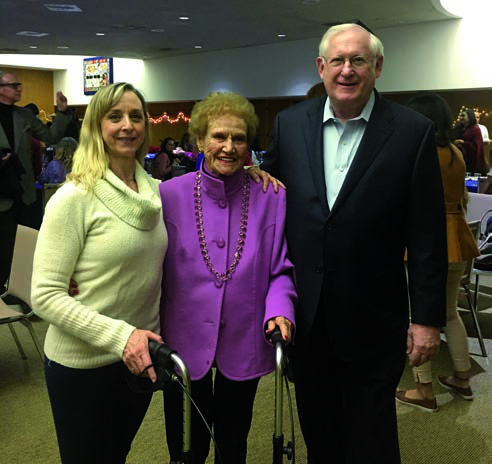
A photograph from a December 2017 Chanukah celebration shows Rubin beside Debra Pazos and Evelyn Goodman at Congregation B’nai Zion. Gerald and Stanlee supplied the evening’s dinner. It is a small occasion beside a corporate acquisition, and belongs to the same life.
Later recognition followed: a Greater El Paso CCIM real estate award in 2021, induction into the El Paso Athletic Hall of Fame in 2024, and a CCIM Institute Foundation scholarship established in his name that April. The honors span property, sports and professional education.
Rubin’s career can be followed through the names on boxes and the places on a city map. He changed products when fashion changed, sought a recognizable label when retail demanded one, and returned to an acquisition he had once missed. Back home, a college football player could discover the local connection simply by opening his gift bag.
Follow the names and places
- River Oaks: Gerald Rubin’s current role
- Helen of Troy
- Jerry Rubin on LinkedIn
- The 1988 licensing story
- Rubin’s Sun Bowl recognition
- The Sun Bowl’s hairdryer tradition
- The January 2014 leadership announcement
- The November 2014 departure dispute
- The Jerry Rubin Scholarship
- The community celebration photograph
- The Rubin Center for the Visual Arts