A bank technology chief flew to Athens with a question that could spoil a perfectly agreeable sales meeting: could George Konstantinidis actually deliver? Colin Dinn of Siam Commercial Bank wanted a collections system his team could change for itself. He also wanted it soon. Konstantinidis gave him a commitment. Later, Dinn put the verdict plainly: “He guaranteed EXUS could deliver, and he was right.”
It is a useful place to begin with the founder and CEO of EXUS. A promise about enterprise software has an unusually unforgiving audience. Eventually someone must install the thing, connect it to other systems and use it on Monday morning. Charm has a short warranty.
Konstantinidis has spent his career on that practical side of technology. His story runs from an engineering degree in Athens to international banking software, with a continuing interest in what makes people willing to trust the organisation behind the product.
Athens, 1989: a degree and a beginning
In 1989, Konstantinidis graduated from the National Technical University of Athens, studying electrical engineering with a computer science specialisation. That same year, he co-founded EXODUS in Greece. Education and entrepreneurship share a date in his biography; the business would go on to work through several generations of enterprise computing.
EXODUS developed multimedia software for businesses in the early 1990s and later contributed to web applications including Piraeus Bank’s Winbank. Mobile applications and business intelligence also became part of its work. These are different technical settings, but each asks a familiar question: how can a company make useful decisions with the technology available to it?
He also co-founded London-based EXUS SOFTWARE. Its specialisation in banking software gave his career a more concentrated commercial focus. The path from multimedia to financial systems is a reminder of how much ground a software founder can cover while remaining concerned with the everyday machinery of an organisation.
A career that spans those changes has to accommodate more than new programming tools. The customer’s expectations change too. The continuity in his story lies in working with enterprises through those shifts, then narrowing the product around a recurring institutional problem.
The customer wanted the controls
At Siam Commercial Bank, Dinn valued the ability to adjust the system without waiting for an outside supplier. His meeting with Konstantinidis and the EXUS team centred on that independence, together with confidence about the timetable. The resulting mortgage collections implementation took seven months.
The distinction matters for understanding Konstantinidis’s business. A bank buys software because it needs something to happen: a strategy changed, an account understood, a decision put into practice. A system that requires another lengthy project whenever those needs shift adds friction to the purchase.
The episode gives his leadership a concrete test. The conversation in Athens became work that a customer could evaluate. A delivery date offers less room for interpretation than a mission statement. For a founder selling to large institutions, that is a demanding but rather useful form of accountability.
“He guaranteed EXUS could deliver, and he was right.”
Colin Dinn · Siam Commercial Bank
Three installations, one local test
By March 2016, Bank al Etihad’s selection of EXUS Financial Suite marked the company’s third installation in Jordan. Konstantinidis welcomed the decision as evidence that EXUS could support the country’s financial institutions in managing credit risk.
The bank’s general manager, Nadia Alsaeed, described a team that understood the requirements and delivered a working system quickly. Her assessment placed professional conduct and execution beside the technology itself. The emphasis puts the founder’s responsibility in practical terms: understand the job, then carry it through.
International expansion can look very tidy on a map. The local experience is more exacting. A customer has its own systems, requirements and people. A third installation in one country has meaning because the company must keep translating its expertise into another institution’s working day. The geography changes; the obligation to be useful remains.
The founder goes back to class
Konstantinidis’s education continued long after the engineering degree. He attended Harvard Business School’s Owner/President Management programme between 2013 and 2015. He also holds an Advanced Certificate for Executives in Management, Innovation, and Technology from MIT Sloan Executive Education.
The dates are telling. These studies came more than two decades after the 1989 beginning. The founder was returning to formal learning with a substantial operating history already behind him. That puts a different weight on the classroom: management ideas have an existing business against which they can be examined.
The interest has extended to colleagues. At a 2026 company meetup in Athens, employees learned from Harvard Business School professor Boris Groysberg. People and Development leader Christina Kalkantzi thanked Konstantinidis and Leto Laskou for investing in that learning. Her account highlighted leadership, talent, team performance and the conditions that allow people to improve.
There is something pleasantly practical about bringing a management discussion into the company’s own gathering. The questions belong to the people who will return to work together afterwards. Whatever survives the meeting can be tested in the next conversation, decision or project.
An engineer’s interest in a feedback loop
In November 2024, Konstantinidis described being inspired by Amy Edmondson’s closing remarks at the Global Peter Drucker Forum. He connected the idea of organisations that inspire others to EXUS’s own stated purpose of setting an example.
His explanation followed a sequence: invest in employees; enable them to serve customers well; use the resources generated by satisfied customers to invest further in employees. He invoked Jim Collins’s flywheel to describe the repetition. It is a management argument with an engineer’s interest in how one part affects the next.
The revealing detail is where he places the beginning. People receive the initial investment. Customer work produces the resources that let the process continue. In his account, the workplace and the commercial result belong to the same operating model.
He called that cycle the legacy he wanted EXUS to leave. Legacy is a large word for a LinkedIn post, but the mechanism he described was deliberately ordinary: people, customers, resources, repeat. Its credibility depends on daily behaviour. A feedback loop cannot run on a framed quotation alone.
- 01Invest in peopleGive employees the support to do the work.
- 02Serve customers wellPut that capability to work for customers.
- 03Reinvest the resultsReturn resources to the people doing the work.
Two appointments with the CEO
In September 2026, EXUS placed 35th on the list of Europe’s 100 Best Small & Medium Workplaces. Employees described a specific form of access to the chief executive: an individual meeting with him twice a year. In the employee survey, 98% agreed management was approachable and easy to talk to.
The appointment is the interesting unit here. Accessibility becomes easier to judge when it occupies time in someone’s calendar. A founder may say that people matter; a recurring conversation gives an employee a place to bring an experience, ask a question or discuss the work.
Earlier in 2026, EXUS had ranked first in the medium-sized category of the UK’s Best Workplaces list. Konstantinidis’s response credited the culture built by employees and thanked Christina Kalkantzi and the People and Development team.
An award makes a convenient photograph. The more revealing question concerns the habits behind it. In this case, the recurring meetings and the employee responses provide something more concrete than a trophy shelf: a description of how leadership is encountered inside the organisation.
agreed management was approachable and easy to talk to
individual meetings with the CEO each year, as described by an employee
A birthday with a reading list
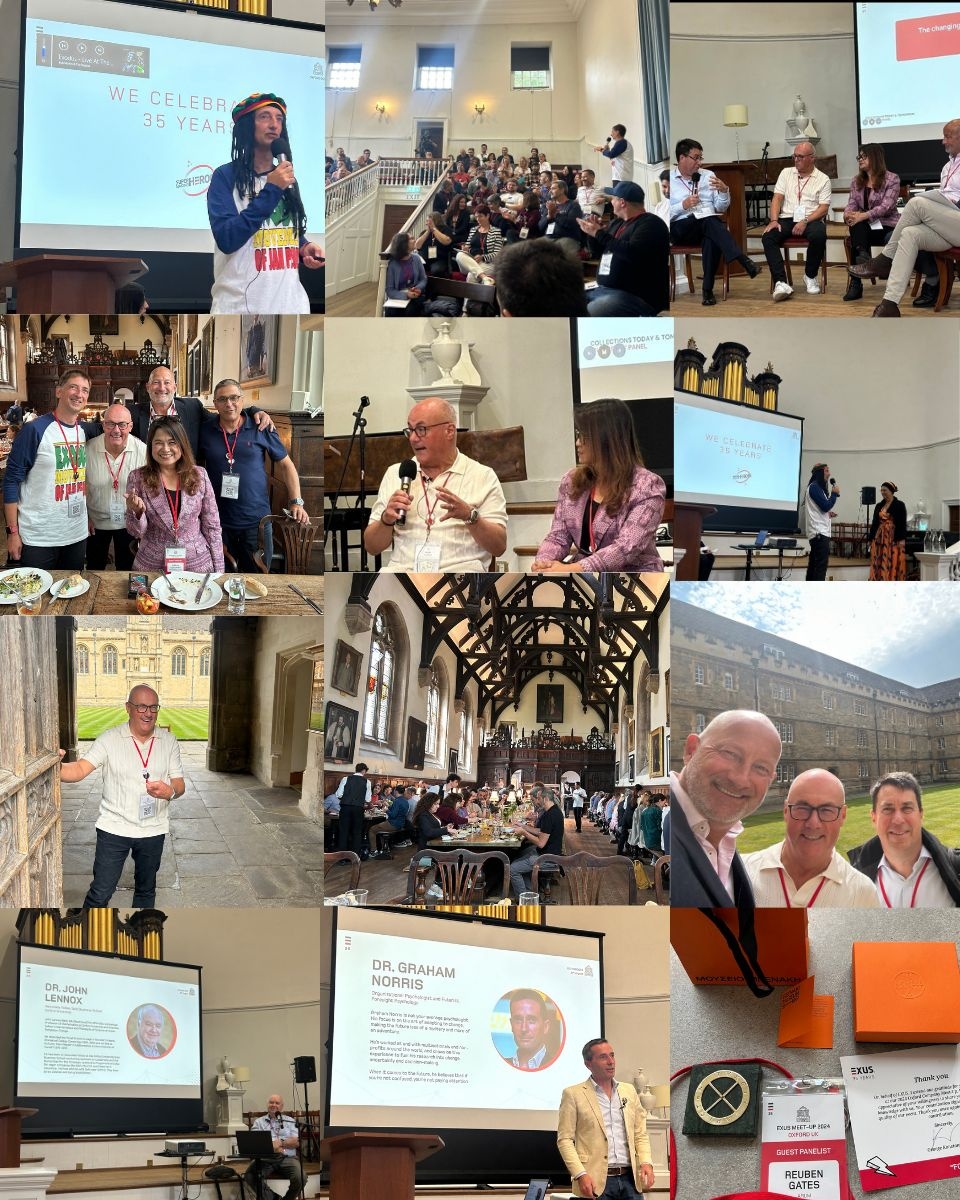
For EXUS’s 35th anniversary in August 2024, the company gathered in Oxford. Reuben Gates, an invited participant, thanked Konstantinidis and Chris Maranis for bringing him into the occasion. The programme included an industry panel, presentations on futurism and artificial intelligence, and time with the wider team.
The gathering put different kinds of expertise in the same room. Chris Warburton moderated the panel, with contributions from Pimjai Tongmee, Kosmas Raptopoulos and Huw Vaughan. Graham Norris and John Lennox gave presentations. Wadham College formed part of the setting.
The photographs contain the appropriate mixture for a company birthday: people talking, people eating and a screen reminding everyone how many years have passed. Discussion of the future shared the occasion with the anniversary. Thirty-five is apparently old enough to celebrate and young enough to assign homework.
For Konstantinidis, the occasion sits comfortably beside the later Athens learning sessions. Both bring employees together around ideas beyond the immediate project. They offer a glimpse of the company he is trying to sustain over time: commercially specialised, but still willing to make room for a broader conversation.
The promise travels to Canada
In July 2026, EXUS joined the Canadian Lenders Association. The announcement described work with financial institutions and utilities in more than 50 countries across five continents. Konstantinidis linked the Canadian expansion to the company’s experience in other markets and its ambition to help collections professionals improve their results.
The scale is a company measure, rather than a personal accolade. For its founder, it means that the practical questions raised in Athens have many more settings. Customers still need to understand what they are buying, adapt it to their work and trust the people responsible for delivery.
Collections software is a particular place to spend a career. Its work begins around obligations, decisions and conversations that people would often prefer to postpone. Konstantinidis has built his professional life around making that work more manageable for the organisations doing it.
The bank meeting remains a fitting closing image. A customer asked whether the company could meet its commitments. The founder answered. Then the team had to make the answer true. Across classrooms, company gatherings and new markets, that remains a useful measure of his work: what happens after the promise.
Continue the conversation
Explore his work, writing and the moments in this story.
- George Konstantinidis on LinkedIn
- Professional profile on XING
- The Greeks Are Back: speaker biography
- His employee-customer feedback loop
- The Siam Commercial Bank implementation
- EXUS’s Oxford anniversary gathering
- EXUS’s European workplace recognition
- EXUS joins the Canadian Lenders Association
- EXUS website