United Airlines once wrote to Rambus about an employee who had occupied a first-class seat in shorts and sandals, surrounded by newspapers. The employee was the chief executive, Geoffrey Tate. There are elaborate ways to communicate that you are unimpressed by corporate ceremony. Tate had apparently chosen footwear.
Back at the office, he was more likely to wear a polo shirt than a tie. He worked in a cubicle. This informality had a purpose: keeping a small technology company from acquiring the distractions of a large one. He had already spent a decade inside AMD. He knew how much organization could accumulate around the work.
The detail is useful because Tate’s career can otherwise disappear behind its nouns: microprocessors, memory interfaces, programmable logic, optical interconnects. These are consequential things with names that discourage conversation at dinner. His job has repeatedly been to turn such things into an argument a customer can understand, a team can execute and an investor can finance.
He became Rambus’s founding CEO in 1990 and later co-founded Flex Logix in 2014. Both businesses asked customers to reconsider something buried inside a chip. Neither could succeed on a persuasive presentation alone. Semiconductor customers eventually need silicon that works. A good slide has yet to survive being soldered to a board.
A physicist changes his mind
Tate was born in Winnipeg and grew up mainly in Edmonton after his family moved. His father, a land surveyor, had a practical relationship with mathematics. His parents encouraged education, and young Geoffrey’s possible futures changed regularly: astronomy, paleontology, the sciences in various combinations.
He entered university intending to study physics. Calculus helped interrupt that plan. Computing proved a better fit. He earned his computing science degree at the University of Alberta in 1974, then completed an MBA at Harvard in 1976. The combination became the basis of a working identity: someone comfortable with technical ideas who wanted to build a business around them.
His own account of ambition is refreshingly light on monuments. Looking back at his career in 2015, he described following challenges and the work that interested him. The progression looks tidier on a résumé than it appears to have felt while he was living it. Curiosity kept supplying the next assignment.
At AMD, which he joined in 1979, he held marketing and product-management jobs before becoming a senior vice president responsible for microprocessors and peripherals. That history matters. The person later selling unconventional chip architectures had spent years close to the practical decisions that determine whether semiconductor products become businesses.
“The whole time at university, and after university, I have always just been chasing challenges and doing what motivated me.”
Geoff Tate · 2015
Four people, and a reason to license
Rambus brought Tate together with the inventions of Mike Farmwald and Mark Horowitz. Its problem was a widening mismatch: processors were getting faster while memory struggled to supply data quickly enough. A processor waiting for memory is an expensive illustration of the difference between potential and performance.
The business model grew out of an awkward commercial reality. Building a fabrication plant demanded enormous capital. Memory customers also wanted more than one supplier. Rambus therefore licensed its technology to manufacturers. The invention could travel through other companies’ factories instead of requiring Rambus to own the whole production chain.
Tate led the company from its four-person beginning through its May 1997 public offering, remaining CEO until January 2005. Ayar Labs now describes that tenure as a journey to a $2 billion market capitalization. It was a company valuation, with all the movement that implies, rather than a measure of the chief executive’s personal wealth.
One lesson he carried away concerned the timing of belief. Customers can study a new technology seriously while waiting for somebody else to use it at scale. He later pointed to Nintendo’s N64 as the visible application that helped unlock broader adoption of Rambus technology. A working product in the market could do something a meeting could not: make the risk feel less solitary.
Rambus also became entangled in patent disputes with memory manufacturers. Licensing an invention creates a business relationship in which adoption, compensation and ownership can become intensely contested. Any account of the company’s commercial success needs room for that friction. The model made the interface valuable; it also made the terms of using it consequential.
The next challenge came with solar panels
In March 2010, Tate became CEO of Nanosolar, a manufacturer pursuing thin-film solar panels. The change took him from licensing designs to the demands of a production business. Its promise depended on moving a manufacturing process into useful commercial volume, a familiar sounding sentence with an entirely different factory behind it.
The assignment was intended to be temporary. He later joked about falling for the “temporary CEO trick.” By January 2012, Eugenia Corrales, whom he had recruited to lead engineering and operations, was taking over as chief executive. Tate’s remit had included assembling a team capable of scaling production.
It is an instructive interlude in a career often compressed to AMD, Rambus and Flex Logix. Experience does not remove the difficulty of taking a technology into a market. Solar panels still have to be manufactured, shipped and bought. The label on the executive’s previous business card does very little of that work.
Leave a little room to change
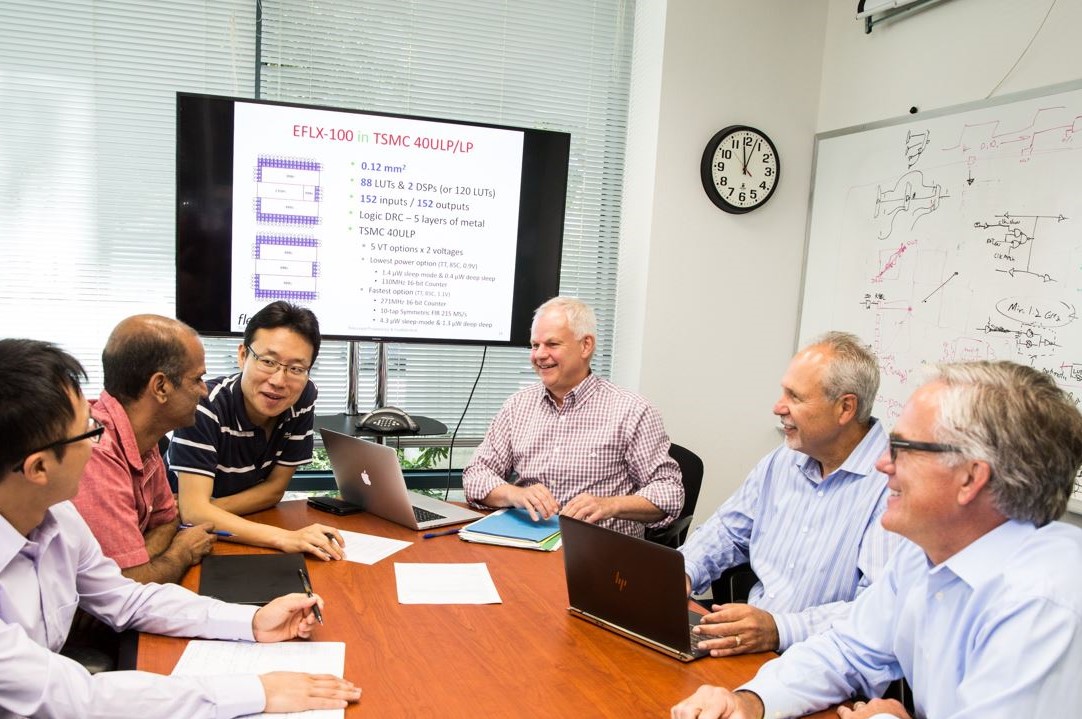
Flex Logix began with work by Cheng Wang at UCLA under professor Dejan Markovic. Tate co-founded the business in 2014. Wang’s interconnect architecture offered a way to make programmable logic more practical inside another company’s chip. Tate once again had an invention whose commercial prospects depended on what it could connect.
An FPGA, or field-programmable gate array, contains logic that can be configured after manufacture. Flex Logix’s embedded version put that capability inside a larger chip. It gave designers a portion of hardware they could alter after the rest of the design had been committed to silicon.
The attraction was quite concrete. A change to a conventional chip design can require a costly manufacturing revision and months of delay. An embedded programmable block lets some changes happen without remaking the whole device. New requirements do not politely wait for a product’s development calendar to clear.
Selling that flexibility required patience. In 2016, Tate described customers conducting extensive checks of the architecture, software and physical design. The team had to demonstrate working silicon, and customers needed tools with which to use it. He understood the desire to wait for an early adopter; he had encountered it at Rambus.
The same interconnect expertise also fed Flex Logix’s InferX approach to AI inference. Training produces a model; inference runs that model on new inputs. The commercial question becomes how much useful work the hardware can perform within a customer’s constraints on speed, price and power. A factory camera does not get a larger electricity budget merely because its task has acquired the letters AI.
The bicycle and the benchmark
Tate could be pointed about the way AI chips were compared. A headline measure of arithmetic operations does not establish how a particular model will behave. The developer needs to run the intended model on the candidate hardware and measure the result. Convenient comparisons have a way of becoming less convenient when an actual customer arrives.
In a 2021 discussion, he explained that performance differences between two chips could vary considerably with the model being run. His advice put the application ahead of the slogan. For buyers, that means checking throughput and power against their own work rather than treating a single published number as a universal answer.
That March, Flex Logix announced a $55 million Series D led by Mithril Capital Management, with Lux Capital, Eclipse Ventures and the Tate Family Trust participating. The stated uses included expanding software, engineering and customer support. Those are the less photogenic companions to a new chip, and essential ones if anybody is going to use it.
Running the company filled his calendar. In 2022 he described early starts, late finishes and meetings throughout the day. He also said he would “usually bike 8 miles to and from work every day.” The description gives the working day a tangible border: there was a bicycle ride between one set of demands and the next.
Away from chip specifications, he has spoken about cycling and pub-to-pub hiking. His advice to people early in their careers was to join a growing startup to learn. The connection to his own choices is easy to see: he repeatedly chose assignments where the organization, as well as the product, still needed building.
Capital for the people and tools around the silicon: software, engineering and customer support.
The first customer becomes the last
In November 2024, Analog Devices acquired Flex Logix’s technology assets and technical team. The transaction closed a decade-long chapter. There was a pleasing circularity to the buyer: Analog Devices had been an early customer of the technology it was now bringing inside its own business.
Tate subsequently confirmed the sale and described taking a few months off before reconnecting with people across the semiconductor industry. His list included Marvell, Rambus, Eliyan and Ayar Labs. The next stage involved conversations, conferences and a return to examining where computing was headed.
His current roles reflect that shift. Ayar Labs lists him as a board member. He also writes as a technology strategy advisor, concentrating on the constraints emerging around AI computing. The titles have changed since the Flex Logix years. The interest in getting useful inventions into working systems remains recognizable.
Now follow the traffic
During 2026, Tate’s writing has addressed silicon photonics, lasers, data-center supply constraints and the competition between GPUs and custom AI chips. In April, he argued that AI data-center interconnects would become optical within five years. That is his forecast, and the time horizon is part of the claim.
The subject fits his board seat at Ayar Labs, which develops optical connectivity. It also fits the longer arc of his work. At Rambus, the issue was moving data between memory and processors. At Flex Logix, programmable connections helped make hardware adaptable. In AI infrastructure, connecting computing resources efficiently has become a major engineering and commercial question.
His October 5, 2026 essay, “The Agentic AI Super Cycle,” turns to the wider implications of AI agents. These are arguments about the future rather than completed achievements. Their value to this portrait is the evidence of continued engagement: after two founding-CEO chapters and a solar detour, Tate is still picking apart the next set of assumptions.
There is a temptation to describe a career like this as an uninterrupted march toward ever larger things. The more interesting pattern is smaller and more practical. Find an obstruction. Work out who has an invention that might remove it. Persuade other people to try. Then deal with everything that happens after they agree. Somewhere in the schedule, leave room for the bicycle.
Follow the connections
Writing, conversations and the next chapter.
Geoffrey Tate on LinkedIn ↗His technology strategy essays ↗Ayar Labs leadership ↗Watch: a conversation with Karl Freund ↗Listen: a brief history of embedded FPGA ↗The recorded career, in his own words ↗The Analog Devices acquisition ↗