
The checkout screen is an odd place to look for a change in American healthcare. Yet that is where General Medicine wants to put a little more power: beside a service, a price and a decision the patient can make before the bill arrives. The ambition is easy to understand. Anyone who has tried to arrange care knows how quickly a simple request can turn into a second job.
On October 6, the company announced a $120 million Series B led by Andreessen Horowitz, bringing reported total funding to $152 million. TJ Parker has joined full time as CEO; cofounder Ashwin Muralidharan becomes chief product officer, while Elliot Cohen remains president. The money will support expansion into more categories of care. Those are the facts of the financing announcement. The argument underneath them is more interesting: patients should be able to see useful options and choose among them.
First, make the choice real
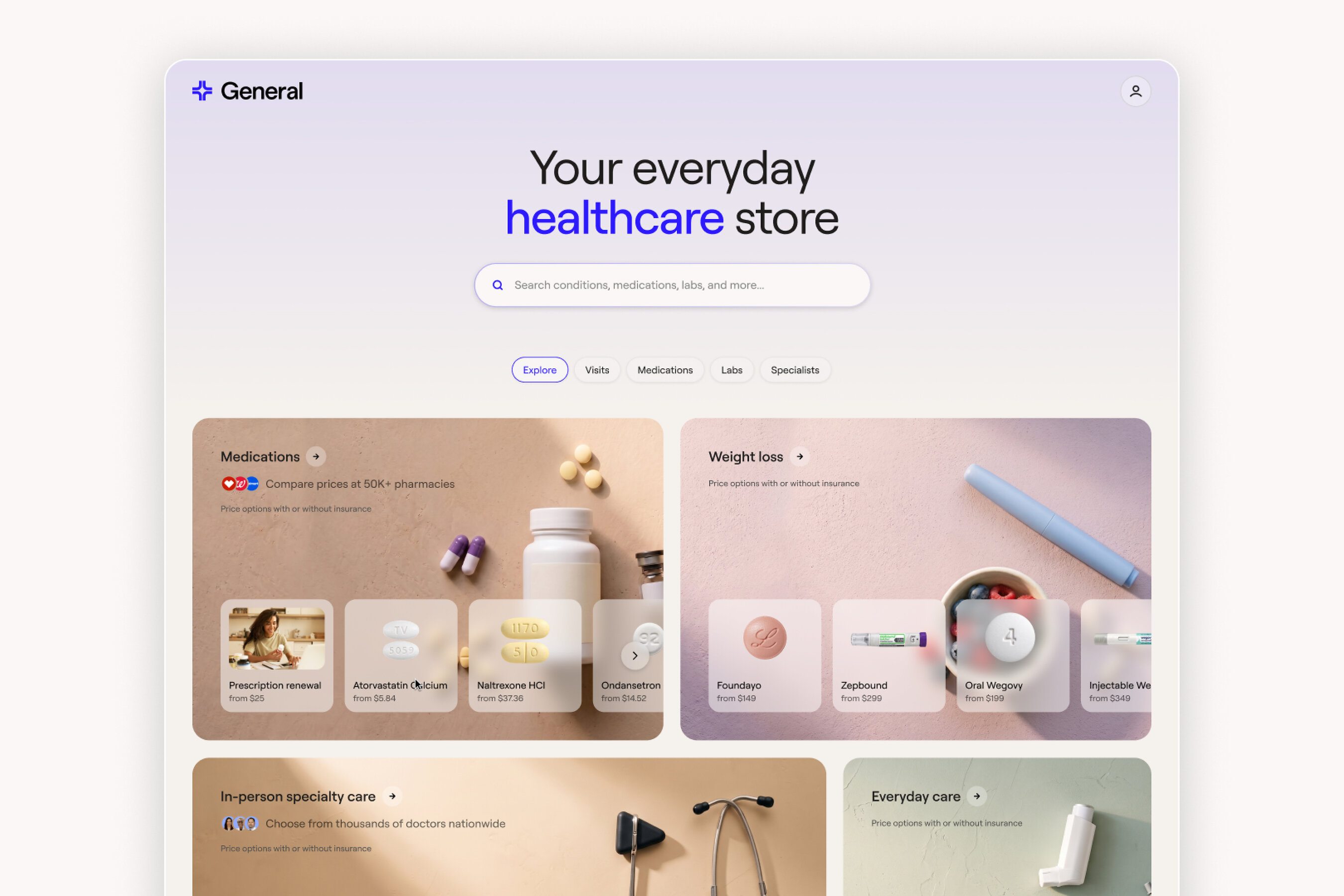
General Medicine calls itself a healthcare store. Its company overview describes medications, labs, telehealth, specialist e-consults and selected in-person visits and procedures, with insurance and out-of-pocket prices. Customers can shop directly, ask a licensed clinician for guidance or explore needs through an AI chat. The point is to give someone an entry based on what they are trying to accomplish.
That is a useful distinction for a person with an ordinary question. A prescription needs renewing. A doctor has requested a test. A skin concern needs attention. The person should not have to learn the organizational chart of medicine just to discover where to start. A store organized around needs can make the first decision easier, provided the options lead to appropriate care.
“Consumers don’t shop by specialty. They shop by need.”
Ashwin Muralidharan · Company announcement
Shopping, in this context, needs a careful definition. A patient is choosing among services that may require professional judgment. A low price cannot establish that a test is necessary or that a treatment fits. General Medicine says clinical decisions remain independent and AI does not replace clinical judgment. That safeguard belongs inside the product experience, where people make decisions, rather than in a reassuring statement they may never read.
The work hiding behind a price
A price can look wonderfully simple on a screen. Underneath it sit several questions: Which service does this include? Who delivers it? Does the insurance plan cover that provider? What happens if the clinician recommends something else? An attractive number is useful only when the patient understands what it buys and can complete the next step.
The company’s current storefront lists visits, prescriptions and laboratory tests as separate, browsable offerings. Its homepage includes lab booking at Quest, Labcorp and other providers, alongside medication comparison and specialist care. These categories suggest practical uses: arrange a requested test, compare a prescription option or begin a clinical consultation. A reader should treat displayed starting prices as starting prices, then check the actual service and payment details.
For the customer, the meaningful unit is the completed task. A search result that sends someone back into a chain of phone calls has saved less work than it appears to. The storefront therefore has to carry its promise into scheduling, records and follow-up. This is where a consumer interface becomes an operating responsibility.
A pharmacist returns to the counter

Parker’s interest in the consumer side of medicine has a personal origin. In written congressional testimony in September 2025, he described himself as a second-generation pharmacist who grew up delivering medications to customers of his father’s New Hampshire pharmacy. He and Cohen later cofounded PillPack, acquired by Amazon in 2018. The detail about deliveries is useful: pharmacy service is experienced at the doorstep as well as the counter.
That background gives the new venture a recognizable question. How much administrative complexity can the company absorb so the person seeking care encounters less of it? The ambition has widened beyond pharmacy, but the test remains concrete. Did the customer receive the service? Was the price understood? Did the next step happen?
The leadership transition also deserves precision. Parker had been a general partner at Matrix, which backed General Medicine early, and now remains a venture partner there. Muralidharan, the founding CEO, continues to lead much of the company’s daily work in his new role, according to the announcement. Calling this simply Parker’s comeback would erase the team already building the store.
An opera singer’s deadline
The company’s May 2025 launch announcement offered a memorable example: an opera singer called Damon had a persistent cough ahead of a charity performance. General Medicine said its clinicians asked for a video of him singing and obtained specialist input, helping him establish a care plan in time. The important detail is the question the team asked. For this patient, the problem included a deadline and a voice he needed for work.
It is a company-selected testimonial, and the release says featured customers were compensated for their time. It should be read as an illustration of the intended service, not a representative result. Even so, it captures something a department-based menu can miss: the customer arrives with circumstances, not just symptoms.
Good care navigation must hold those circumstances in view. A parent needs an appointment that fits around school pickup. A worker needs to know whether another visit means another unpaid afternoon. These are ordinary examples, not reported General Medicine cases. They explain why access has several dimensions: money, time, location and the effort required to coordinate them.
Advice needs somewhere to go
Andreessen Horowitz’s investment essay makes the case for connecting medical history, guidance, prices and access. It also describes an enterprise opportunity: the same infrastructure could support partnerships with health systems, insurers and other organizations. That is the investor’s thesis, and should be read with its financial interest in mind.
The underlying product problem is easy to recognize. An answer about what to do next leaves work unfinished if the person cannot act on it. As AI makes explanations easier to obtain, reliable access may become more valuable. A useful healthcare assistant needs somewhere dependable to send the patient.
General Medicine’s AI announcement describes a conversational route into its services. The worthwhile question is what happens when the conversation ends. Can someone understand the proposed step, get clinical guidance where needed and arrange care? A polished exchange can be helpful, but fulfillment is what gives it practical value.
Organize around the customer’s task. Then measure how much work remains after the customer chooses.
The evidence still to earn
The company says hundreds of thousands of people have signed up. Sign-ups establish interest; they do not tell a reader how many people completed care, returned or saved money. General Medicine also reports customer satisfaction and delayed-care figures. Such measures can be informative, but they need methodology and context before becoming a verdict on the service.
A useful assessment would follow patients through the full journey. How often does a quoted option become a completed appointment? How frequently does the eventual cost differ from what the patient expected? How long do customers wait for a needed next step? Those questions would test the storefront at the point where its promise matters.
Clinical outcomes require a further standard. Easier purchasing could improve access to appropriate care, or encourage more use without a corresponding benefit. The announcement does not establish comparative clinical outcomes or broad cost savings. Investors have funded a model; patients still need evidence of what it delivers.
One way to judge the experience is to ask whether a customer can explain the choice afterward. Could they tell a family member what they booked, why it fit their need and what they expect to pay? Could they name the person responsible for the next step? Those are modest questions, but they expose whether the service has made a complicated decision legible.
For the business, that creates a harder assignment than attracting a first click. People may forgive a slow shopping site and try again later. When a healthcare transaction stalls, the unfinished task travels back to the patient. The value of coordination is that someone takes ownership of resolving it. A clear account of that responsibility would make the storefront easier to trust.
There is also an everyday limit to the shopping metaphor. A patient cannot always defer a decision, travel farther or evaluate providers as interchangeable alternatives. Choice becomes useful when the options are clinically sound and realistically available. A catalog alone cannot create that availability.
Power lives in the next step
The idea worth taking from General Medicine is that showing the options changes the conversation. A customer who can understand a service, its likely cost and the route to receiving it has a stronger starting position than someone trying to assemble the same information from scattered offices.
For readers considering the service, the practical move is to begin with a specific need and inspect the details. Check what the offering includes, how insurance or self-pay applies, which clinician or provider is involved and what happens afterward. General Medicine’s published FAQs say customers pay for care without a subscription or membership fee. The usefulness of the purchase depends on the care behind it.
The funding gives the company room to build. The patient’s standard can remain smaller and more demanding: a clear option, an understood price and a next step that actually happens. If General Medicine can make that sequence dependable across more of healthcare, the storefront will have earned its place.