An opera singer had a cough and a deadline. In General Medicine’s launch announcement, the customer called Damon described going from doctor to doctor before finding a consultation that took his impending performance seriously. The clinicians asked for something unusually useful: a video of him singing. The company says he received a treatment plan within hours. A concert, after all, cannot be rescheduled around a referral queue.
General disclosed that the customers in its launch testimonials were compensated for their time. The anecdote is therefore an illustration, not a clinical trial. Still, it captures the company’s chosen problem. A person arrives with a need. Healthcare often responds with a sequence of tasks. General wants to sell a shorter route between the two.
- Shop care with insurance and cash prices visible before deciding.
- Pay for care, with no subscription or access fee.
- Use clinicians, gathered records and AI to work out the next step.
- More than 2,900 catalog items, according to General’s October announcement.
The trouble starts before the appointment
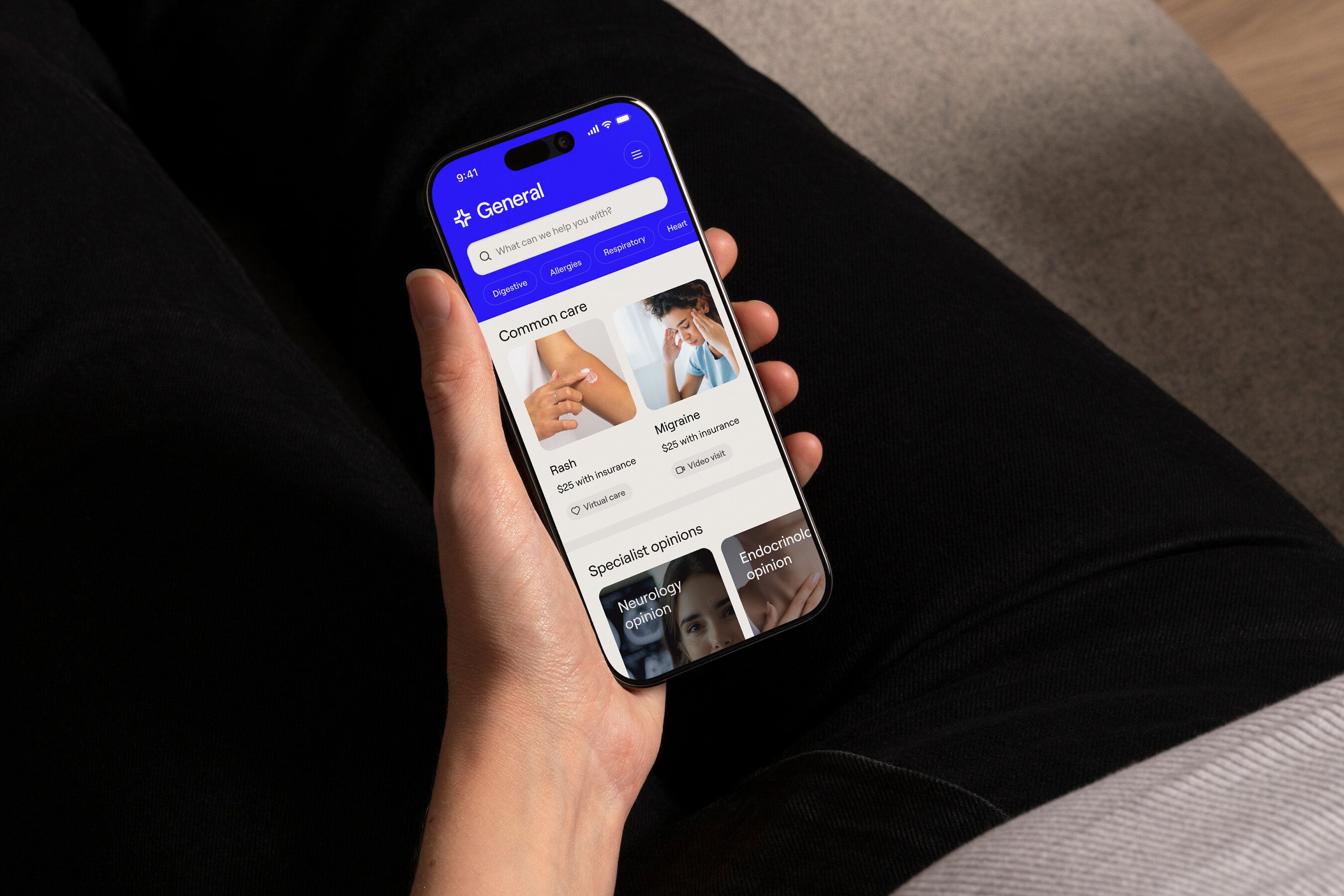
General is a US healthcare storefront for adults. Customers can browse medications, laboratory tests, virtual visits, specialist e-consults and selected in-person services. Those who know what they need can head toward it directly. Those who do not can ask for guidance. Licensed clinicians decide what is medically appropriate when review is required.
The distinction matters. A prescription renewal and a puzzling symptom are different errands. Making both begin with the same obstacle course is convenient for an institution, rather less convenient for the person with the cough. General’s storefront gives them different entrances, with their history following them through.
A pharmacy education, applied to everything else
The company began in fall 2023 with TJ Parker, Elliot Cohen and Ashwin Muralidharan. Parker and Cohen had founded PillPack; Muralidharan had worked in Amazon’s healthcare leadership organization. Their experience supplied a useful suspicion: the apparent simplicity of a consumer product depends on somebody doing the complicated work elsewhere.
General’s underlying system, MedicineOS, brings clinical information and care coordination together. At launch, the company described interpreting insurance rules across deductibles, coinsurance and networks, alongside arranging outside specialists, labs and pharmacy services. That is a considerable amount of backstage activity for a screen that asks what you need.
“What looks simple to the customer is actually an intricate choreography of clinical expertise, technology, and care coordination.”
Elliot Cohen, co-founder
The catalog is the less glamorous, more revealing invention. Patients, physicians, insurers and laboratories can describe the same service differently. General reconciles those descriptions into items that can be compared, priced and arranged. Think of the difficulty of comparison shopping when every shop uses a different name for the same thing.
This places General between conventional care providers and narrower digital services. Alternatives include local practices, Amazon One Medical, Teladoc and condition-focused companies such as Ro and Hims & Hers. General’s chosen distinction is breadth, joined to price visibility and coordination. Whether that combination earns repeat business matters more than how many tiles fit on the screen.
Two prices, one decision
The consumer model is pay for care, without a membership or access fee. Insurance is optional. The amount depends on the service and coverage, so there is no single price that describes General. Its promise is to make the relevant numbers visible before the customer decides.
On October 5, 2026, General announced pharmacy price comparison and pay ahead. Customers can compare insurance prices with the General Medicine card’s prices, select a pharmacy and, at eligible retail locations, prepay through the cash/card option. Mail-order pharmacies are excluded from pay ahead. A customer can change pharmacies rather than remain attached to the first choice.
This is a useful feature precisely because it makes a modest claim. General says it cannot promise a cheaper price than your current pharmacy. A comparison earns its keep by allowing a decision, even when the decision is to stay put. For a reader, the copyable habit is simple: inspect both payment routes before committing.
The conversation finally goes somewhere
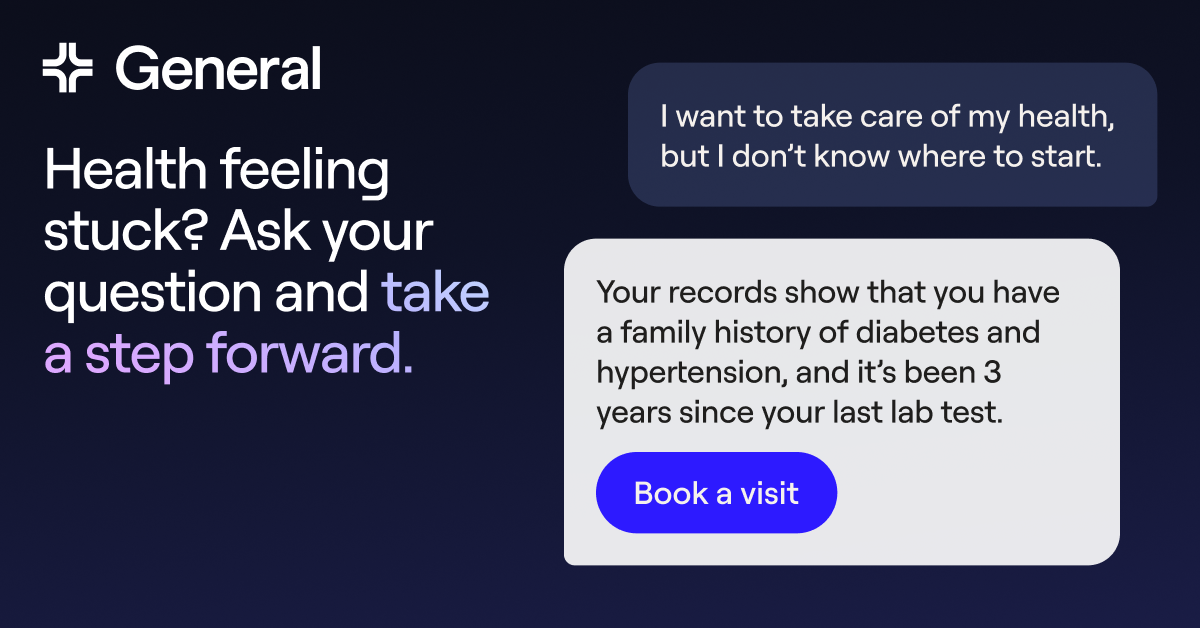
In December 2025, General opened consumer-facing AI tools built around gathered health records and conversations. Cohen explained that people were using AI for extended health questions, but those discussions were disconnected from the doctors who could act on them. General’s response was to connect the preparation to the visit.
Customers can discuss concerns in plain language; the system organizes context for a clinician to review. General says it developed the tools with doctors across more than 35 specialties. Prescriptions, diagnoses, laboratory orders and referrals remain decisions for licensed clinicians. The chat is an entrance to care, with a human responsible for clinical judgment.
Continuity is another practical attraction. General’s visit FAQ says customers can check a previous clinician’s availability, while their history remains with the account regardless of whom they see. Its lab FAQ says licensed clinicians review results and contact customers about out-of-range findings. A test produces another step, rather than another abandoned tab.
The $120 million question
On October 6, 2026, General announced a $120 million Series B led by Andreessen Horowitz, taking total funding to $152 million. Parker became full-time CEO; founding CEO Muralidharan moved to Chief Product Officer, and Cohen is President. The money is intended to expand the store into more categories.
of customers say General helped them address a health need they had put off.Company-reported, October 2026
General also reports hundreds of thousands of sign-ups and an average customer record spanning 11 years. These are company figures, not proof that every patient’s outcome improves. The operational test is whether the next appointment, prescription or procedure actually happens.
The storefront has boundaries. Its terms exclude emergencies and recommend keeping a local primary care relationship. Controlled medications are unavailable; other prescribing options vary by state. An examination or procedure can still require physical attendance. General’s lesson for other businesses is to take responsibility for the handoff after the recommendation. A handsome answer is pleasant. An arranged next step is what gets someone off the sofa.