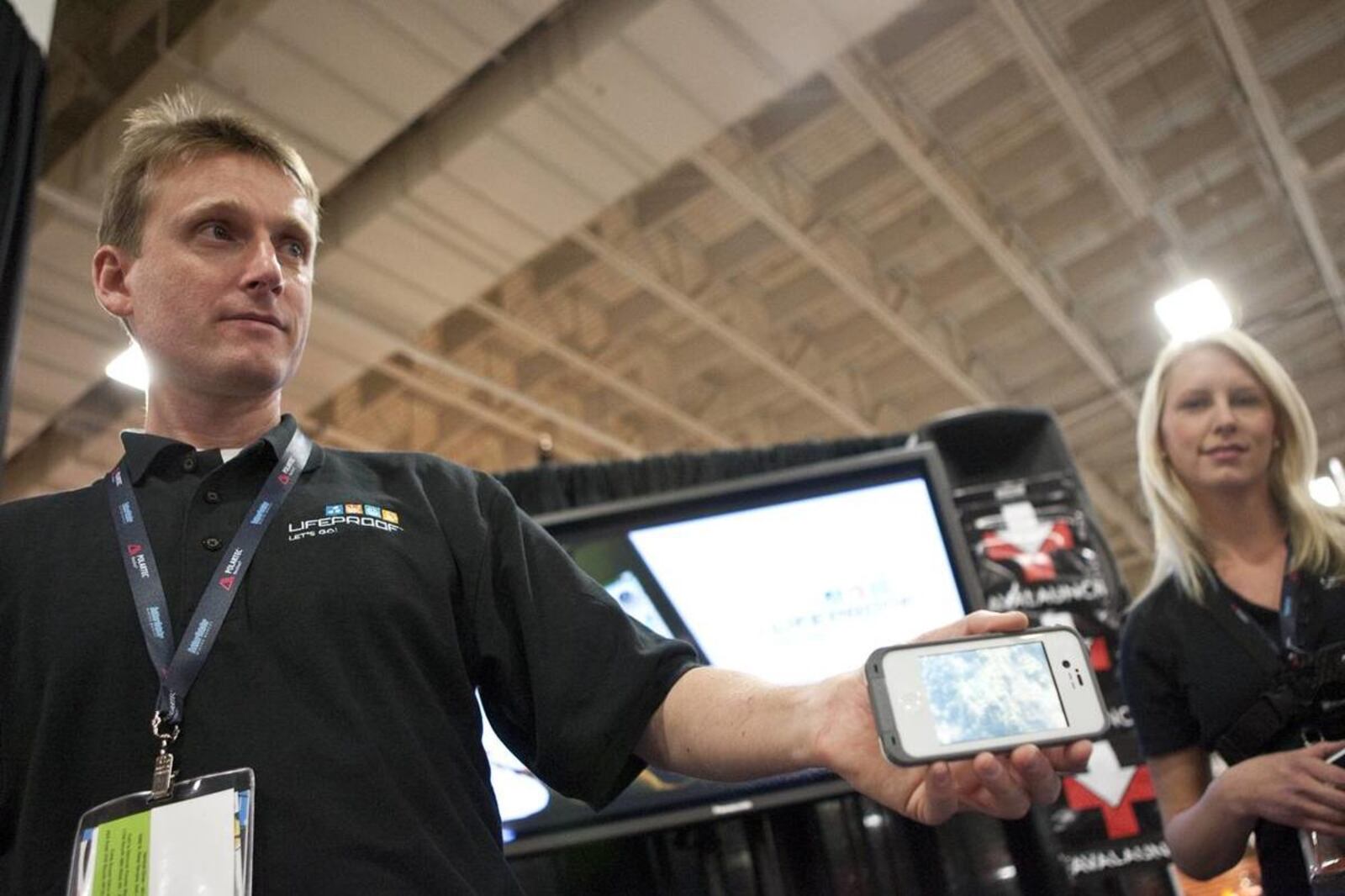
Gary Rayner dropped an iPhone from six feet, then dipped it into a fishbowl. At the Outdoor Retailer Winter Market in Salt Lake City in January 2012, this was a sales demonstration. The phone continued to work. For a protective case, there are few more economical ways to make an argument. You can explain the engineering, or you can introduce an expensive piece of electronics to water and allow everyone a moment of private alarm.
Rayner had come to sell LifeProof, the case company he founded after his children broke several iPhones. He had also come with a useful understanding of his audience. Outdoor retailers sold equipment for the places where delicate electronics were inconvenient companions. A phone that could go along on the trip had a different appeal from one that needed to stay in the car.
By then, Rayner had already helped put cameras into vehicles through DriveCam, the business that became Lytx. His two inventions appear to belong on different shelves. One records an event. The other keeps an object intact. Both begin with the same practical objection: why should an ordinary day leave you with so little evidence, or so much broken equipment?
A witness small enough for the windshield
Rayner grew up in Mullumbimby, Australia. His uncle taught him to solder at five. Years later, a road-rage incident left his car damaged by half a brick thrown from another vehicle. He wanted a record of what had happened. While working at NiteRider, he developed DriveCam during evenings and weekends, financing prototypes with credit cards and turning his bedroom into a laboratory.
He founded DriveCam in 1998. In 2001, he stepped down as CEO to concentrate on development. That change matters in a career often compressed into the word “founder”: building the device and running the organization were jobs he could separate.
The problem called for a device that knew which moments to keep. A recorder that simply accumulated footage would leave someone with the additional job of finding the useful bit. The engineering had to reduce that burden before a fleet manager ever sat down to review an incident.
The early DriveCam was palm-sized and mounted behind a rearview mirror. Its looping memory paired video with audio and acceleration data. Hard braking and other forces could trigger a saved event. A manual trigger gave the driver another way to retain a recording. The machine was designed around the brief interval when a routine journey becomes something worth reconstructing.
Rayner’s work also survives in the technical language of a vehicle-operator performance-monitor patent granted in 2002. It names Gary A. Rayner as inventor and describes memory, signals and retrieval. Patent prose has little interest in a founder’s charisma. Its concern is whether the mechanism has been specified. That makes it a useful companion to the more familiar business biography: an invention must eventually become an arrangement of parts.
The camera acquired a second job
A saved clip can explain an event after it happens. A collection of reviewed clips can also shape what happens next. That distinction helped DriveCam develop beyond a recording device. In 2002, the company launched software for reviewing and scoring driving video. A driver-coaching model followed in 2006. The camera supplied material for a conversation between a driver and the people responsible for a fleet.
Those developments belong to the company’s subsequent history, alongside the founder’s early work. They show how a hardware idea can acquire a larger purpose as customers use it. Once people can examine a journey, they can ask different questions about it. What needed attention? Which behavior could change? What would a useful coaching session look like?
By fall 2005, DriveCam had sold about 30,000 systems and ranked 67th on the Inc. 500, with three-year sales growth of 1,106 percent. Bruce Moeller was then CEO. The numbers describe a company finding commercial demand after the invention stage, with professional management and larger fleets carrying the work forward.
The DriveCam name eventually became part of a larger identity. The business rebranded as Lytx in 2013. Its later history includes cameras with machine vision and artificial intelligence. Rayner’s original contribution remains legible beneath those additions: capture a useful record at the moment people are most likely to need one.
A phone case with somewhere to go
With LifeProof, founded in 2009, Rayner returned to a more intimate scale of frustration. He wanted to take his iPhone to the beach, camping and hiking. The cases available to him were bulky and restricted what he could do with the phone. Protection had its own inconvenience attached, which is an awkward selling point for an accessory intended to make life easier.
LifeProof’s February 2011 launch announcement described 18 months and more than $1 million of development. The goal combined environmental protection with a slim form and working phone features. That combination explains why an apparently simple case could absorb substantial engineering effort. Every opening, control and surface introduced another requirement.
The development was collaborative. Outerspace Design worked on industrial design and engineering to commercialize the invention, and the flagship LifeProof 4 launched in 2011. A founder could supply the ambition, but a product headed for volume production needed other people to work through its physical details. A case is only as persuasive as the one a customer actually takes home.
That insistence on usability continued with the iPad. The LifeProof nüüd case won a CES Innovations 2013 Design and Engineering award. Its exposed screen allowed direct interaction with the display while the case protected the device. The design addressed a familiar irritation: buying a beautiful screen and then placing an unwelcome layer between it and your fingers.
First keep it dry. Then keep it afloat.
The surrounding accessories reveal how closely the business followed the activity of using a phone outdoors. In July 2012, LifeProof introduced the LifeJacket for the iPhone 4 and 4S. Made from buoyant foam and colored bright orange, it helped keep the phone afloat and visible. Waterproofing had solved one problem. Locating the phone in the water remained a separate matter.
There is a pleasing lack of abstraction in that progression. A device can survive submersion and still be thoroughly inconvenient at the bottom of a lake. The next product answered the next question a customer might ask. Rayner’s business offered protection, then paid attention to the circumstances in which that protection would be used.
In April 2013, LifeProof added an optional Total Water Protection Program. For eligible purchases, it offered a one-time repair or replacement if a device suffered accidental water damage in its case, subject to fees and conditions. The offer addressed the buyer’s remaining hesitation. A demonstration can attract attention; a policy gives the customer terms to inspect.
Recognition arrived while the company was expanding. Rayner received the San Diego Business Journal’s Most Admired CEO award in 2012. By June 2013, a launch announcement for Australia reported more than six million LifeProof cases sold worldwide. For an Australian-born founder, the arrival in that market also gave the product’s travels a geographical symmetry.
The rival became the buyer
OtterBox acquired LifeProof in 2013. Rayner’s explanation of the decision was unusually practical. Growth had reduced the number of companies capable of buying the business. An initial public offering had been under consideration for 2014; OtterBox then presented an offer the owners accepted. Scale had created choices and narrowed them at the same time.
In his interview after the acquisition, Rayner emphasized resources for product development and the fit between the companies. He also said he would no longer serve as CEO, although he would help as needed. LifeProof was his sixth technology venture. Selling it therefore marked another transfer of responsibility in a career already accustomed to moving between invention and management.
No reserved parking for the rock star
Rayner’s comments about managing people complicate the image of the solitary inventor. He favored hiring for cultural fit, developing people internally and sharing credit. In an interview about company culture, he argued that the company had no indispensable rock stars. A founder saying that includes himself in a rather useful piece of organizational housekeeping.
“no single person among us is a rock star, we are all replaceable.”
He also argued that innovation suffers when failure carries a severe penalty and success receives a weak reward. His preference for trying an idea rather than avoiding an attempt gives his management thinking a connection to his product work. Experimenting requires people who will expose an unfinished answer to scrutiny. The organization has to make room for that behavior.
In March 2025, Rayner spoke at the Hyve conference at Andrews University. His keynote connected his business experience with biblical principles and care for others. It was a different setting from a trade-show demonstration, but again he was discussing what business should accomplish for people.
The fishbowl remains a good place to leave him. A founder has made a claim. An audience can watch it being tested. Somewhere between the splash and the working screen, a complicated product becomes understandable. Rayner’s career contains patents, management changes, awards and acquisitions. At the demonstration table, the proposition fits in one hand.