At 22, Gary Hoberman was given a money-transfer system to build. He could see the likely reward for doing it well: another money-transfer system. Then another. A promising career, perhaps, but also a rather elaborate way of doing the same homework forever. So he decided to build a platform that could generate the systems instead.
This was Bankers Trust in 1994. Long before he founded Unqork, before the CIO title and the fundraising announcements, Hoberman had already identified the part of engineering that irritated him. A solved problem had an unfortunate habit of returning to the desk wearing a different tie.
“I always say the best engineers are the laziest,” he has said. He means the engineer who checks whether somebody has already solved a problem before volunteering to solve it again. In his account, that early platform automated transactions across the private bank within six months. Avoiding future boredom had turned out to be a fairly productive ambition.
A useful kind of laziness
The distinction matters because Hoberman eventually became the founder of a company that sells a way to build enterprise applications without writing custom application code. It would be easy to mistake the pitch for a quarrel with engineering. His own history suggests a more personal quarrel with repetition.
The Bankers Trust platform generated code. Unqork’s later approach centered on configuring reusable components. Those are different technical choices, separated by years of experience. The recurring desire was to let people spend more time solving the business problem and less time manufacturing the machinery around it.
He did not arrive at that desire through a brief encounter with corporate software. He worked inside the institutions that paid for it, depended on it and had to keep it running. The uneventful day was an achievement. Money still needed to move correctly when nobody was watching the demonstration.
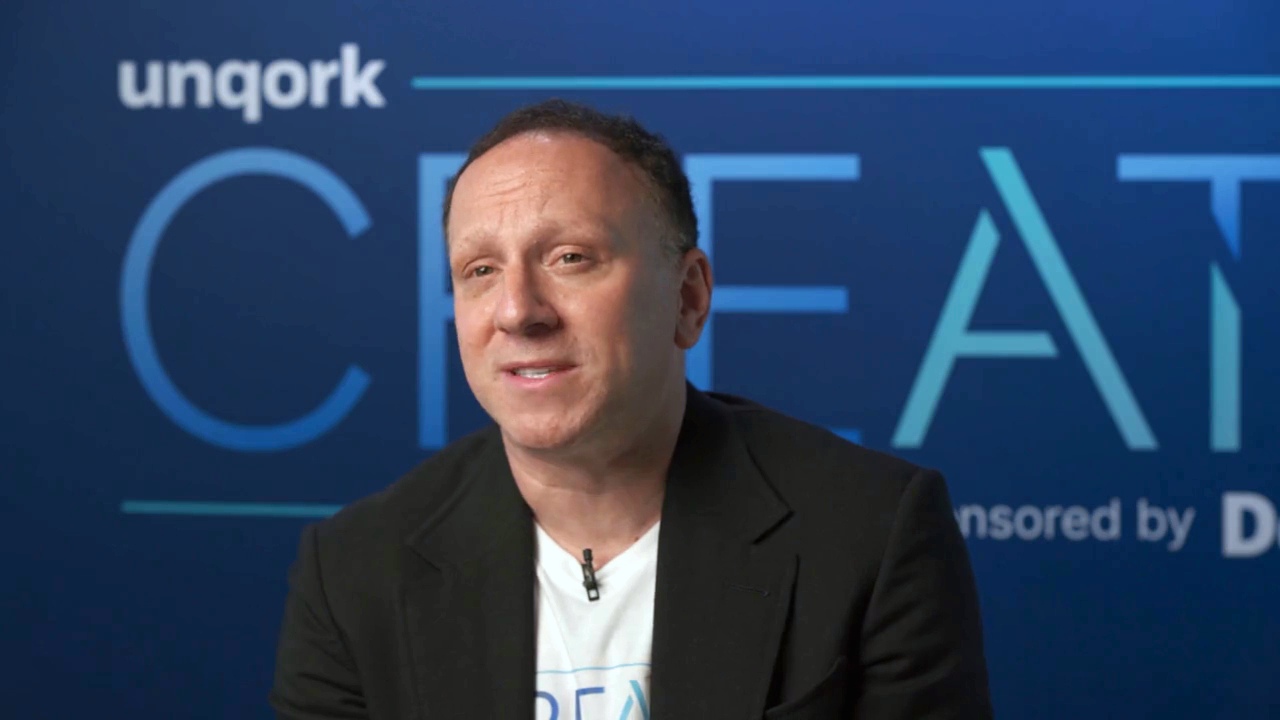
Before the bank, a backyard ramp
Hoberman’s early computing project involved a more manageable collection of assets: comic books. In fifth grade, he indexed them using his father’s punch-card machine. His father ran a publishing business. His siblings, he has recalled, also became entrepreneurs. Making things was ordinary family business.
His other ambitions required rather more plywood. He was a sponsored skateboarder, with a half-pipe in the backyard. When the city objected to the structure, he recalled tearing it down and building another. The planning department appears to have supplied a recurring practical assignment.
There was surfing before work, too, and snowboarding. These details offer a welcome interruption to the executive biography. The child sorting comic books and the skateboarder rebuilding a ramp are recognizable alongside the adult who would later question why an expensive system had to be rebuilt yet again.
He studied at New York University’s Stern School of Business. Then came Wall Street, where small mistakes could have consequences far larger than an untidy comic-book catalog. The setting changed. His interest in getting machines to do something useful remained.
The bill that came after the launch
Hoberman’s career took him through Smith Barney and Citigroup before MetLife. His official biography credits him with seven patents. At MetLife, his technology responsibilities extended across 47 countries. He had reached the kind of job that makes a résumé look satisfyingly conclusive.
From that position, however, he kept seeing the same arithmetic. He has described a $1.2 billion annual technology budget, with roughly 80 percent devoted to keeping existing systems working. The remaining portion financed new work. Once that work went live, it joined the collection that needed maintaining.
of his technology spend went to keeping existing systems running, in Hoberman’s account.
A recollection of his own budget, not an industry benchmark.The launch party concealed a recurring invoice. Each new application came with an obligation to patch it, secure it and adapt it as the technology around it changed. Success added another dependent to the household.
His complaint was directed at the structure of the work. A team could deliver its project, meet its deadline and still enlarge the burden carried into the following year. From the CIO’s office, the accumulation was difficult to miss. Better delivery alone would not make that obligation disappear.
A founder with the wrong résumé
In 2017, he left MetLife to found Unqork. There is a pleasing awkwardness in the timing. After spending years acquiring the experience to understand a difficult market, he discovered that some investors regarded the experience itself as a drawback.
He has recalled being told he was too old to start a technology company. He was 45. He also heard that a career at Citigroup made him an implausible startup CEO. The résumé that opened a corporate door could apparently jam a venture-capital one.
He funded the company himself at first. Customers produced revenue before investors supplied funding, he has said. The order mattered: his argument had to survive contact with an organization willing to pay for the result.
That gives the departure its human scale. He was exchanging a position of established authority for the obligation to persuade people all over again. The institutional title could explain where he had been. It could not do the new company’s work for him.
“Focus on revenue, clients, and delivery.”
Gary Hoberman, offering startup advice in 2019
The difficult customer, on purpose
Unqork went after large enterprises and complicated applications. Hoberman’s reasoning was that a platform tested against demanding customers would have a stronger answer when the next buyer asked whether anybody larger or more complicated had used it.
His background helped him understand another part of the sale: the institution around the customer. A promising project could lose its internal champion. A budget could change. A sponsor could move jobs. None of those events required the software to fail.
He has described rejecting advice to begin quietly with one customer. Unqork instead started with five concurrent clients, spreading the risk of a single institution changing its priorities. Corporate experience had supplied an unusually detailed list of things that could go sideways.
There was also a question of incentives. He argued that customers should buy a business result, and that technology leaders should be judged by the value their work produced. A large team and a large budget might indicate responsibility. They could also become things an organization learned to preserve for their own sake.
A date attached to the billions
On October 6, 2020, Unqork announced a $207 million Series C financing at a $2 billion valuation. Funds and accounts managed by BlackRock led the round. CapitalG and Goldman Sachs were among the participating existing investors.
The milestone arrived three years after the company’s founding. It was a striking change in circumstances for a founder who had described early meetings with skeptical investors. It also gave the enterprise-software argument a financial headline that traveled much more easily than a discussion of application maintenance.
The date belongs beside the figure. It records what investors agreed to at that financing, rather than a permanent price tag for either the business or its founder. The more revealing continuity is the problem Hoberman kept discussing after the announcement: what happens to an application once somebody has finished building it?
Rockets with less luggage
One of his later startup ideas grew out of watching his son build custom rockets, using carbon fiber and computer-aided design. A lighter rocket travels faster. Hoberman took the observation into a familiar business metaphor and began inspecting the luggage.
Startups called themselves rocket ships while carrying engineering, finance, legal and compliance functions from the outset. He described funding an incubator called Hoberman Rockets, with a former Unqork chief operating officer leading it. The ambition was to see how small a startup team could be when its software was built on Unqork.
It is an aspiration about the shape of a business, rather than evidence that every business can dispense with a team. It does, however, sound like the same person who worried that one successful money-transfer assignment would condemn him to building the next.
His activities also extend beyond software. He serves on the board of The Shed and as a trustee of the New York Hall of Science, which honored him at its 2022 gala. Art, science and enterprise technology make a less predictable collection than the corporate titles alone suggest.
The old question meets AI
By 2026, Hoberman was co-hosting Architecting the AI Enterprise with David Ferrucci, Unqork’s chief technology and AI officer. Their conversations examine a problem that sits close to his original concern: easier software creation can leave an organization with more decisions about reliability, architecture and accountability.
Unqork announced UnqorkAI in May 2026, describing an approach that combines AI with its governed component architecture. On October 13, it announced that Voya Financial had selected UnqorkAI for targeted retirement experiences and workflow initiatives, extending a seven-year relationship. Those are concrete steps in the company’s current direction; the promised benefits still have to be delivered in practice.
For Hoberman, AI gives an old question a new urgency. Creating software has become easier to demonstrate. Living with the resulting systems remains an enterprise responsibility. His career has repeatedly brought him back to the work that survives the applause.
The young engineer wanted to avoid the next identical assignment. The founder has spent years trying to give that impulse a business. Somewhere between the comic books, the bank and the rocket, he found a question worth keeping: how much of tomorrow’s work can a good decision today remove?
Keep the conversation going
Read Hoberman’s official biography, visit Unqork, or follow him on LinkedIn and X.
Watch: Architecting the AI Enterprise