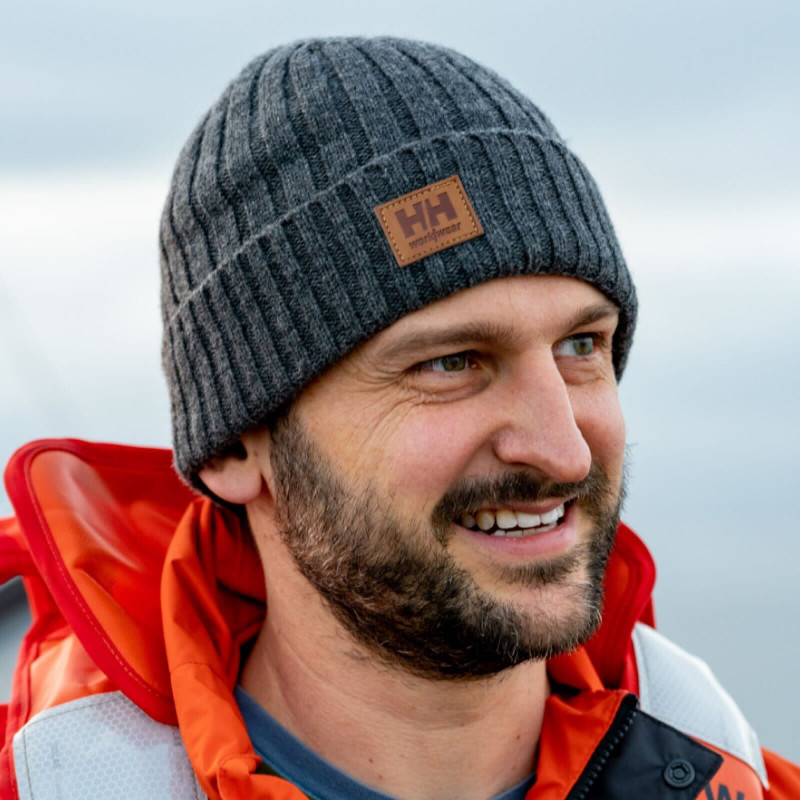
Peter Thiel put it plainly: the ocean frontier is open. In May 2026 he led a $140 million round into a Portland company most people had never heard of, run by a man with a Harvard law degree who spends his days thinking about how water moves. Garth Sheldon-Coulson is the co-founder and CEO of Panthalassa, and his plan is to build power plants where nobody lives and run artificial intelligence where nobody looks.
Right now, Sheldon-Coulson is preparing to send the Ocean-3 pilot series into open water. Each unit is a free-floating node: a spherical head bobbing on the surface, a steel tower dropping 70 meters beneath it. As the swell lifts and drops the structure, water is forced through a single turbine. Out comes up to a megawatt of continuous clean electricity - no mooring to the seabed, no cable to shore, no grid to wait on. Pair that power with onboard servers cooled by cold seawater, beam the data home through low-Earth-orbit satellites, and you have a data center that floats.
What we're doing is totally crazy. We're the first company that's going to the middle of the ocean to do this.
- Garth Sheldon-Coulson, CEO of Panthalassa
The idea sounds like science fiction, which is precisely why it went unfunded for so long. Panthalassa was founded in 2016 as a public benefit corporation, and for nearly a decade it was a quiet engineering shop, not a headline. Sheldon-Coulson and his co-founder, engineer Brian Moffat, spent those years doing the unglamorous work: filing wave-energy patents, running simulations, dunking prototypes in a wave tank at Oregon State University. The AI boom did not create Panthalassa. It arrived to find Panthalassa already there, holding a decade of hardware.
The Screening Test
First he did the math. Then he went to sea.
The origin story is not a lightning bolt. It is a spreadsheet. Before writing a line of engineering, Sheldon-Coulson and Moffat asked a blunt question: which clean energy sources could realistically supply half the planet's primary energy? Most contenders were already crowded with capital and talent. Solar had armies. Fusion and fission had national labs. One resource sat almost entirely ignored.
There are three sources of energy on the planet with tens of terawatts of new capacity potential, he says: solar, nuclear, and the open ocean. Two of those three were taken. So he took the third.
There's this resource that is totally untapped, very low cost potential, very large scale potential.
- Garth Sheldon-Coulson
The physics is genuinely on his side. A wave node in the right water can deliver power up to 90% of the time. Offshore wind manages roughly a third of that. The company targets energy costs near two cents per kilowatt-hour, a number that, if it holds at sea, would embarrass most data centers on land. That "if" is the whole company. Skeptics point out that a kilowatt in the wave is not a kilowatt at the GPU, that free-floating nodes drift, that saltwater corrodes everything it touches. Sheldon-Coulson does not dispute the hardness. He built a company around it.
How a wave becomes a thought
The Ocean-2 / Ocean-3 node, step by step
01
Bob
A 50-meter head floats on the surface; a 70-meter steel tower hangs below, riding the swell.
02
Pump
Wave motion drives water into a pressurized reservoir inside the structure.
03
Spin
That water flows through a single turbine, generating up to a megawatt, up to 90% of the time.
04
Compute
Onboard servers run AI, cooled by cold seawater, sending results home via satellite.
The Resume Nobody Predicted
Swarthmore. MIT. Harvard Law. Bridgewater. Then the sea.
The path here is not linear. Sheldon-Coulson studied at Swarthmore College, earned a master's of science from MIT, and took a law degree from Harvard. He was a research fellow at Stanford and, before founding the company, a senior investment associate at Bridgewater Associates, the largest hedge fund in the world. He grew up between two continents, attending high school at Horace Mann in New York and Hong Kong International School.
It is an unusual toolkit for a hardware founder: the lawyer's patience for detail, the engineer's respect for physics, the investor's instinct for a mispriced asset. The open ocean, in his telling, is exactly that - a mispriced asset. He did not fall in love with waves. He noticed nobody else had, and treated that as an opportunity rather than a warning.
He built the team the same way. Chief engineer Daniel Place came from SpaceX. Others arrived from Google, Blue Origin, Apple, Boeing, Amazon, and Tesla. It is a roster you would expect at a rocket company, assembled instead to go the opposite direction - down, into the water, toward the Southern Ocean between Antarctica, South America, and Africa, where the swell is relentless and the real estate is free.
In His Own Words
“We've built a technology platform that operates in the planet's most energy-dense wave regions, far from shore, and turns that resource into reliable clean power.
“This will be the lowest cost way to do large segments of AI computing, inference reinforcement.
“We will be significantly lower cost than data centers on land.
“There's this resource that is totally untapped, very low cost potential, very large scale potential.
The Bet
Forget data centers in space. He wants them at sea.
There are two camps in the off-grid-compute story. One dreams of solar-powered server farms in orbit. The other, Sheldon-Coulson's, stays on Earth and goes to water. His pitch to investors was not modesty. It was a claim that the ocean is a better frontier than space because the physics is friendlier and the cooling is free. Thiel agreed, calling the ocean frontier "opened." John Doerr and Gigascale Capital joined the round. The valuation landed near a billion dollars for a company that, until recently, mostly existed in patent filings and a wave tank.
The plan from here is deliberate. Deploy the Ocean-3 pilot series now. Prove the nodes survive, hold station, and keep making power in real seas rather than simulations. Move to commercial systems in 2027. Then scale from hundreds of buoys to thousands, in the emptiest, roughest, most energy-dense water on the planet. Sheldon-Coulson knows the objections better than his critics do - drift, degradation, servicing a fleet nine times a day in heavy swell. He has spent ten years answering them one at a time. Whether the answers hold at commercial scale is the question a billion dollars is now riding on.
The Long Iteration
Ocean-1, Ocean-2, Wavehopper. The naming tells the story.
Panthalassa did not arrive at the current node on the first sketch. The company worked through a lineage of designs - Ocean-1, Ocean-2, a concept called Wavehopper - each one a lesson in what the sea does to hardware. The Ocean-2 is an overtopping wave-energy converter: its bobbing motion forces water through an internal pipe and then a turbine. The mechanism is almost aggressively simple. There is one turbine. There are no seafloor connections. Solid-state where possible, few moving parts, because every hinge and cable in the ocean is a future repair.
The validation loop is where the years went. The team started with occasional simulations and scaled to running hundreds of them a week, using Oregon State University's wave tank to test scale models before anything touched open water. When they finally ran ocean trials, the forecasts matched with the kind of precision that turns a science project into a company. That is the quiet discipline underneath the splashy headline - a decade of tightening the gap between what the model said and what the water did.
The economics Sheldon-Coulson describes are built for scale rather than spectacle. He puts production cost near $1,500 per kilowatt, and estimates that a single gigawatt-capacity factory could be stood up for roughly a billion dollars a year. The point of a free-floating, mooring-free node is that it can be manufactured on an assembly line and towed out, rather than custom-installed on the seabed at ruinous cost. Whether that manufacturing logic survives contact with saltwater at fleet scale is exactly what the pilots are meant to prove.
The Skeptics
The ocean is not a server rack. The critics know it.
Not everyone is convinced, and the sharpest doubts are technical rather than dismissive. Analysts note that a kilowatt in the wave is not a kilowatt at the turbine, and a kilowatt at the turbine is not a kilowatt of useful compute - each conversion bleeds efficiency. Free-floating nodes drift, which raises questions of collision and recovery. Marine hardware degrades, and a fleet large enough to run a serious data center implies a relentless servicing schedule in some of the world's harshest water. The two-cent-per-kilowatt-hour promise is the number every skeptic circles.
Sheldon-Coulson's answer is not to wave the objections away but to treat them as the actual product. Anyone can generate a watt in a wave tank. The company that can generate it reliably, cheaply, and repeatedly in the Southern Ocean - and keep the servers running on top of it - wins a market no one else is even contesting. As one observer put it, customers do not buy romantic ocean energy; they buy useful compute at a reliable price. That is the bar. Panthalassa has spent a decade building toward it, and now has $140 million and a 2027 deadline to clear it.
There are three sources of energy on the planet with tens of terawatts of new capacity potential: solar, nuclear, and the open ocean.
- Garth Sheldon-Coulson, on why he chose the water
Odds & Ends
- The name is a map. Panthalassa was the single global ocean that surrounded the supercontinent Pangaea. A fitting flag for a company that treats the whole sea as one power plant.
- Two degrees, opposite instincts. A Harvard law degree and an MIT engineering master's, both aimed at the same hardware. He is as comfortable with a patent claim as a turbine curve.
- He is a prolific inventor. He is named on multiple wave-energy patents, including inertial pneumatic wave energy devices filed through Lone Gull Holdings.
- From the trading floor to the swell. Before the ocean, he analyzed markets at Bridgewater Associates. He now reads wave forecasts with the same eye for mispricing.
- Slow before fast. Nearly a decade of quiet R&D preceded the $140M headline. The overnight success was ten years in the making.